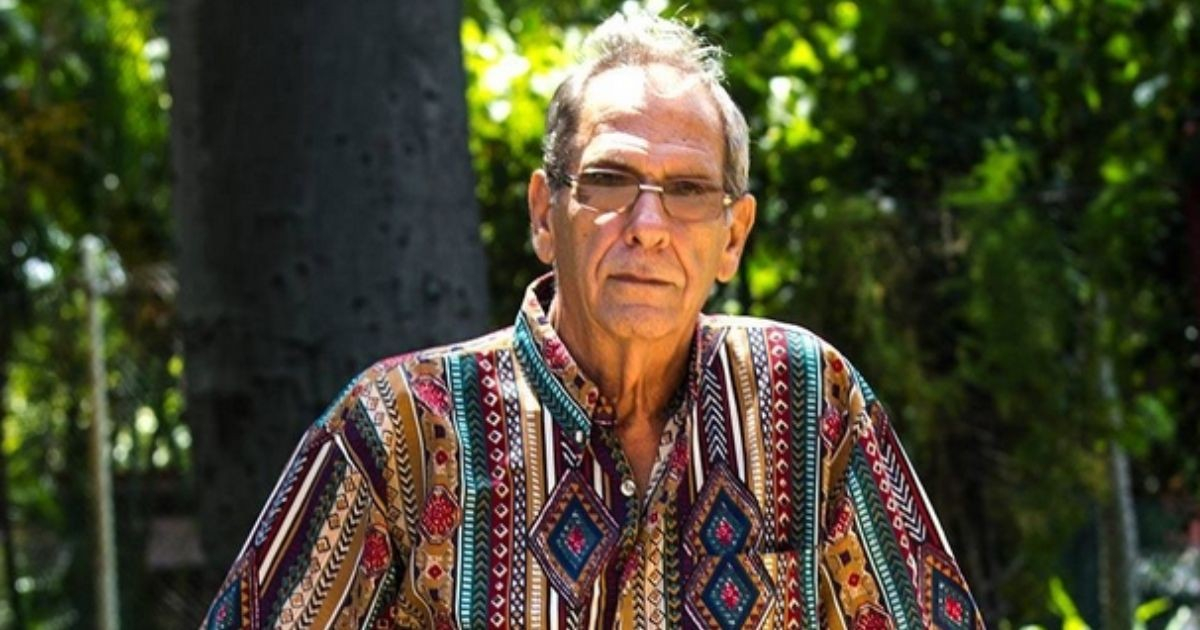
The veteran sports commentator René Navarro surprised his followers on Facebook this Friday with a confession that few expected: in addition to the 32 sports he covered throughout his official career, he also lent his unmistakable voice to rodeos, horse races, and cockfights in various corners of Cuba.
The communicator, who is 80 years old and regarded as one of the most emblematic voices in Cuban sports, published the account under the title "Activities Outside of TV in My Mature Years and Among an Enthusiastic Audience," making it clear from the outset that the revelation warranted a warning: "Yes, do not be surprised by what you read."
Navarro explained that he recounted the rodeos in Rancho Boyeros, Las Tunas, and in a small town in Guantánamo. "If I remember correctly, it was in San Antonio del Sur," he specified, with the same ease as if he were mentioning the Olympics.
But the truly juicy part came later, when he described his foray into horse racing and cockfighting, both in his beloved province of Mayabeque.
According to what he recounted, between the 1980s and 2000, these activities became very popular on weekends in various municipalities east of the capital, bringing together thousands of people in rural areas far from the municipal centers. The complicating detail: "They were illegal and sanctioned by the authorities."
To narrate them, Navarro had to learn a completely new vocabulary. "The indio, cenizo, pinto, and those who called themselves runners entered my language," he wrote, referring to the terms from the cockfighting environment. With the horses, the challenge was similar: names of the animals, distances, and riders became part of his improvised repertoire, once through a megaphone and another time using a makeshift audio system.
However, the narrator made it clear where his moral boundary lay. "I never understood why the roosters were killed. It seemed cruel and inhumane to me," he confessed, in what perhaps was the only time in his life that the emotion of the story could not overcome his aversion to what was before him.
Chicken fighting has colonial roots in Cuba, with records dating back to the 18th century. They were banned after the 1959 Revolution, with the closure of the arenas, although in 1980 the authorities partially decriminalized them. Betting, however, remained prohibited. The Decree-Law 31/2021 on Animal Welfare prohibits fighting between animals, although it includes an exception for fights authorized by the competent authority, which does not prevent the clandestine practice from continuing to be part of the rural landscape in Cuba.
Navarro also recalled an anecdote that encapsulates his life philosophy better than anything else: in 1991, he returned from the World Athletics Championships in Tokyo—where Cuba won silver medals with Javier Sotomayor in the high jump and Ana Fidelia Quirot in the 800 meters—and just days later he was already narrating sprint races on the streets of Madruga, his hometown. "To be in the heart and feel of the people, you must combine THE BIG AND THE SMALL," he wrote in capital letters, as if he were shouting into a microphone.
The post sparked comments among its followers, who celebrated the anecdote with humor and nostalgia. Several internet users pointed out that this ability to adapt to any setting, from an Olympic stadium to a clandestine field, is precisely what makes the narrator unique.
The revelation comes at a time when Navarro remains an active and critical voice on social media. The same communicator who in January 2024 revealed that he sold his car to afford food, with a pension of only 1,733 Cuban pesos per month, and who this July described the Cuban reality as “mental and physical torture”, shows that at 80 years old he has not lost his sense of humor or his desire to share stories that, as he puts it, range from big to small.
Related videos:
Filed under: