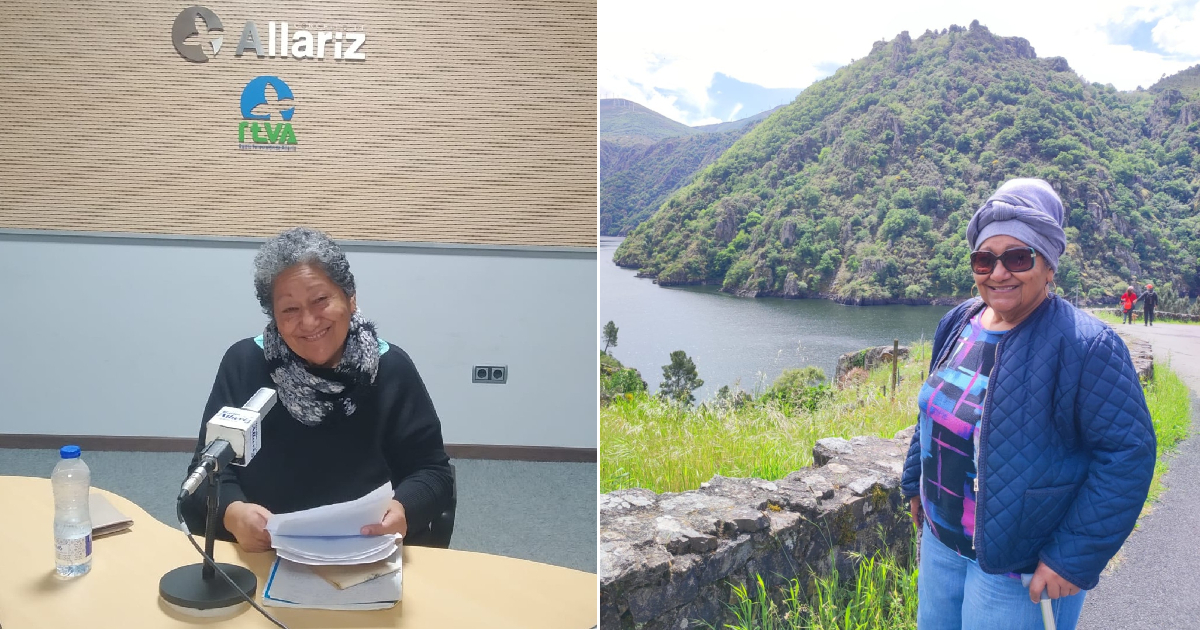
There are those who reach eighty to bid farewell to the world. The leading actress Obelia Blanco, on the other hand, arrived in Galicia to start anew. In Allariz, a town of stone and memory, she discovered that age could close doors, but it could never silence her voice.
The voice that continues to speak about Cuba was born in Santiago de Cuba, a land of rhythms, legends, and volcanic emotions. An unforgettable actress with an unmistakable voice, the eternal Yara, carried the essence of Cuban culture through radio and television for decades. Together with Alden Knight, she turned the radio program "Hablando de Cuba" into a daily refuge for the memory and soul of a country.
Obelia, who inhabited stages, radio studios, and the heartfelt memories of several generations for more than six decades, traded applause for new learnings, grand forums for a local station, and the whirlwind of television for the tranquility of poetry. At 84 years old, she continues to demonstrate that art does not age; it simply finds new ways to blossom.
Dear friend, welcome… How is life treating you?
Julita, my friend of so many years, I want to tell you that I am celebrating four years in Galicia, in a town called Allariz, which is part of the province of Ourense. I live with my daughter, my son-in-law, and my granddaughter. I arrived here when I was 80 years old, filled with the desire to keep working in whatever I could, but every time I went out to look for a job, they looked at me with disbelief and told me that at my age, I needed to rest.
Imagine that, I who have worked my whole life!
I have had to reinvent myself. I was able to do theater, I taught a course on patchwork, and I studied pattern making. I created a small poetry and music program for the station 107.2 Radio Allariz, called “Voices and Verses”, which I enjoy a lot.
Meanwhile, I attend gymnastics, memory, and crafts classes that are held at the Fogar dos Maiores, and along with them, I contribute to another radio program that is made for the community.
To keep up with the times, I share something I also enjoy doing on my Instagram and Facebook pages: reciting poetry.
Looking back to your childhood, what memories do you keep of that little girl from Santiago who dreamed of a beautiful future?
As a child, I dreamed of being a dancer, a pianist, a painter... But I saw it only as a dream; I never thought it could come true. My family laughed at me; they didn't have the sensitivity to understand me.
What lessons did you receive in your childhood?
I was an orphaned little girl who grew up among strangers; without a mother to share my dreams with. I grew up filled with insecurities, introverted. I had no friends to play with; my dolls were the little ones in the house whom I had to take care of.
From those strangers, I learned everything I would not become when I grew up. The mockery and criticism fueled me when, at 16, I faced life alone, without any knowledge, being my own advisor.
I knew that I had to fight and study to achieve my goals, always following the straight path, even if it was the hardest one.
When did you discover that art, words, and interpretation would be the path of your life?
It was already too late to study piano or ballet, but the opportunity arose to join an amateur theater group. I didn't really know much about theater, but it was art, and for me, that was enough.
When I discovered it, I realized that theater would allow me to live, travel, and be many Obelias at once, and I was fascinated. Later, when I succeeded in enrolling at the Provincial School of Dramatic Arts in Santiago de Cuba, I was fortunate to have the Argentine professor Adolfo Gutkin, who took me by the hand and helped me gain confidence on stage and overcome my great shyness.
What role did your studies and professional training play in shaping the artist you became?
This career that I have devoted myself to for over 60 years has taught me to be a better human being. It may seem outdated to say this, but I have always worked in pursuit of excellence — which is not always achieved — and I did so with complete commitment. I took pleasure in suffering for each character.
My goal has always been to provide an education, sometimes bringing comfort to that viewer who needs to forget their problems by watching or listening to a program. I believe that artists are the healers of the soul.
The actress or the announcer, which one?
Since I was very young, I loved reading aloud to anyone who wanted to listen. I was a broadcaster without knowing it. While living in Havana, I returned to Santiago for the inauguration of the Tele Rebelde channel. As I have said before, it was a wonderful project that I fell in love with.
One fine day, the beloved and late Enrique Bonne, who was involved in programming, came to find me because the announcer who was supposed to open the broadcast didn't show up, and it was live television. Bonne came to plead with me to step in.
It had never crossed my mind to be a broadcaster, but I was aware that someone had to do it, so with a trembling voice and tears streaming down my face, I spoke up to air the channel.
From there, it happened often. Again, I threw myself into the arena with a music magazine. Little by little, I started to enjoy it so much that I insisted they let me do news segments.
When I returned to Havana to continue my career, I requested to be evaluated as a speaker. Thanks to that, I was able to do many things: I narrated novels (a role typically associated with male voices); I was the voice of the program "Andar La Habana" for 20 years, of the Palomas Project, and of the children's program "Tren de Maravillas," which earned me the affection of many children who grew up watching it; I also worked on "Hablando de Cuba" at Radio Taíno, alongside my dear Alden Knight, for 37 years.
I also cherish a beautiful memory of “Elogio de la memoria,” which earned me a Caracol Award at the age of 70-something. After that, and in response to your question: the actress and the announcer are one and the same. An announcer needs to have some acting skills to better master the profession.
The character of Yara lives on in the memory of several generations. What did it mean to portray such an endearing character?
It’s impossible to forget Yara, the audience won’t let me. I’m an actress who came from theater with significant leading roles. On television, I had already played a Cecilia Valdés and tackled complex characters in different settings. However, Yara overshadowed everything else. We cannot deny that “El Corsario Negro” was a social phenomenon; I don't know of any other instance in Cuba where the ending of a series was changed because children didn’t want Yara to die. It’s the character I’ve received the most affection for, and I will always consider myself blessed.
What difference do you find between acting for television and communicating from the intimacy of a microphone on the radio?
When I first walked into a radio studio, it was love at first sight.
First, I combined my work in theater with radio. Then it was television and radio. Although each medium has its differences, if you are an actor/actress, you just have to adapt to the medium you are in. I love radio and I defend it. In it, I had the opportunity to do everything I couldn't in theater, television, or film due to reasons such as age, color, etc.
For more than three decades, you and Alden Knight accompanied listeners on "Hablando de Cuba." What do you believe was the secret to that deep connection with the audience?
Since I arrived in television, I was associated with Alden. When we were given this program, it was very easy for us to connect. There was no insistence on prominence or leadership, just respect and admiration from both sides. We developed a strong connection; we didn't need to speak to each other, just a gesture and the other person already knew what to do. It came so naturally that the audience believed the show was live.
Beyond art, who is Obelia Blanco when she is with her family?
Julita, since I don't have grandmothers and at 84 years old no one will speak for me. Using the oft-misused saying "modesty aside," I say that I am a good person. Even though many times they've tried to silence me, I've managed to save myself from hatred.
I wanted to form a large family, but after many difficult years, I finally welcomed my “desired Irina,” as the beloved Fela Jar named her, who experienced my dreams and losses for years until the miracle happened. She arrived as the missing half that completed me into the person I have become. Art and my daughter complement each other in a whole. The oxygen and the hope. We have created a beautiful story of love, understanding, friendship, support, and defense against all neglect.
What have your children, grandchildren, and the new generations taught you about the passage of time?
Just when I thought I would never be a grandmother, Sofía arrived, bringing a breath of fresh air to illuminate our lives. Sofía represents the new generation that comes to teach us, to educate us, and to unite us through love. With a vitality and a desire to learn.
It is up to us to quicken our pace to move forward together with her, guiding her while learning at the same time. Enjoying this gift that life has given us.
Today you dedicate part of your time to crafts and handmade creations.
Crafting has gone hand in hand with my career as an actress. I have always enjoyed sewing, embroidering, knitting, and unraveling. I belonged to the ACAA (Cuban Association of Artisan Artists), participated in group exhibitions, and sold at craft fairs. Here, it has been a great companion and has allowed me to stay active. Crafting will always be a part of me.
As the evening descends upon the stone streets of Allariz and the murmur of the river accompanies the silence, Obelia Blanco continues to sow beauty wherever life places her. Among verses, threads of color, voices on the radio, and the embrace of her family, she has learned that it is never too late to bloom again.
Her story reminds us that talent does not age, that dreams can take different forms without losing their essence, and that there are souls capable of turning every season of life into an act of creation and love.
Related videos:
Filed under: