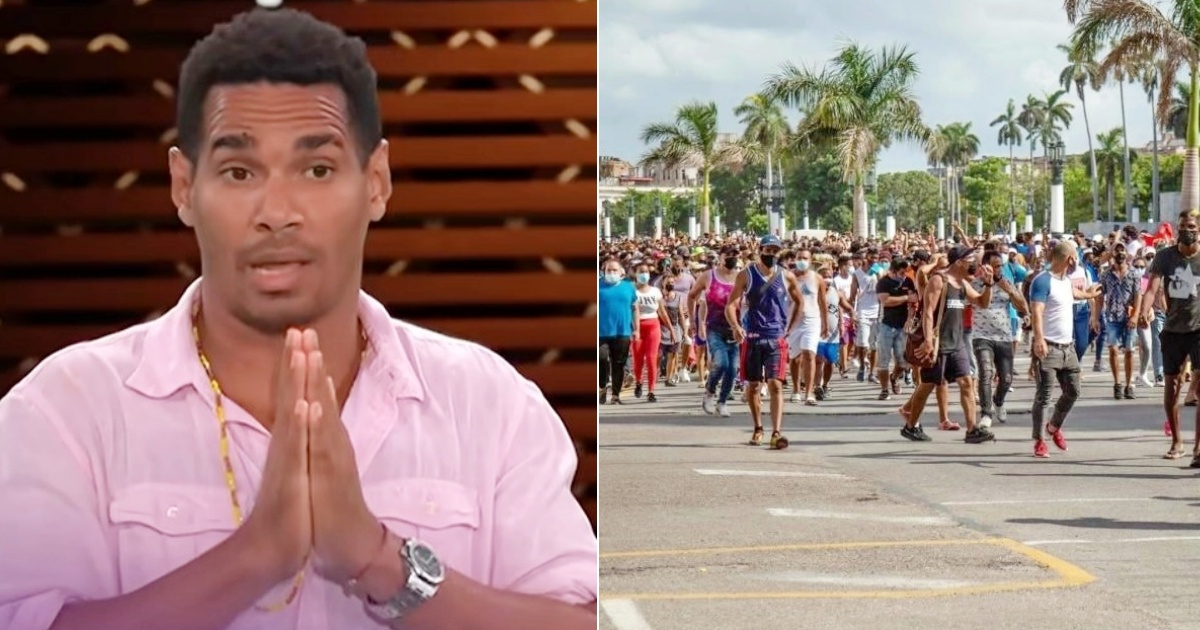
Luis Manuel Otero Alcántara, founder of the San Isidro Movement, warned in an interview with the EFE agency that Cuba is currently in a situation that could lead to a social explosion surpassing the magnitude of the protests on July 11, 2021, the largest recorded on the island in nearly three decades.
The 38-year-old artist arrived in Miami on July 18 after serving five years in prison at the Guanajay penitentiary, convicted for "contempt, public disorder, and outrage against the symbols of the homeland." The regime made his release contingent upon a definitive and forced exile.
"The conditions are in place for a devastating social outbreak."
In statements to EFE published on Friday, Otero Alcántara was categorical:
"The conditions are ripe for a devastating social explosion in Cuba that will defeat the dictatorship. Now it is us who must come together—us thinkers, artists, civic activists, and politicians—to guide that people."
He argued that the social base willing to protest is now broader than in 2021
"The situation in Cuba is so critical right now that at any moment a social outbreak similar to that of July 11 could occur, or even on a larger scale, because there are people today who were even supportive of the system or possibly indoctrinated, and now they are disillusioned with the system and will also join in."
Its preferred scenario, however, excludes any armed intervention:
"The ideal scenario for me, and I reiterate that I am a pacifist, is for the 9 million Cubans to take to the streets saying 'enough', seizing the future of their country in their hands. Will this happen? I hope so. Will we need international support? Yes, we will."
Trump, Rubio, and International Pressure
Otero Alcántara expressed his gratitude to the Donald Trump administration for the humanitarian parole that allowed him to leave Cuba, approved on July 17, 2026.
Marco Rubio publicly welcomed him in Miami and demanded the release of over 700 political prisoners on the island.
The artist emphasized that Washington enjoys more credibility than the regime among the Cubans themselves
"People have more credibility in the words of Donald Trump and Marco Rubio than in those of the president of Cuba, Miguel Díaz-Canel."
He added, "The Cubans in there, when they saw Donald Trump impose a sanction or something, were grateful."
In response to the question of whether he would support a military operation to force a change, he answered with nuances:
“I would support an action, whatever it may be that saves the Cuban reality, and I would back it from a pacifist structure, but with a commitment to the people who are asking for something to happen in Cuba now.”
And he added, "People need to breathe; imagine it's like a boot on your neck."
Maykel Osorbo, still imprisoned despite the approved parole
Otero Alcántara also referred to his companion from the San Isidro Movement, the rapper Maykel Osorbo, who remains incarcerated in Guanajay despite the fact that the U.S. approved a humanitarian parole on July 21. Osorbo is serving a nine-year sentence that extends until 2030.
Otero Alcántara speculated on the reasons for the regime's refusal: "Why won't they release Maykel? Because I imagine they don't want him to join this new frenzy, because that's when it will truly be something formidable. It's like the fourth leg of the cat."
In a preliminary interview, he had delved into that interpretation:
"They possibly have better thermometers than us, the opponents, regarding the Cuban reality. That means they know, they are certain of the impact that the San Isidro Movement, Maykel Osorbo, and Luis Manuel Alcántara currently have on the streets."
Otero Alcántara arrived in South Florida with a plan that combines art and political action: to publicly display over 4,000 paintings created during his confinement, to create a collective mural with political prisoners, and to perform to highlight the suffering of the Cuban people.
"They are testimonies from these five years, witnessing injustices, experiencing suffering, encountering frustrations, and the feeling of confinement, which is an extremely overwhelming and torturous sensation that almost leads you to death," he described regarding those works.
He will consider Cuba sufficiently free when he can exhibit at the National Museum of Fine Arts and criticize the government "without it costing him five years in prison."
Related videos:
Filed under: