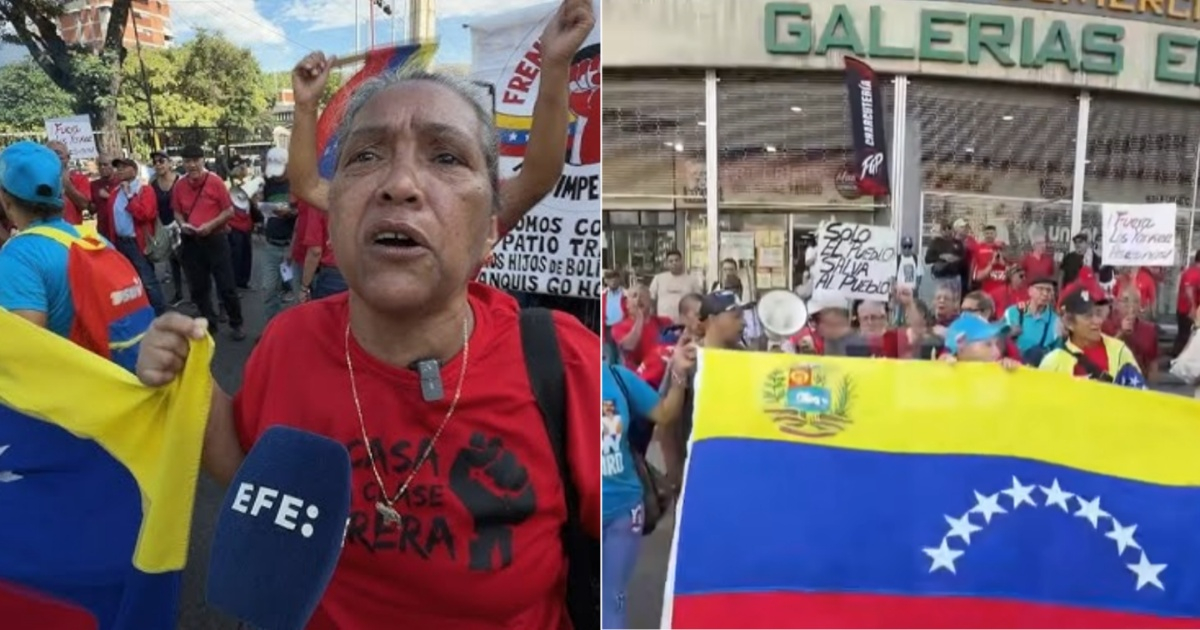
Dozens of followers of chavismo took to the streets of Caracas this Saturday to reject the dialogue process that begins between the Venezuelan government and a segment of the opposition, promoted by Washington.
The gathering was called by the Anti-Imperialist Popular Front, whose members arrived dressed in red —the emblematic color of Chavismo— and carrying Venezuelan flags. The organization described the process as "part of the deviously orchestrated transition process by imperialism to eliminate" the legacy of the late President Hugo Chávez.
The group also warned that the real objective of the dialogue is to install "puppet personalities in the U.S. government" within the justice system and the electoral body, in order to then call what they consider unconstitutional elections.
One of the protesters, Rubén Gutiérrez, 67 years old, stated to the EFE agency that the process is "nothing more than an imposition by the Government of the United States" and the "forfeiture of sovereignty." Gutiérrez accused the Trump administration of "attempting to disregard" the Venezuelan Constitution and imposing "a transitional government that serves its interests along with the henchmen of the far-right," and he called on the interim president Delcy Rodríguez to "uphold the sovereignty."
Another protester, Aidé Romero, refused to sit down to negotiate with those she called "traitors" and described the process as "another earthquake, a political earthquake." While she expressed trust in the acting president, she felt it was necessary to "tell the Americans that they do not have the right to rule here."
The fracture that chavismo displays in the streets reflects a deeper tension within the government. Figures like Elías Jaua had already rejected the process days earlier, demanding a dialogue "among Venezuelans, for Venezuelans, and by Venezuelans," without foreign oversight. For his part, Diosdado Cabello ruled out in June any negotiation with María Corina Machado and the Democratic Unitary Platform.
The dialogue that has sparked these protests is led by Jorge Rodríguez, brother of the interim president and president of the Parliament, representing the chavismo, and by former opposition lawmaker Dinorah Figuera, who leads a group of former legislators defending the validity of the National Assembly elected in 2015. At the time the discussions began, key details such as the time, location, complete member lists of the delegations, and specific agenda points had not been disclosed.
Figuera stated this week that the process "must be carried out in good faith, with transparency, clear objectives, and a genuine commitment to reaching concrete agreements that lead to the recovery of democracy through free and fair elections."
The process was formally confirmed by U.S. Secretary of State Marco Rubio on July 20, and it occurs in a political context transformed since the capture of Nicolás Maduro by U.S. forces on January 3, 2026. María Corina Machado and Edmundo González Urrutia conditionally supported the process, demanding the release of political prisoners and a timeline for the presidential elections.
The dialogue also begins under the shadow of the humanitarian catastrophe caused by the earthquakes of June 24, which according to official Venezuelan figures resulted in more than 5,500 deaths and nearly 16,740 injuries in the country.
Related videos:
Filed under: