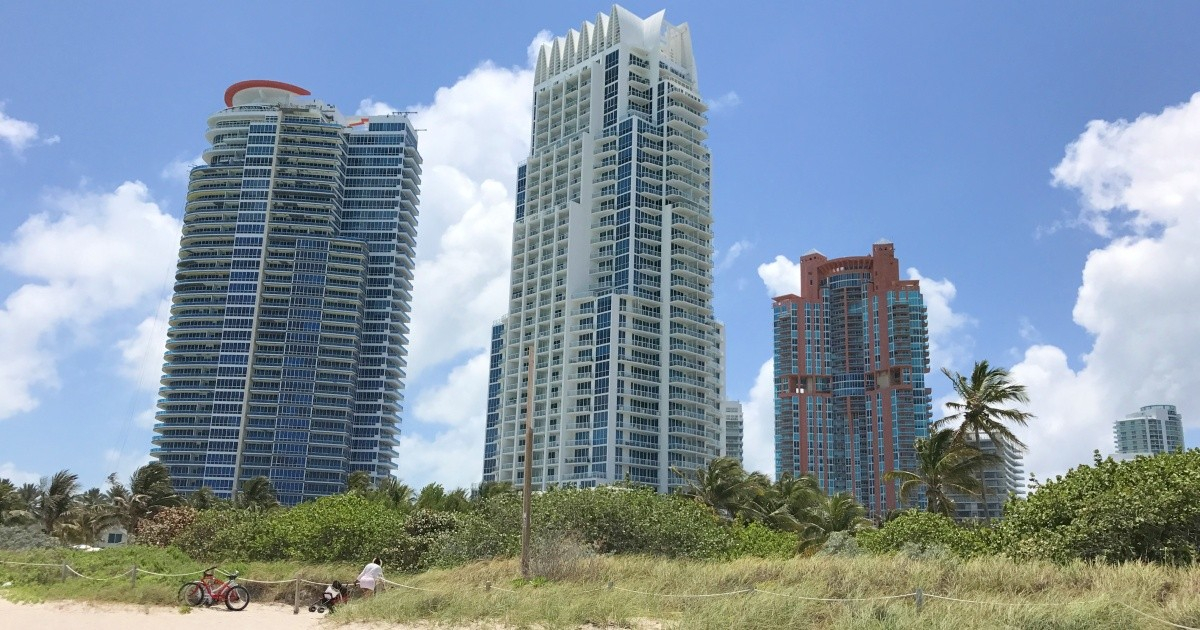
There is good news for those looking for housing in South Florida: rental prices are easing.
In June 2026, the average rent requested in Miami fell to $2,277 per month, representing a year-over-year decrease of 2.6%, according to the latest market report from Realtor.com.
This decline not only surpasses the average contraction of 1.5% recorded nationwide, but it arrives in the midst of summer—the peak rental season—a time when historically, rents tend to increase due to vacation demand and seasonal moves.
Moreover, June marked the 35th consecutive month of year-over-year declines in the 50 largest metropolitan areas in the United States.
However, the relief for tenants has very clear limits.
Despite these occasional declines, southern Florida remains one of the most prohibitive regions in the country, and the latest economic indicators confirm an unprecedented reality: Miami has surpassed New York in cost of living for the first time in history.
The rental market in South Florida
The decline in Miami would be attributed to a structural supply factor: the intense pace of construction in recent years has significantly expanded the available residential stock.
During 2025, the Miami metropolitan area recorded 2.6 new multifamily units per 1,000 residents in building permits, surpassing the 1.6 units of 2024 and reaching levels equivalent to the peak of 2021.
In the rest of the state, Orlando led the real estate expansion with 4.5 permits for every 1,000 residents.
Thanks to this volume of deliveries, analysts at Realtor.com anticipate that the trend of moderation in prices will continue throughout the remainder of 2026.
However, while the rental market is experiencing a slight improvement, home buying remains out of reach for most workers.
The average listing price in Miami reached $499,000 in June 2026, a figure that is far removed from the $258,000 considered the maximum affordable purchase for a middle-income family in Florida.
To complicate matters, the active inventory of houses for sale fell by 16% year-on-year, further restricting the buyer's market.
A city that expels its middle class
An analysis by Bloomberg based on data from the Bureau of Economic Analysis -published in July 2026- revealed that the Miami-Fort Lauderdale-West Palm Beach metropolitan area reached a regional price parity index of 114,155, surpassing New York's 112,563.
The global cost of living explains why a slight decrease in rent is not sufficient: the consumer price index in South Florida has risen by 36% since 2019, the highest increase in the entire U.S. except for Tampa.
This is compounded by disproportionate fixed costs: home insurance premiums average $8,292 per year (four times higher than in New York, according to Insurify).
This is compounded by the fact that property taxes have increased by 62% since 2019, more than double the national average.
" It's no longer just about the purchase price. It's about the total cost of ownership," warned real estate agent Michael Buttacavoli of Corcoran in comments to Bloomberg.
This inflationary spiral is forcing thousands of families to leave the region.
In just 2025, Miami-Dade lost 113,700 net residents due to internal migration to other counties or states, marking the largest exodus in its recent history, according to Census figures analyzed by Reventure Consulting.
“It’s discouraging how defeated you feel when you get pushed out of so many neighborhoods,” said Colby Eisenberg, an advertising sales director who moved to Brickell in 2020 paying $2,150 a month and ended up relocating first to Fort Lauderdale and then to Boca Raton after experiencing increases of nearly $1,000 in his lease contract.
The paradox of millionaires
While the working class seeks more affordable alternatives outside the county, South Florida is establishing itself as a magnet for big capital.
The region currently hosts around 38,800 affluent residents spread across Miami, Miami Beach, and Coral Gables, a figure that grew by 94% between 2014 and 2024, according to data from Henley & Partners and New World Wealth.
The main draw continues to be the tax advantage - Florida does not levy a state income tax - which has attracted significant wealth from New York, California, and Chicago.
"People are blinded by the absence of the state income tax," warned Nicolas Valdes-Fauli, a financial planner who moved from Manhattan to Miami.
“Miami has a way of quickly normalizing the increase in spending levels. The social pressure surrounding consumption is strong,” he added to Bloomberg.
The national panorama
In general in the United States, the average rent requested in the 50 largest metropolitan areas ended June 2026 at $1,692, representing a year-over-year decrease of 1.5%.
The correction was reflected across all types of housing:
- Studies: fell by 2.2% to $1,422 per month.
- A bedroom: fell by 1.4% to $1,579 per month.
- Two bedrooms: fell by 1.4% to $1,893 per month.
Despite this downward trend, the national rental market remains $238 more expensive (a 16.4%) than in June 2019, before the pandemic.
At the most expensive end of the country, metropolitan areas like San José (California) reached a historic high of $3,423 per month (+3.3% year-on-year), driven by the economic boom associated with the artificial intelligence industry.
Related videos:
Filed under: