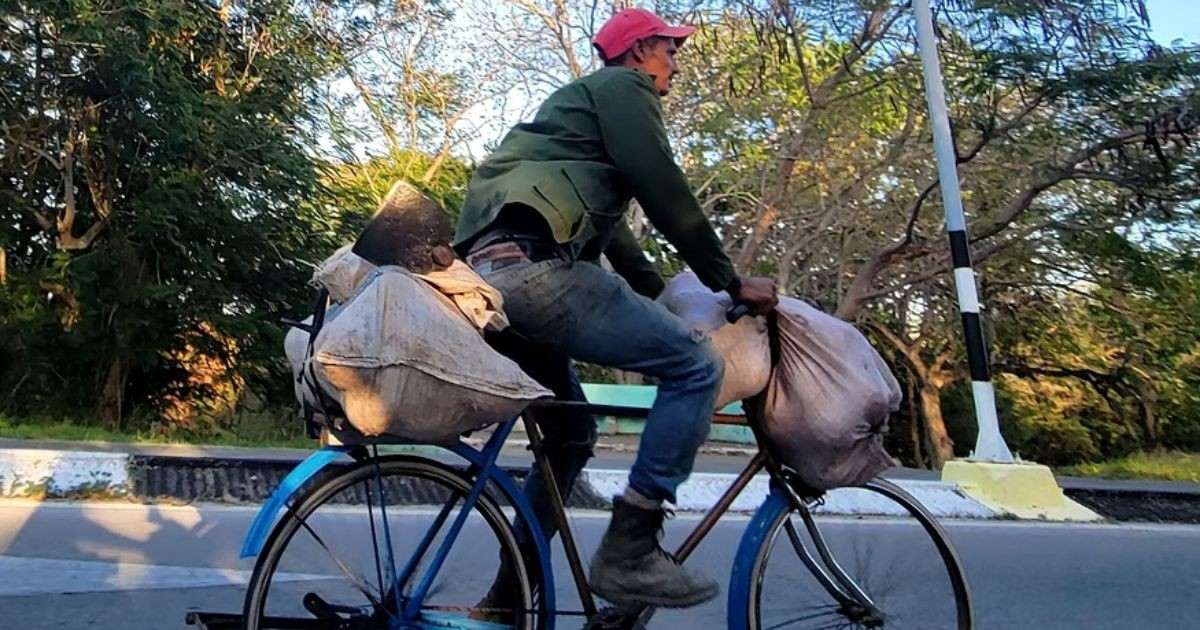
An analysis by the organization Food Monitor Program (FMP) warns that the Cuban food crisis goes far beyond empty markets, reduced ration quotas, or the decline in national production: what is deteriorating is the entire system that allows for the production, transportation, preservation, and delivery of food to households.
The report, titled "From Farm to Table: The Broken Chain of Hunger," argues that Cuba has gradually replaced its formal logistics network with precarious survival mechanisms: horse-drawn carts, bicycles adapted to transport bags of food, state vehicles that transport eggs without minimum protection conditions, and family, neighborhood, and informal networks that barely sustain a reduced flow of essential products.
"In current Cuba, eating increasingly depends on a broken infrastructure, an exhausted economy, and a succession of improvised solutions," the document notes.
FMP indicates in its analysis that 97.65% of households reported difficulties in accessing essential products, while 98.82% identified price increases in the previous twelve months.
According to the analysis, more than 24% of the Cuban population lives in periurban, rural, or hard-to-reach areas and relies on these logistics chains for their supply.
In those communities, food arrives less frequently, arrives late, or is sold at higher prices.
Vulnerable families, pensioners, elderly people, and those lacking transportation or support networks are exposed to a double exclusion: they have lower incomes to buy and fewer opportunities to travel in search of food.
The report argues that speculation cannot be reduced solely to the individual behavior of resellers: "Speculation thrives because there is a structure that allows it: a State unable to ensure regular distribution, a weakened public network, an economy lacking stable rules, and a population forced to compete for basic goods under conditions of extreme vulnerability."
"The Cuban food problem does not only lie in how much the country produces. It also depends on how much it manages to move, under what conditions, with what losses, with what health risks, and at what human cost," FMP adds.
The organization warns that the deterioration of food production, transportation, and preservation results in "a sustained increase in hunger, malnutrition, territorial inequality, and the loss of purchasing power of a population forced to survive within a system that no longer ensures sufficient production or dignified distribution."
On its part, the national survey "There is Hunger in Cuba 2025", presented in May 2026 by Food Monitor Program and Cuido60, revealed that 33.9% of respondents had at least one member of their household who went to bed hungry due to lack of food in the past 30 days.
The figure represented an increase of 9.3 percentage points compared to 2024.
The same survey, conducted from 2,513 valid responses gathered across the 16 provinces, found that 94.9% had lost some degree of access to food purchasing over the past year, and 47.1% rated that loss as significant or total.
The numbers support that diagnosis. According to official figures cited by Reuters, cargo traffic in Cuba dropped by 19% in 2024, falling from 57.5 million metric tons in 2023 to 46.5 million.
In 2019, before the deepening of the current crisis, the country handled 68 million tons. Economist Ricardo Torres pointed out to the agency that the volume had dropped to levels not seen in 20 years.
The energy crisis of 2026 further exacerbated the situation. In May, the Minister of Energy and Mines, Vicente de la O Levy, acknowledged that the country had no reserves of fuel oil or diesel for electricity generation, while blackouts and fuel shortages impacted transportation, agriculture, and food distribution.
The extent of the outages was reflected in citizen testimonies: a Cuban reported that she went without electricity for 30 consecutive hours and received only two hours of service, a cycle that made it difficult to cook, preserve food, and recharge the electric vehicles used for transporting goods.
That same month, the government eliminated the fixed price of fuel in foreign currency and authorized each importer to set their rates based on supplier costs, freight, route, insurance, and the risks of each operation.
The shortage also boosted the informal market: the price of a liter of gasoline soared to between 3,000 and 6,000 Cuban pesos, increasing the cost of transportation and any food that relied on it to reach consumers.
Related videos:
Filed under: