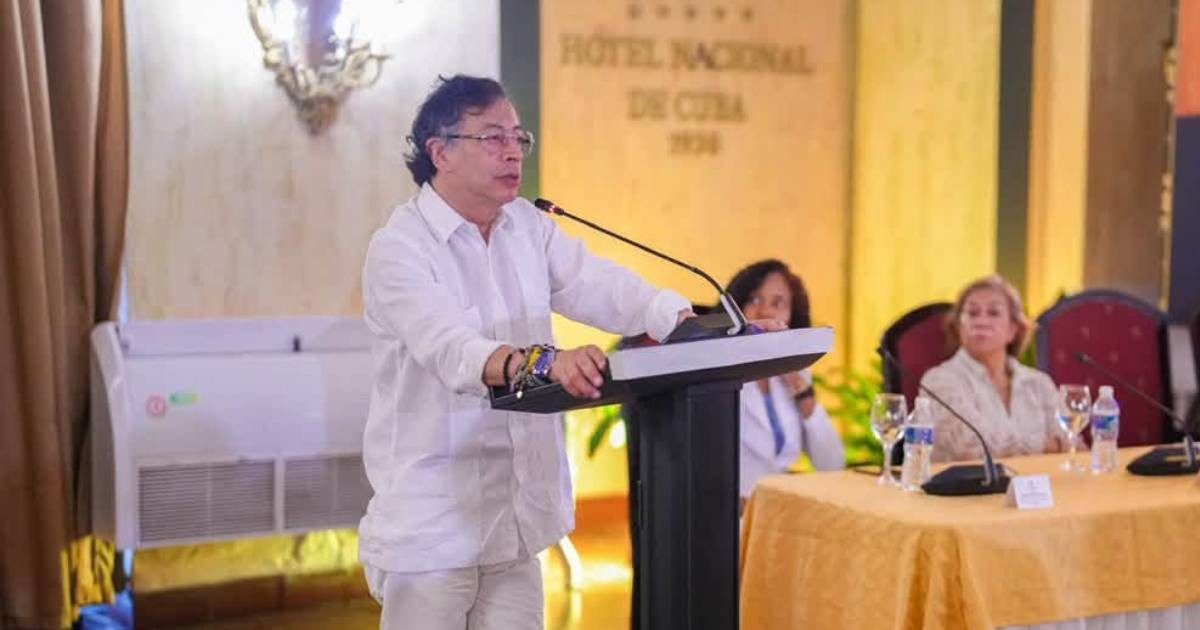
The Coordinator of Strategic and Digital Communications of the Presidency of Colombia, Andrés Camilo Hernández Ramírez, spoke out on Monday to address the controversy surrounding the presence of former Deputy Minister Andrés López during the recent official visit of President Gustavo Petro to Cuba, which took place from July 31 to August 1.
The explanations came after journalist Diana Saray publicly questioned López's role in the trip on the social media platform X, recalling that the former official no longer holds any position in the Government.
"In what capacity did former Deputy Minister Andrés López accompany President Petro on his trip to Cuba? If he is no longer an official, why was he part of the delegation that accompanied the president?" wrote the communicator.
In response, Hernández Ramírez denied that López was part of the official delegation and asserted that his presence on the island was due to personal reasons.
"Former Deputy Minister Andrés López did not travel with the presidential delegation. He was already in Cuba for personal reasons that I am unaware of, as he is a free citizen who can travel," he stated.
The official explained that the former deputy minister only requested to attend the meeting that Petro held with Colombian medical students at the Latin American School of Medicine (ELAM), a request that, according to him, was approved specifically.
“I was asked to be at the student event, and that’s how I allowed his entry. That's all,” he specified.
An explanation that does not quell the doubts
The clarification, however, has not put an end to the controversy due to López's recent political history.
The former Deputy Minister of Information and Communications Technologies resigned from his position on June 2, 2026 amid concerns regarding an alleged involvement in politics in favor of the presidential campaign of Iván Cepeda, the candidate from the Pacto Histórico, Petro's political coalition.
According to La Silla Vacía, López acknowledged that he left the Government after discussing with the president to join the digital strategy of Cepeda's campaign, although he denied playing an active role in it.
Weeks after his departure, Colombian media reported that the former official was seeking to return to the same deputy ministry he had left, a situation that has fueled questions about his closeness to the presidential circle.
Petro's last trip before leaving power
The controversy arose during Gustavo Petro's last international trip as President of Colombia, just a few days before he hands over power on August 7.
In Havana, Petro was welcomed by Miguel Díaz-Canel at the Palace of the Revolution and met with Colombian students from ELAM, an institution linked to the commitments arising from the 2016 Peace Agreement with the FARC, a process in which Cuba served as a guarantor country.
The visit was also marked by the imminent shift in Colombian foreign policy. The elected president, Abelardo de la Espriella, announced that he will sever diplomatic relations with Cuba starting August 7.
Its spokesperson, Carolina Gómez, questioned Petro's trip and stated, according to Infobae Colombia, that "it has nothing to do with the benefit of Colombians."
For his part, De la Espriella justified the impending diplomatic break with a powerful statement: “In my administration, there will be no connections with tyrannies,” foreshadowing a radical shift in relations between Bogotá and Havana.
Related videos:
Filed under: