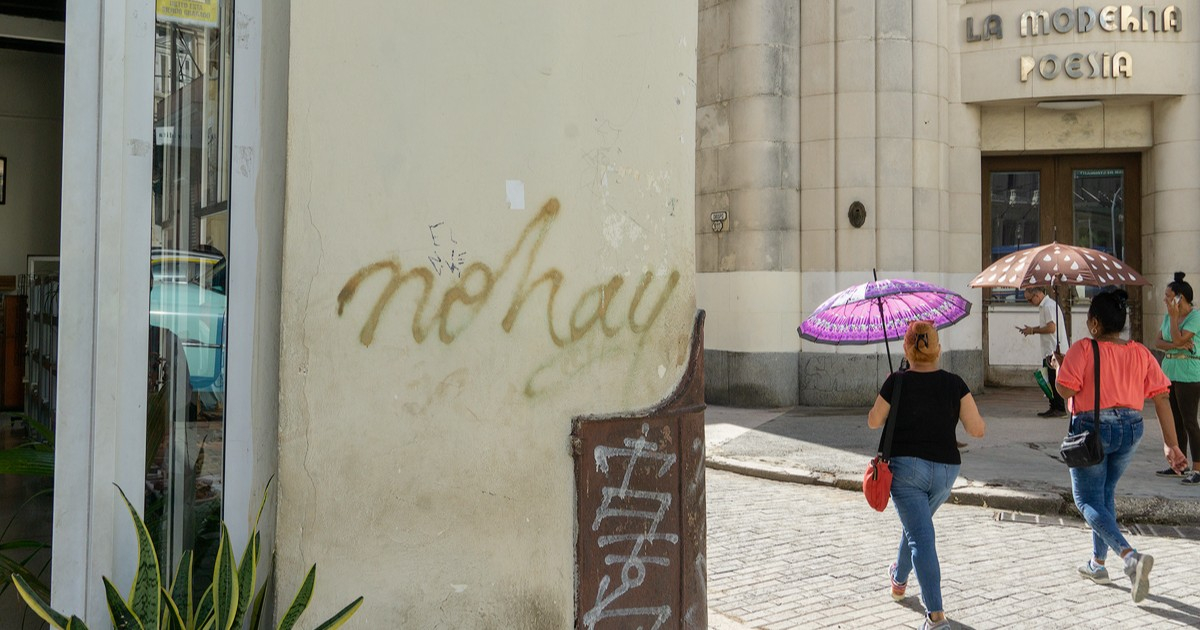
The Cuban professor and jurist René Fidel González García published this Sunday, from Santiago de Cuba, a fiery post on Facebook in which he directly addresses the Communist Party of Cuba and questions whether its members and militants will support what he describes as a process of privatization and impoverishment of the population.
Doctor in Legal Sciences and former full professor at the Universidad de Oriente, González García described himself as "thoughtful" at the beginning of his publication and posed a series of rhetorical questions that strike at the heart of the model the regime defends as socialism.
"Will the Communist Party of Cuba, its leaders and militants, provide political support for the process of restoring capitalism, for privatization and the commodification of socioeconomic and cultural rights; for the dismantling of public institutions; and for the impoverishment of the Cuban population through a fierce, import-driven, profitable, corrupt, unpunished, and authoritarian mode of exploitation of man by man?" wrote the jurist.
González García also questioned whether the PCC would accept "to make invisible, for as long as possible, the brutal and tremendous inequality in the distribution of wealth; the opacity and the dealings involved in granting, without bidding, each license, public facility, or state asset; […] as well as the final stage of the original accumulation of capital carried out by economic, business, and political elites in Cuba, and the expansion into a public, legal, and ostentatious phase of their members' belonging to a winning social class."
His complaint also extends to those who, he claims, are already looking the other way in the face of misery: "Will they do all of this while turning a blind eye to poor Cubans, as many already do, avoiding encountering them on the streets and in the dumpsters where they survive and eat?"
The jurist was unequivocal in describing the nature of power in Cuba: "They can no longer even invoke the definition of a dictatorship of the proletariat. It is against the proletarians, at the expense of the proletarians, without the proletarians."
The text arrives days after the regime closed a parliamentary session in which it approved 176 economic transformations —including private banking, private currency exchanges, and the conversion of state enterprises into commercial companies— while Prime Minister Manuel Marrero Cruz insisted before the National Assembly that Cuba is not deviating from the socialist model.
Miguel Díaz-Canel closed that session on July 30, stating that the reforms are "not for more capitalism, but to defend and advance the construction of socialism." However, he himself acknowledged concerns about "the growth of private capital, the concentration of wealth […] and the increase in inequalities." One deputy even admitted during the debate that, although it may seem like capitalism, "it is what we are doing."
González García does not shy away from the issue of repression and addresses it directly: "Why must we continue to endure exclusion, persecution, and punishment for our political beliefs in Cuba? Yes, that is what they do. That is why they are repressors."
The jurist knows firsthand what it means to be punished for one's ideas. He was dismissed from the University of Oriente in November 2016 after publishing critical articles in independent media. According to an investigation by El Toque, the institution claimed that his writings "lacked scientific character" and "negatively influenced the holistic development of the professional," although González García himself and human rights organizations reported that the dismissal was a political retaliation.
The repressive context surrounding its publication is equally severe: Prisoners Defenders reported 1,306 political prisoners in Cuba in July 2026, and the Cuban Observatory of Human Rights recorded 332 repressive actions just in May, including 55 arbitrary detentions.
González García concluded his publication with a reflection that encapsulates his view on power in Cuba: "Our recent history — and also its upcoming episodes — is, in essence, a love story with power. There is no epic. There is no honor. There isn't a single drop of decency in it." He ended with a call to resistance: "We continue. We have to continue. We will continue."
Related videos:
Filed under: