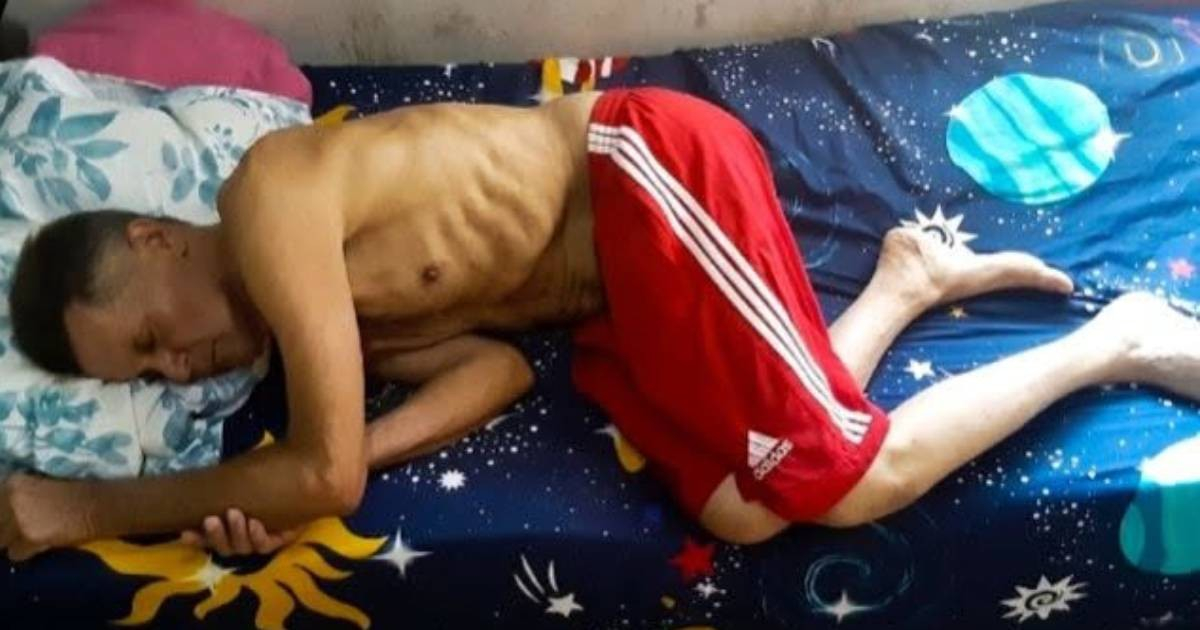
The Cuban activist and independent journalist Guillermo del Sol Pérez completed this Wednesday 49 days on a hunger strike, as his health continues to deteriorate and he sends out a message that reflects the seriousness of the moment: "I don’t want to die."
In an interview granted to the program La Noche, from NTN24, the opposition figure, 61 years old, explained that although the hunger strike officially began on June 19, he has actually been without solid food for nearly 56 days, as he progressively reduced his intake before starting the protest.
"Honestly, I feel quite weak physically; spiritually, I feel very good," he stated.
Del Sol affirmed that the consequences of previous hunger strikes, along with his chronic illnesses, have worsened his physical condition.
"As a consequence of the hunger strikes, against type 2 diabetes, I have suffered two clots, one in the right jugular and another in the right leg," he explained.
The activist also suffers from severe hypertension, bronchial asthma, and a heart condition. In 2019, he experienced a left ventricular infarction after going on a hunger strike for 40 days.
The Cuban doctor exiled in Brazil, Eduardo Enrique Herrera Durán, described the situation as a medical emergency and warned that prolonged fasting in a diabetic person can lead to potentially life-threatening metabolic, cardiovascular, and renal disturbances.
His son, Adrián del Sol Alfonso, described his father's physical deterioration.
"Drinking water is very cumbersome for him because he is practically dehydrated muscle-wise," he stated.
The strike's main objective is to demand the release of 18 political prisoners, including Félix Navarro Rodríguez, Mayelín Rodríguez Prado, and Leonel Tristá García, the latter of whom was readmitted in June to the maximum-security prison of Guamajal following the revocation of his extrapenal license.
During the interview, Del Sol stated that he is not the only opposition figure who is engaging in this extreme form of protest. He mentioned that other prisoners and Cuban activists are also on hunger strikes in various prisons across the country.
The opposition member also stated that the actual number of political prisoners in Cuba would be much higher than documented by independent organizations.
"We really don't have just over 1,300 political prisoners. We have around 3,000; many families, out of fear, do not declare them," he stated.
Del Sol also reported that both he and other opposition members have received threats from the authorities.
"Everyone has been threatened, without exception... They have told us that we will be erased from the map, that they would use us as human shields if the United States invades Cuba," he stated.
The activist remains in his home in Santa Clara, where, as he reported, he also faces the daily challenges of the Cuban crisis. He stated that there is no regular access to drinking water in his neighborhood and that he relies on a solar panel and a portable power station donated by Cubans in exile to cope with the frequent blackouts.
As his condition continues to worsen, the organization Centro de Denuncias Defensa CD requested that the Inter-American Commission on Human Rights (IACHR) take urgent precautionary measures to protect his life, demanding independent medical attention and an end to the harassment against him.
Despite his physical deterioration, Del Sol insisted that he will not abandon the protest until the political prisoners for whose release he began the hunger strike are freed.
"The night cannot be eternal. Cuba must open up to the world," he asserted.
And he concluded with a statement that summarizes the spirit with which he assures he faces each day of the strike:
"That is my strength, that is my faith, and in Christ I can do all things because He is the one who strengthens me."
Related videos:
Filed under: