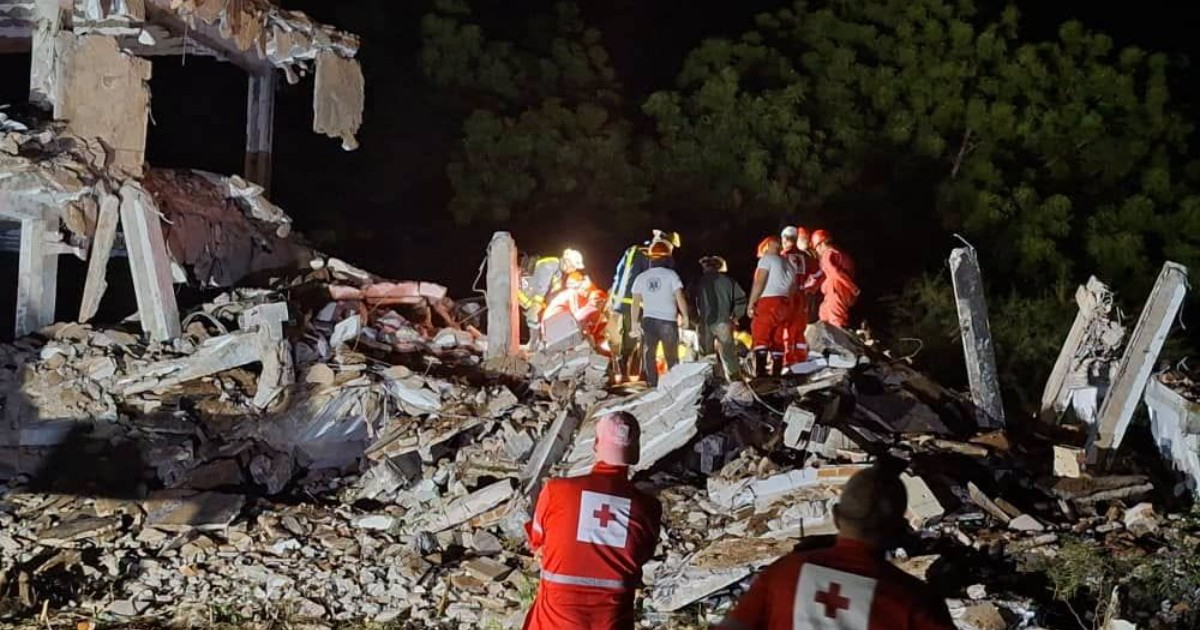
The rescue teams deployed in Remedios, Villa Clara, are maintaining active contact with at least one of the individuals located among the rubble of the collapse of the abandoned structure of an old school in that municipality, according to a report from the state-run Cuban News Agency (ACN) in an update issued at 10:11 PM on Wednesday.
The collapse affected what local sources identified as the former Basic Secondary School in the Field (ESBEC) number one, known as "La 1," located on the road to Rojas.
Henry Omar Pérez, local correspondent for ACN, specified that the interaction between rescuers and a person trapped in the debris "allows for the continuation of assistance efforts while the clearance operations progress in the affected area," according to the rescue forces on site.
The trapped individuals were confirmed to be from the municipality of Caibarién, a nearby coastal locality also belonging to Villa Clara, and their relatives remained at the site closely monitoring the progress of the operations.
The operation involves firefighters, Red Cross personnel, staff from the Integrated Medical Emergency System (SIUM), and heavy machinery, including cranes and shovels to remove debris.
The use of drones to geolocate those trapped has been confirmed as part of the operation by the Provincial Fire Command, which described the work as "highly dangerous and complex."
The first secretary of the Communist Party in Villa Clara, Susely Morfa González, estimated preliminarily that about three people were inside the building at the time of the collapse.
Unverified versions circulated on social media raised that number to 14 people trapped and mentioned two bodies recovered, information that authorities have not confirmed.
It also emerged, though not officially confirmed, that some of those present in the abandoned building may have been extracting iron and other materials when the structure collapsed, a common practice in Cuba due to the shortage of construction materials.
ACN confirmed the presence at the site of "the highest political and governmental authorities of the province and municipality," alongside representatives from Caibarién. The health system has activated all its resources for any immediate care that may be needed, the agency stated.
"The authorities reiterated that the priority remains to ensure the safety of the rescuers and the saving of lives," according to the latest update.
Dozens of former ESBECs across the country have been rendered unusable and the buildings now show significant structural deterioration due to the passage of time and environmental conditions.
These schools, established in 1971 as part of the educational model of the regime that combined study and agricultural work, reached a peak of approximately 1,400. Their dismantling began in 2009 and was formalized by Communist Party Guideline 148 in 2011, leaving many of those structures in complete abandonment.
The collapse of old or poorly maintained buildings is a recurring phenomenon in Cuba. At the end of July, two men were trapped under the debris after a prefabricated structure collapsed in the area that used to house the old military unit of the municipality of Colón, in the province of Matanzas.
Days earlier, a building located on Milanés Street, between Manzaneda and Zaragoza, in the historic center of Matanzas, collapsed. No one was injured.
In March, residents of Cerro, in Havana, reported the risk of collapse of an old school without any action from the authorities.
Related videos:
Filed under: