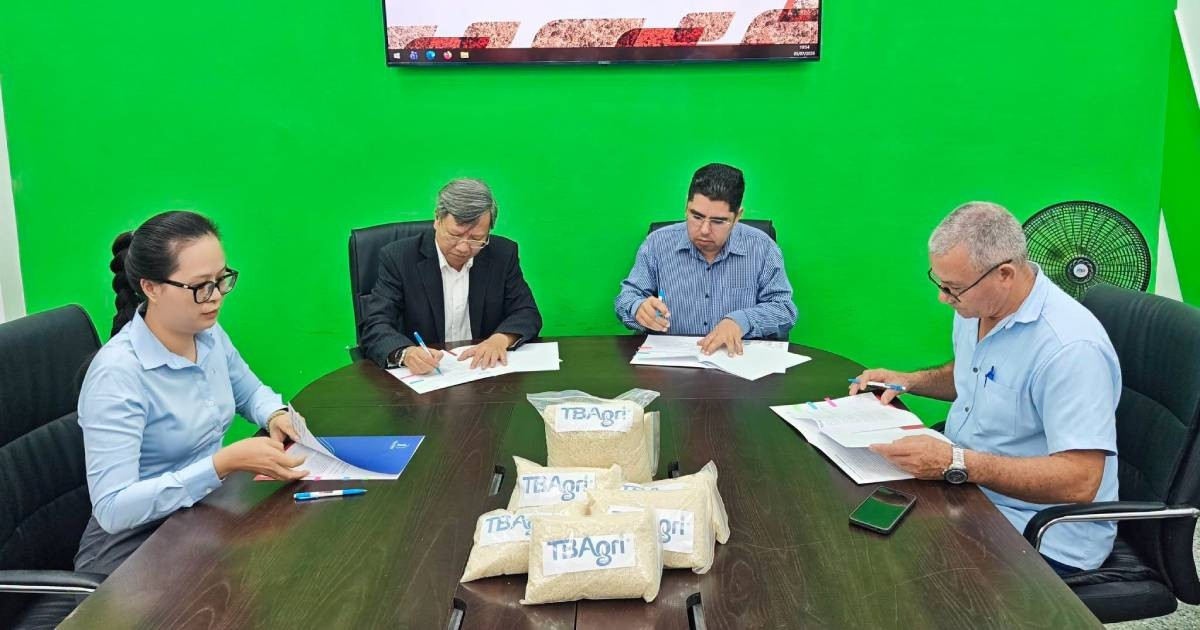
The Vietnamese company TBAGRI officially delivered the first batch of rice produced in Cuba using technology and varieties developed in Vietnam, a project through which both governments aim to increase national production amidst the deep crisis facing the Cuban agricultural sector.
According to the Vietnamese state media VOV, the delivery was formalized on Tuesday during a ceremony held at the headquarters of the Agricultural Group (GAG), which is part of the Ministry of Agriculture of Cuba.
The event was attended by the Vietnamese ambassador in Havana, Le Quang Long; the Cuban Deputy Minister of Agriculture, Telce Abdel González Morera; as well as representatives from TBAGRI and the Cuban company GRANMAX.
As part of the project, the Vietnamese company delivered over 470 tons of commercial rice of the OM5451 variety, obtained from approximately 940 tons of paddy rice harvested in the municipality of Yara, in the province of Granma.
This marks the first tangible result of the joint program that TBAGRI is developing in Cuba, which includes a 25-year alliance, aimed at expanding rice cultivation to 25,000 hectares. The pilot phase began with approximately 360 hectares planted in Granma.
During the autumn-winter 2025-2026 campaign, the company cultivated 166 hectares, achieving an average yield of over seven tons per hectare, more than three times the Cuban national average recorded in 2025, which was 2.12 tons per hectare.
For this year's summer-autumn campaign, the project has already expanded its area to 246 hectares, with estimated yields exceeding 6.5 tons per hectare.
TBAGRI attributes these results to the transfer of technologies developed in the Mekong Delta, one of the major rice-producing regions in the world, as well as the use of Vietnamese varieties such as OM5451 and OM8017, which, according to the company, have demonstrated good adaptation to the climatic and agricultural conditions of Cuba.
The delivery comes at a particularly delicate time for rice production on the island.
Cuba needs between 600,000 and 700,000 tons of rice per year to meet national demand, but in 2024, it produced only about 80,000 tons, forcing the country to rely on imports to supply even the rice distributed through the rationing booklet.
Despite this situation, the ruler Miguel Díaz-Canel assured in March that Cuba could achieve rice self-sufficiency "in a short time", a statement that contrasts with the ongoing decline in national production and the need to rely on international aid, such as the donation of 60,000 tons of rice made by China in May to alleviate the shortage.
The Thai Binh Group has maintained a presence in Cuba for nearly three decades and is currently developing four investment projects on the island valued at over 43 million dollars, establishing itself as one of the main Vietnamese investors in the country.
The commitment to increasing agricultural production takes on special significance in a context of growing food insecurity. According to the Food Monitor Program, 33.9% of Cuban households reported in 2026 that at least one member of their household experienced hunger in the 30 days prior to the survey, compared to 24.6% recorded two years earlier.
Related videos:
Filed under: