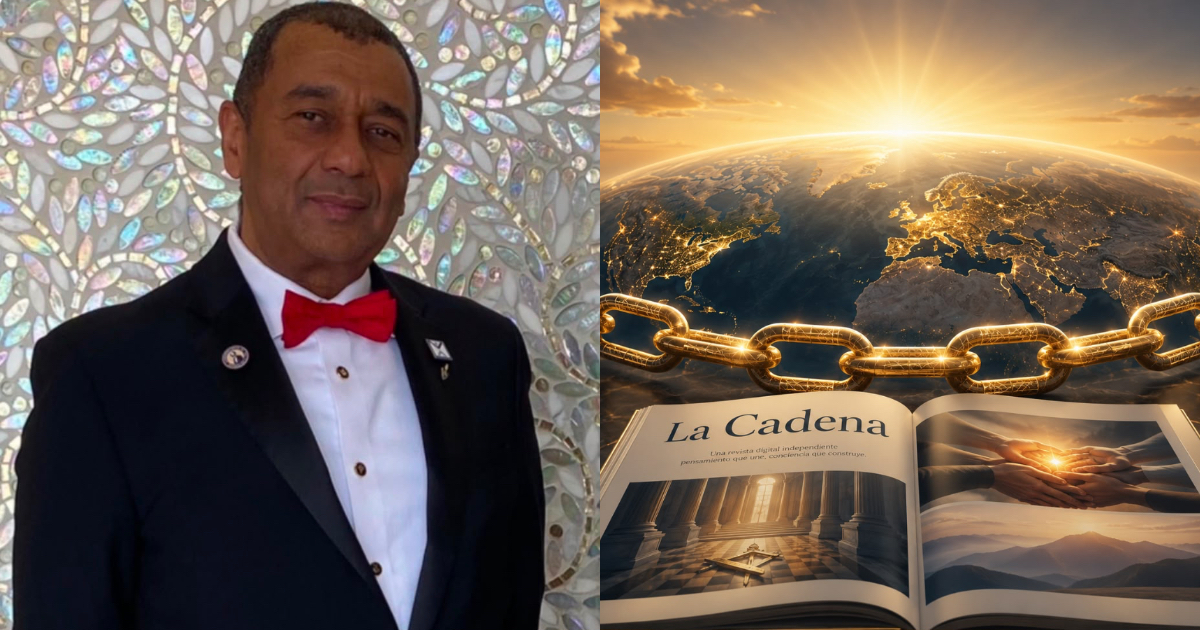
Juan Antonio Blanco Alzola is a babalawo and a Cuban mason, residing in New York and professionally linked to the Massachusetts Department of Transportation as a Network Engineering architect. He is also the editor of a new publication, La Cadena, aimed at Freemasonry, with the goal of rescuing its history and the voices scattered around the world. Additionally, he is part of the Organizing Committee for the Letter of the Year of the Miguel Febles Association (the independent Yorubas of Cuba).
The magazine, launched this Thursday, brings together contributors from various countries and is designed as a platform for exchanging experiences among Freemasons. CiberCuba interviewed Blanco Alzola through a questionnaire to uncover what lies behind this project; why it arises now, what it aims to contribute, and the path its promoters hope to take. This platform also asked the Ifá priest for a message of hope, and his response was emphatic: there are reasons to have hope, but we must work to build the future we dream of.
This Thursday, La Cadena will be officially presented. What does it mean to you?
Reaching the official launch of La Cadena represents for me a combination of joy, responsibility, gratitude, and deep commitment. It is not merely about presenting a digital magazine. It is about seeing an idea come to life that was born from the desire to preserve our history, recognize the work of those who came before us, and create a space where different generations of Masons can share knowledge, experiences, and reflections.
It has been many hours of research, writing, design, reviewing, and coordination with brothers from different places. Therefore, reaching this moment means confirming that when one works with perseverance, discipline, and a clear vision, an idea can evolve into a tangible work.
It also means taking on a greater responsibility. The launch does not mark the end of the work, but the beginning of a new phase. As we always say: the work continues.
Behind every project, there is a story. At what moment did you think, "There is a need for a publication like this"?
The idea emerged while I was researching the historical background of La Fraternidad Lodge No. 387, a lodge founded in New York in 1855 by the prominent Cuban Mason Andrés Cassard. During this process, I realized that a significant part of our Masonic history was scattered across archives, books, records, photographs, libraries, and personal memorabilia. I also understood that many valuable stories could vanish if we did not make an organized effort to preserve them.
At that moment, I thought that something more than a collection of documents was needed. It was essential to create a vibrant, accessible, and engaging space where history could meet the present. Thus, La Cadena was born: from the need to research, document, and share, but also to connect people, lodges, countries, and generations.
The publication is titled that way because a chain is made up of links. Each brother, each testimony, each document, and each generation represents one of those links. Separated, we can accomplish important things; united, we can build a much stronger legacy.
Today, there is an enormous amount of information on the internet. Why did you think it was necessary to launch a digital Masonic magazine right now?
Precisely because there is so much information, there is a greater need for responsibility in identifying, organizing, and presenting content that is serious, verifiable, and truly useful. The internet offers us extraordinary access to knowledge, but it also contains fragmented, repeated, decontextualized, or, in some cases, incorrect information. La Cadena seeks to contribute in a different way: by researching, consulting sources, preserving documents, and presenting topics with clarity and respect.
The digital format allows us to reach brethren from numerous countries without the economic and geographical limitations of an exclusively printed publication. It also facilitates the magazine being accessed, shared, and preserved for future generations. This is the right moment because technology enables us to create bridges that were much more difficult to build in the past. However, we want to use that technology not to produce hasty information, but to preserve memory, promote Masonic education, and strengthen brotherhood. Our philosophy is very simple: quality, not quantity.
La Cadena is defined as an independent publication. What exactly does that independence mean?
Independence means that La Cadena is not the official organ of any Grand Lodge, lodge, political party, government, or religious institution. It is a personal and collaborative editorial initiative that deeply respects Masonic regularity, the authorities of each jurisdiction, and the autonomy of all institutions, while maintaining its own identity and editorial standards.
This independence allows us to include voices from different countries, cultures, generations, and experiences, always within a framework of respect, fraternity, and responsibility. We do not seek to intervene in the internal affairs of any jurisdiction or to turn the magazine into a space for confrontation. Nor do we intend to speak on behalf of all Freemasonry. Our editorial line will focus on history, culture, Masonic education, research, institutional memory, fraternal activities, and contributions that can help build a better understanding among brethren.
Independence does not mean the absence of principles. On the contrary, it means that we must be even more rigorous, balanced, and responsible with every piece of content we publish.
One of the most noteworthy aspects is the participation of authors from different countries. How have you managed to gather such diverse voices around the same project?
It has been possible thanks to the trust, friendship, and fraternal bonds built over many years. When I explained the mission of La Cadena, many brothers immediately understood that it was not about promoting a single person, lodge, or country. It is about creating a space where each participant can contribute a part of their story and experience. Freemasonry has an extraordinary cultural diversity. Each country, each jurisdiction, and each lodge has stories, traditions, and key figures that deserve to be recognized.
What has united all these voices is a common idea: Masonic history must be preserved and shared with future generations. I am deeply grateful to the Grand Masters, Past Grand Masters, dignitaries, researchers, writers, and brothers who placed their trust in this first volume. Each collaboration represents a link in the chain.
Although the launch is now, I imagine that the project has already stirred excitement. What response has it received so far from the Masonic community?
The initial response has been much broader and more positive than I imagined. Before the public launch, we shared presentation copies with certain individuals who collaborated on or supported the project. We have received messages from brothers in different countries, congratulations, constructive feedback, and, above all, a strong interest in participating in future editions.
I have been particularly moved to see that brothers with many years of experience, as well as younger Masons, have found something they can identify with. Some primarily value the historical research. Others highlight the visual presentation, international diversity, or the opportunity to learn about the work done in other jurisdictions. We are also prepared to receive criticism. Every new project can be improved. Respectful, specific, and constructive criticism will always be welcome because it can help us grow. What truly matters is not losing sight of the original mission or allowing praise or criticism to divert us from the publication's purpose.
The magazine is born with a clear focus on research and dissemination. What type of collaborations are they seeking, and how can any mason who has something valuable to contribute participate?
We are seeking collaborations related to Masonic history, biographies of prominent brothers, documentary research, the history of lodges, preservation of archives, Masonic education, fraternal experiences, culture, philosophy, and activities that contribute positively to the community. We are also interested in historical photographs, minutes, letters, certificates, objects, testimonies, and documents that can be properly studied and preserved.
Any brother who believes they have a valuable story or information can reach out to the editorial team of La Cadena. It is not necessary to be a professional writer. The most important factors are the authenticity of the testimony, the value of the content, and the willingness to collaborate on its verification and presentation. Our team can assist in organizing, editing, and shaping the material, while always respecting the author’s voice and intention. We aim to open the doors but also maintain editorial standards. Each contribution will be reviewed to verify its relevance, its sources, and its coherence with the publication's mission.
Looking to the future, how do you envision La Cadena in a few years? What goals have you set for yourself as an editor?
I envision La Cadena transformed into a digital reference archive, comprised of numerous volumes that document different aspects of Masonic history and life. My aspiration is for each edition to retain its own identity while simultaneously being part of a larger work. I hope we can continue to include authors from various countries, rescue documents that have never been published, recognize brothers whose work deserves to be remembered, and create thematic editions dedicated to figures, institutions, and historical events.
I would also like the publication to develop an organized digital archive, searchable indexes, and possibly special printed editions for libraries, researchers, and collectors over time. However, I do not want this growth to come at the expense of quality. I prefer to publish less and do it right, rather than produce a lot of content without depth. The main goal is not to reach a specific number of readers. The true aim is to build something that retains its value over time.
To conclude this first part, if you could send a message to Freemasons from anywhere in the world who discover the magazine for the first time, what would it be?
I would tell you to receive La Cadena as an invitation. An invitation to learn about our history, to preserve the documents of your lodges, to listen to the brothers with more experience, and to give opportunities to new generations. It is also an invitation to look beyond our differences in language, nationality, or culture. Universal Freemasonry has many expressions, but it shares principles that can bring us closer together. La Cadena does not aim to have all the answers or to represent everyone. It merely seeks to provide a serious and fraternal space for learning, remembering, and building. To every brother who discovers this publication, I would say: this chain can also include a link with your history, your work, and your voice.
How do you think La Cadena will be received by Cuban Freemasons?
I hope it is received with affection, curiosity, and a sense of belonging. Cuba has an extraordinary Masonic tradition. Its history is linked to men who contributed to thought, education, culture, and the formation of the Cuban nation. For Cuban Freemasons, both on the island and abroad, La Cadena can represent a bridge. Not a political bridge, but a historical, cultural, and fraternal one.
I know that some brothers may have differing opinions on certain topics or on the way they are presented. That is natural. The diversity of opinions is part of every vibrant community. What is important is that they understand that this publication arises from respect and a desire to acknowledge the contribution of Cuban masonry to the universal history of the institution. As a Cuban and as a mason, that connection represents a very special responsibility for me.
Do you believe it is possible to send a message of hope to the Cuban Masons at this time?
Yes. It is always possible and necessary to offer a message of hope, but it must be a responsible hope, not an empty promise. I would tell the Cuban Masons that their history, their sacrifice, and their work have not been forgotten. Despite the challenges, there are still brothers who uphold their lodges, preserve their temples, educate new generations, and keep alive a tradition of great importance for Cuba.
Hope also means keeping the bridges open between Cuban Masons living on the island and those residing in other countries. We can meet in our respect for our history, in our love for our roots, and in the principles we share.
Material circumstances may be difficult, but as long as there are men willing to work with dignity, brotherhood, and perseverance, there will always be reasons to maintain hope. History shows that no night is eternal. Yet, light does not come merely from waiting; it is also built through knowledge, unity, and hard work.
Juan A. Blanco Alzola is not only a mason. He is also a babalawo. How does he view the future of Cuba? Are there reasons to have hope?
As a Cuban, Mason, and babalawo, I view the future of Cuba from three dimensions that, for me, are not in conflict: reason, experience, and spirituality. I do not consider it responsible to present myself as someone capable of predicting the exact future of a nation. Yoruba religion teaches us to observe, reflect, correct behaviors, and understand that every action produces consequences.
My hope for Cuba is not rooted in a prophecy or a political slogan. It is based on its people, its history, its capacity to resist, and the talent of Cubans living both on the island and abroad.
Cuba needs reconciliation, understanding, and respect among its people, as well as the ability to prioritize the common good above resentments, personal differences, and individual interests.
True hope requires changes in attitude. It requires listening, acknowledging mistakes, respecting human dignity, and understanding that no sector holds all the solutions on its own.
From my faith, I ask Olodumare and the Orishas for wisdom, health, protection, and clarity for the Cuban people.
From my position as a Mason, I believe in education, tolerance, freedom of conscience, dialogue, and work as instruments of construction.
And from my position as a Cuban, I hope that one day we can all look at our homeland without hate and without divisions, understanding that Cuba is greater than any of us.
Yes, there are reasons to have hope. But we must understand that hope is not just about wishing for a better future. It involves working responsibly to build it.
Alone we can be isolated links; together we can become a strong chain.
Let there be Light.
Related videos:
Filed under: