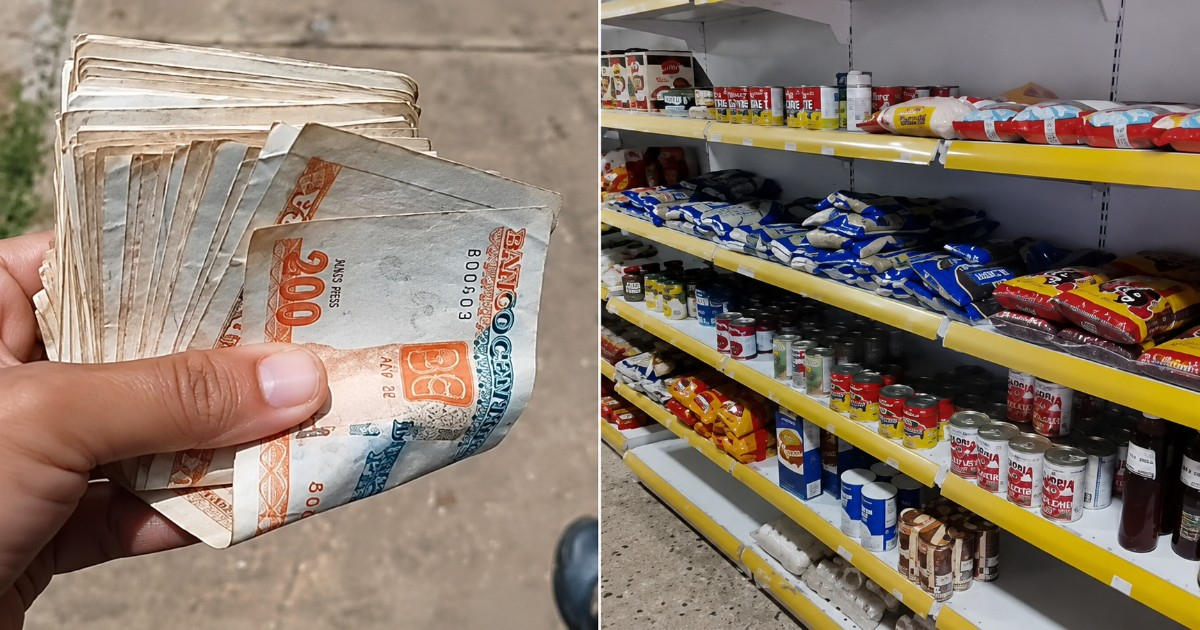
The Municipal Administration Council of San Luis, in the province of Santiago de Cuba, announced this Friday reference prices for the retail sale of basic products, following an extraordinary session held the day before due to what the official note described as "the indiscriminate increase in the price of oil and other products such as rice, chicken, and eggs in retail trade," reported CMKC Radio Revolución.
The agreed values are: oil up to 2,200 pesos per unit, chicken up to 600 pesos per pound, imported rice up to 750 pesos per kilogram, domestic rice up to 250 pesos per pound, and eggs up to 120 pesos per unit.
The authorities hurried to clarify with a semantically precise statement that does not go unnoticed: "It is clarified that this is not a price ceiling, but the result of the economic evaluation conducted on marketing costs and expenses." In other words, it is not a cap, but anyone selling above this price may face temporary closure of their establishment for up to three months, confiscation and forced sale of the product, and fines in accordance with current legislation. The difference, it seems, is merely one of terminology.
The reaction on social media combined cautious relief with a skepticism that captures the mood of the Cuban population regarding such announcements. "I'll believe it when I see it," wrote one user. Another elaborated: "There's a big gap between words and actions; we'll see if it's fulfilled not just in San Luis but throughout Santiago de Cuba." A third user bluntly demanded, "Let it actually happen and not just be talk because the people can’t take it anymore."
Skepticism has historical foundations. In June 2026, President Miguel Díaz-Canel acknowledged that previous price ceilings "caused shortages, deviations towards illegality, and reduced revenue." In July 2023, Finance and Prices Minister Vladimir Regueiro Ale admitted before Parliament that these same measures had been a failure, in a context of annual inflation of 45%.
Paradoxically, the escalation that San Luis is now trying to curb was triggered by a decision from the regime itself: the Resolution 150/2026 from the Ministry of Finance and Prices, published on June 20, removed the retail caps on imported cooking oils and repealed the previous limit of 990 pesos per liter. Since then, oil has experienced an uncontrollable surge: from about 1,500 pesos in April, it jumped to over 4,000 pesos in August, with peaks reaching up to 7,000 pesos. A social media user from the provincial capital summarized it bluntly: "And what about Santiago de Cuba? I've been eating boiled food for days, here the bottle is 6,000."
San Luis does not act alone, although not with much originality either. Guantánamo set a reference price of 2,200 pesos for oil on August 5, with the same formula of "it's not a ceiling but a reference for costs," and Holguín did the same days later in Moa and Banes. One internet user noticed: "It seems to me that it’s a copy and paste of the official note that came from Guantánamo, only the phone numbers have changed."
The Guantanamo precedent also does not inspire optimism: in February 2026, a similar exercise in Guantanamo resulted in 1,538 fines and 162 forced sales without prices stabilizing in a lasting manner.
Dozens of commenters demanded that the measure be extended to Santiago de Cuba capital, Palma Soriano, Granma, and Cienfuegos, with several noting that even the "reference" prices are unattainable: a carton of 30 eggs priced at 120 pesos per unit would cost 3,600 pesos, exceeding a monthly minimum wage. "Everything is really expensive anyway; it doesn't match the salaries and pensions of retirees," pointed out one user. Another was direct about the source of the problem: "They created the problem by freeing the prices and establishing free supply and demand." A commenter warned about the risk of history repeating itself: "Now we need to enforce it consistently so it doesn't happen as always, where actions dissipate and even the inspectors become corrupt."
Related videos:
Filed under: