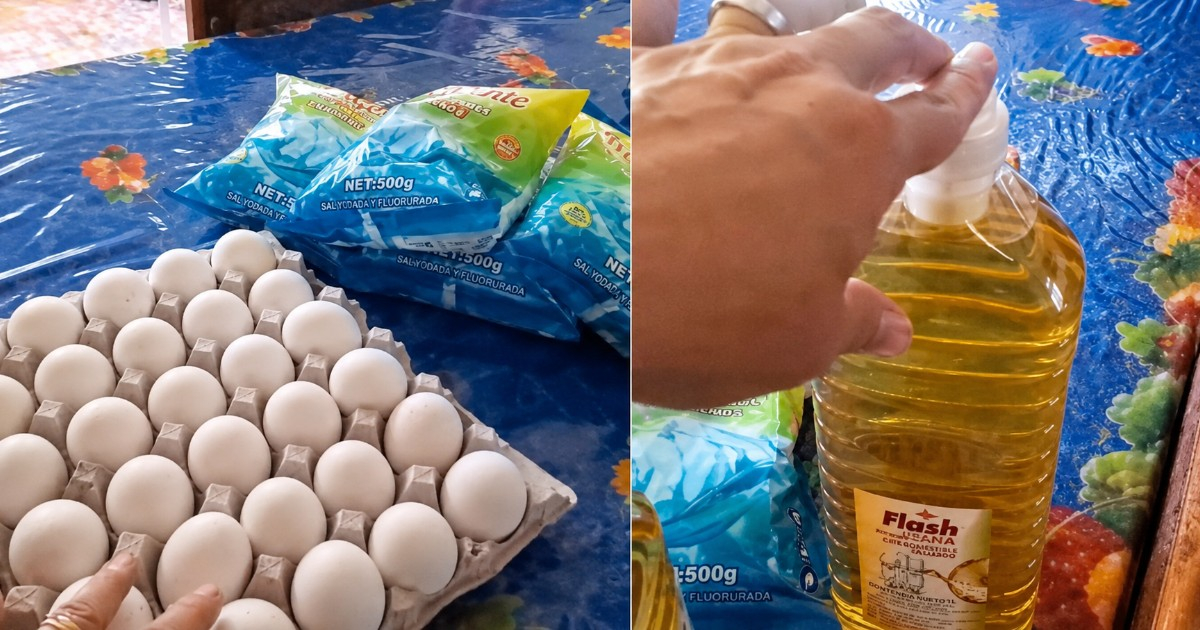
The Provincial Government of Villa Clara announced this Friday the establishment of maximum prices for essential food items through the Agreement No. 127 of the Provincial Council of the People's Power, a measure that the ruling media outlet Cubadebate presented as a gesture of protection for the people, but which arrives at a time when actual prices in the province have already exceeded the newly set limits.
The official statement explains that the decision arose "as a result of the analysis conducted based on the concerns expressed by the people regarding the indiscriminate increase in retail prices of various products [...] as well as the review of the legal standards for the formation and approval of prices adapted to the new Economic and Social Transformations recently approved." In other words: prices rose so much that the provincial government decided to take action. That action, remarkably original, is precisely the same thing that the national government has just acknowledged does not work.
The agreement establishes a maximum commercial margin rate of 30% for wholesale and retail prices, with the approval of the Provincial Party Committee. The specific limits are as follows: eggs cannot be sold for more than 95 pesos wholesale or 110 pesos retail; a liter of oil, no more than 2,250 pesos wholesale and 2,500 pesos retail; a kilogram of powdered milk, no more than 3,120 pesos wholesale and 3,465 pesos retail; a pound of refined sugar, no more than 370 pesos wholesale and 410 pesos retail; and a kilogram of sausages, no more than 1,255 pesos wholesale and 1,500 pesos retail.
The problem —a minor detail— is that this very Friday, in Placetas, a municipality in the very Villa Clara, oil was being sold for 4,000 pesos per bottle, which is 1,500 pesos above the recently declared ceiling. Eggs were reported to be between 150 and 160 pesos each in Santa Clara and Placetas, well above the provincial maximum of 110 pesos. The agreement was born outdated.
The historical irony of the measure is hard to overstate. Just on June 20, the Ministry of Finance and Prices approved the Resolution 150/2026, which eliminated national price caps for edible oils, powdered milk, sausages, pasta, and chopped chicken. Even Miguel Díaz-Canel publicly acknowledged that the caps "failed to contain inflation" and resulted in "disappearance of products" and "diversions into illegality." Less than two months later, Villa Clara resurrects them at the provincial level with the same solemnity as always.
In mid-July, the Council of Ministers also removed the price cap on rice, which had been set at 155 pesos per pound since March 2025. The national trend was clear: price controls do not work, create shortages, and push products to the black market. Villa Clara, however, decided to swim against this tide.
To understand the magnitude of the imbalance, one piece of information suffices: the minimum wage in Cuba is 3,210 pesos per month as of July 1, 2026, following a 53% increase. However, economists and local reports estimate that meeting basic needs requires around 96,000 pesos per month, nearly 30 times that wage. With a cap of 110 pesos per egg, a family buying just 30 units a month would spend 3,300 pesos, which is more than the entire minimum wage for that single product. And that assumes they can find eggs at the capped price, which was not the case in any market in the province this Friday.
The provincial government warned that "actions to confront those who violate the established regulations will be strengthened" and listed penalties ranging from fines and confiscation to closure of establishments and permanent cancellation of licenses, as supported by Law Decree 91 of 2024 and Decree 30 of 2021.
The Provincial Council concluded its statement reaffirming "its commitment to protect the interests of the population and to continue confronting illegal practices and the abusive and speculative prices that affect consumers." A statement that sounds particularly hollow when a carton of 30 eggs was already reported at astronomical prices in various areas of Cuba, and when the recent history of the country shows that price caps do not contain inflation: they simply cause products to disappear from the shelves.
Related videos:
Filed under: