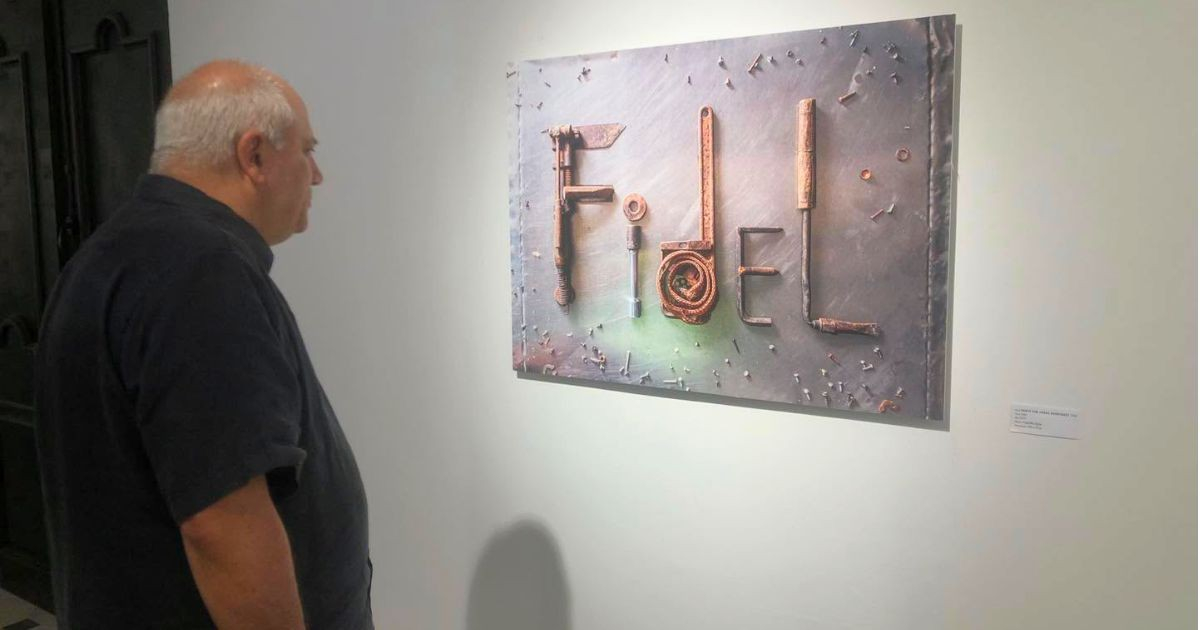
While Cuba registers today an electrical impact forecasted at 2,257 MW —with only 940 MW of available generation against a demand of 3,250 MW— and the Cuban peso plummets to 673 units per dollar in the informal market, the Union of Writers and Artists of Cuba (UNEAC) inaugurated this afternoon the collective exhibition «Arte Fiel» at the Villa Manuela Gallery in Havana, a visual tribute to the centenary of the late dictator Fidel Castro.
The event was attended by the Minister of Culture, Alpidio Alonso, and Marta Bonet, president of the UNEAC, along with several artists. The regime's priorities were thus depicted with a clarity that is hard to surpass: without light, without water, and without food, yet featuring an art exhibition dedicated to the "Commander in Chief."
According to the state agency ACN, the exhibition brings together "about twenty works, each from diverse aesthetics and techniques, [that] focus on the figure of the Commander-in-Chief and the impact of his legacy." Painting, engraving, photography, and graphic art make up a selection that, according to its organizers, will remain open until September.
Among the participants are six National Awards for Plastic Arts: Nelson Domínguez, Alberto Lescay, Raúl Martínez, Roberto Salas, José A. Toirac, and Lesbia Vent Dumois. Also exhibiting are Alex Castro —son of the honoree—, Roberto Chile, Carlos del Toro, Arístides Hernández (Ares), Humberto Mayol, José A. Menéndez (Pepe), Eladio Rivadulla, Dennys San Jorge, and Aldo Soler. A total of fifteen artists to commemorate a man whose legacy includes six decades of dictatorship.
«Arte Fiel» is not a spontaneous or isolated event. The UNEAC launched this campaign in January 2026 under the banner of the "Year of the Centennial of Commander in Chief Fidel Castro Ruz," proclaimed by the regime on December 19, 2025. Throughout the year, the organization has inaugurated exhibitions, organized panels of poets, concerts, caravans, and tree planting in various provinces, all under the official hashtag #ArteFiel. On August 13, the exact centenary of Castro's birth will be celebrated, and the regime has no intention of letting it pass quietly.
The exhibition will also accompany the event for the 65th anniversary of the UNEAC, scheduled from August 17 to 22, and will coincide with the I International Colloquium "Fidel: legacy and future," planned for this month at the Palace of Conventions in Havana. A tight schedule of celebrations for an institution that, established in 1961, has historically served as a conduit for the cultural policy of the regime.
The contrast with the reality experienced by the Cuban people is so harsh that it almost seems like a parody. So far in 2026, there have been at least seven widespread blackouts in the National Electric System. July was the month with the most protests in the recent history of the island: 1,415 incidents, primarily driven by power outages, water shortages, and the deterioration of supplies, according to the Cuban Observatory of Conflicts and Infobae reports. CEPAL projects a contraction of the Cuban GDP by 6.5% in 2026, while The Economist Intelligence Unit estimates an even greater decline of 7.2%.
The Cuban peso, for its part, has accumulated a depreciation of approximately 55% in just eight months: from 435 pesos per dollar in December 2025 to 673 this Friday. Meanwhile, at the Villa Manuela Gallery, the well-lit directional lights and the paintings dedicated to Fidel await visitors.
The exhibition will remain open at the Villa Manuela Gallery until September, which is more than enough time for any Cuban who manages to cope with the power outages, finds transportation, and is in the mood for celebrations to come and contemplate the legacy of the man to whom the regime attributes all its "achievements" and none of its disasters.
Related videos:
Filed under: