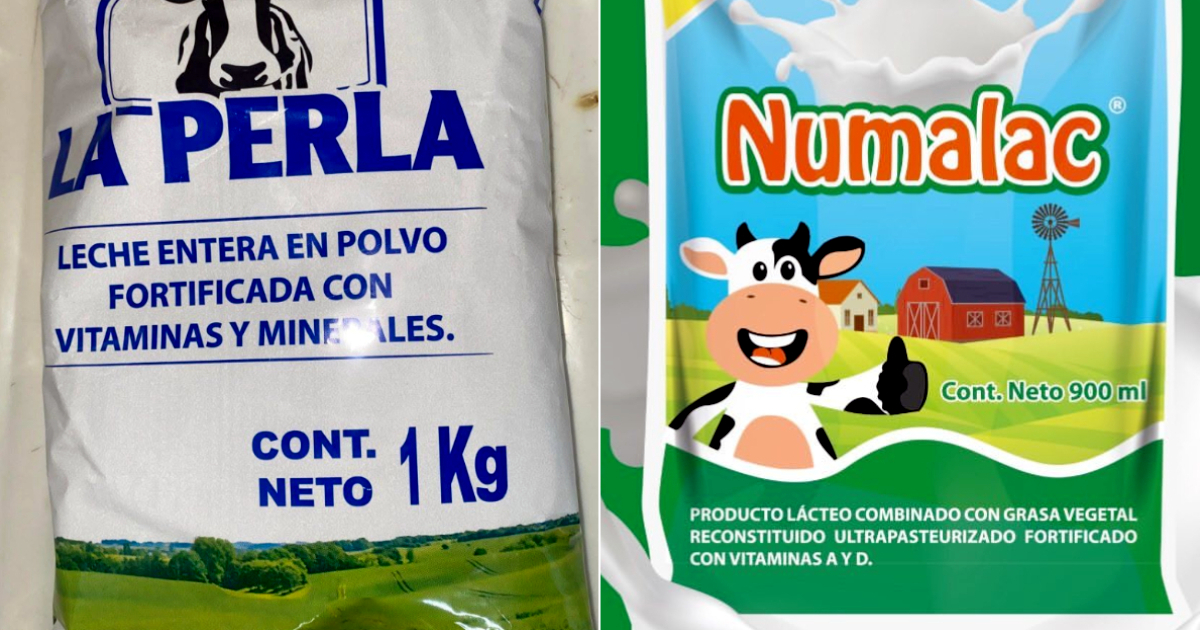
The stores controlled by the military conglomerate GAESA sell imported dairy products whose selling price can far exceed the value at which they entered Cuba, amidst the severe shortage of milk affecting the population.
This is documented in the report 'From Mexico to Cuba: the business routes that fuel scarcity', published by DIARIO DE CUBA and authored by Annarella Grimal, Pablo Díaz Espí, and Mirta Fernández, who investigated the importation and commercialization of products such as Numalac and La Perla on the Island.
One of the most remarkable cases is that of Numalac. According to the foreign trade data examined by the authors, a shipment of 59,400 packages of 200 grams had a declared value of $44,549.97.
That amounts to approximately 0.75 dollars per package.
However, the same product was sold through EnvíosCuba for about 2.39 dollars per unit, more than three times its declared import value.
The difference is approximately $1.64 per package. This figure does not necessarily equate to a net profit, as it would be necessary to discount expenses related to transportation, storage, distribution, and marketing.
The data is particularly significant because these products are sold in a country where millions of people face difficulties in regularly accessing milk and other basic foods.
It is not whole milk powder
The investigation by DIARIO DE CUBA also highlights the composition of the products being sold.
Numalac and La Perla are formulations that include vegetable fat and show significant nutritional differences compared to whole powdered milk.
According to the values gathered in the report by Grimall, Díaz, and Fernández, whole powdered milk typically contains between 25 and 27 grams of protein per 100 grams.
Numalac declares 18.6 grams per 100 grams, while La Perla contains 12.3 grams.
The difference also appears in calcium. Numalac states 381 milligrams per 100 grams, compared to approximately 900-1,000 milligrams that whole powdered milk can provide, according to the standards cited in the research.
Despite these differences, products are sold at high prices.
The report indicates that Numalac was sold for about $9.25 per kilogram in physical stores, while La Perla was around $8 per kilogram.
Additionally, Tiendas Caribe promoted La Perla on its social media as "powdered milk fortified with vitamins and minerals," according to the authors' documentation.
Stores linked to GAESA
Journalists found these products in establishments of Tiendas Caribe and CIMEX, two of the main commercial structures under the control of the military conglomerate GAESA.
The report also analyzes the role of EnvíosCuba, a platform used by Cubans living abroad to pay for products in foreign currency that are subsequently delivered to relatives on the Island.
In this way, the commercialization of basic food does not solely rely on the income of those living in Cuba, but also on the dollars provided from abroad by family members who seek to alleviate the scarcity faced by their loved ones.
Cuba imports much less milk
The situation occurs amid a significant reduction in Cuba's powdered milk imports.
According to data from the National Office of Statistics and Information (ONEI) collected by DIARIO DE CUBA, powdered milk imports decreased by 74% between 2019 and 2023.
The value of those purchases fell from 158.1 million dollars to 65.8 million, while the average import price rose from 2,916 to 4,672 dollars per ton.
National production has also failed to meet the country's needs.
According to the statistics cited in the research, production in the non-state sector fell from 411,800 tons in 2017 to 210,400 tons in 2022.
The result is a particularly harsh combination for Cuban families: less domestic production, a significant reduction in imports, and food sold in foreign currency at prices beyond the reach of a large part of the population.
While the scarcity compels even reliance on international donations of milk, the commercial structures linked to GAESA continue to sell imported dairy products for dollars, a currency in which most Cuban workers do not receive their salaries.
Related videos:
Filed under: