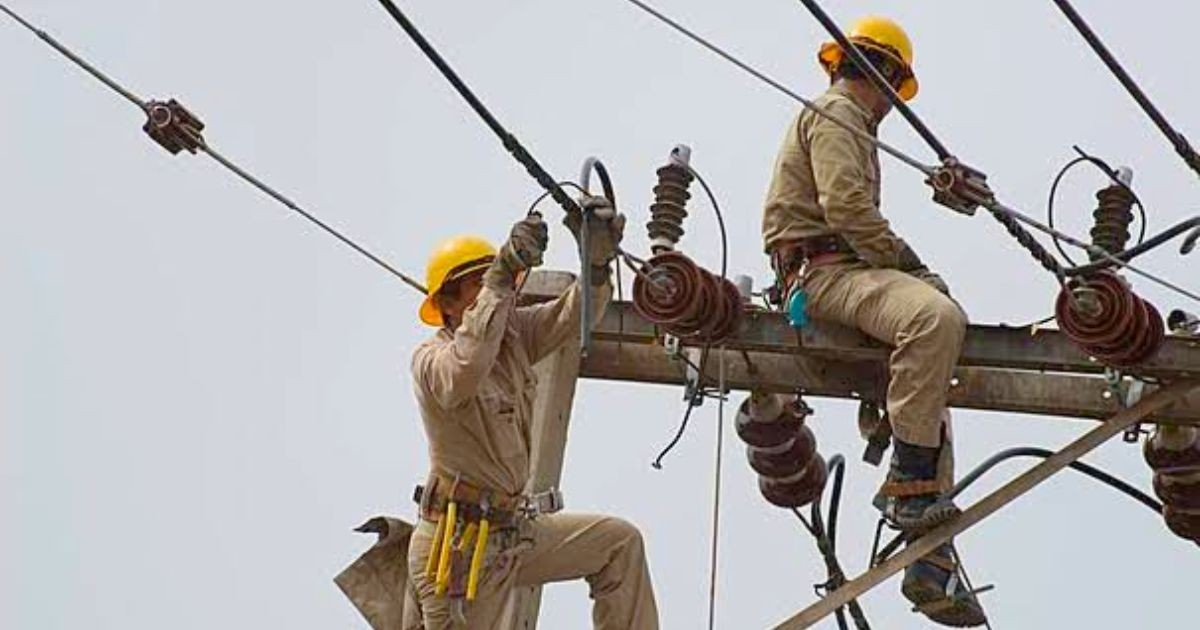
The Cuban journalist and art critic Jorge Rivas Rodríguez published a reflection on his Facebook profile this Sunday that starkly summarizes the deterioration of the image of power line workers in Cuba: "From Loved and Respected to Hated and Cursed", titled his text the head of the cultural section of the newspaper Trabajadores and National Prize for Cultural Journalism José Antonio Fernández de Castro.
Rivas begins his writing with an image that encapsulates the daily drama of millions of Cubans: "In the dimness of every humble neighborhood, where night is not just the absence of light but a shroud of helplessness, the misfortune of blackouts looms."
The journalist recalls that these workers were admired figures for decades. "In the past, those men and women who climbed the poles with steady and brave hands were symbols of hope for a people battered by devastating cyclones. Their work was sacred: to rebuild, to restore the energy that brought life back to homes, schools, and hospitals," he writes.
But that prestige has eroded. According to Rivas, "some unscrupulous linemen, once popular heroes, are now pointed out and cursed, accused of diverting electric service to small and medium enterprises and powerful individuals, leaving humble neighborhoods in distress, whose fate depends on a switch that rises or falls at the whim of interests unrelated to the common good."
The journalist's complaint is not an isolated case. In July, residents of Calabazar, in Boyeros, detained two electrical workers accused of illegally selling the supply while the neighborhood was in darkness; the workers were found with money and beers inside the official vehicle. The Electric Union described the incident as an "isolated act of corruption" and referred the case to the authorities.
The pattern is repeated in different parts of the capital. Last Thursday, the 6th, residents of Marianao thwarted a power cut by demanding that the line workers show the work order authorizing the maneuver and calling the National Revolutionary Police when they refused. This Saturday, women from La Lisa reported that circuits 2073 and 2075 received barely one hour of electricity a day, while another circuit in the same area accumulated between six and eight continuous hours.
The leader of the Communist Party, Roberto Morales Ojeda, publicly acknowledged the existence of corruption complaints in the electric sector, although he attempted to downplay them by stating that “[four or five cases] tarnish the work of the majority.”
All of this is happening during the worst energy crisis recorded in Cuba. The country has experienced at least seven total blackouts of the National Electric System so far in 2026, with power outages lasting up to 20 and 24 hours daily in Havana and up to 87 consecutive hours without electricity in areas of Matanzas.
In that context of extreme scarcity, Rivas warns that "electricity, which should be a basic right, becomes a manipulated privilege, a scarce resource distributed according to influence rather than essential needs," and that "the blade controlling the electric current is, at its core, the switch of hope or despair."
However, the state journalist takes care not to name the main culprits behind the national electrical collapse, the regime leaders who have maintained a fundamental sector for the functioning of all activities in the country under misguided policies and without investments.
The journalist concludes his reflection with a warning and a wish: “History will neither forget nor forgive those who allowed corruption and labor indiscipline to obscure such a fundamental right. May the light, finally, shine again for everyone, without distinctions or barriers, illuminating not only the streets but also the path towards a fairer and more supportive Cuba.”
Related videos:
Filed under: