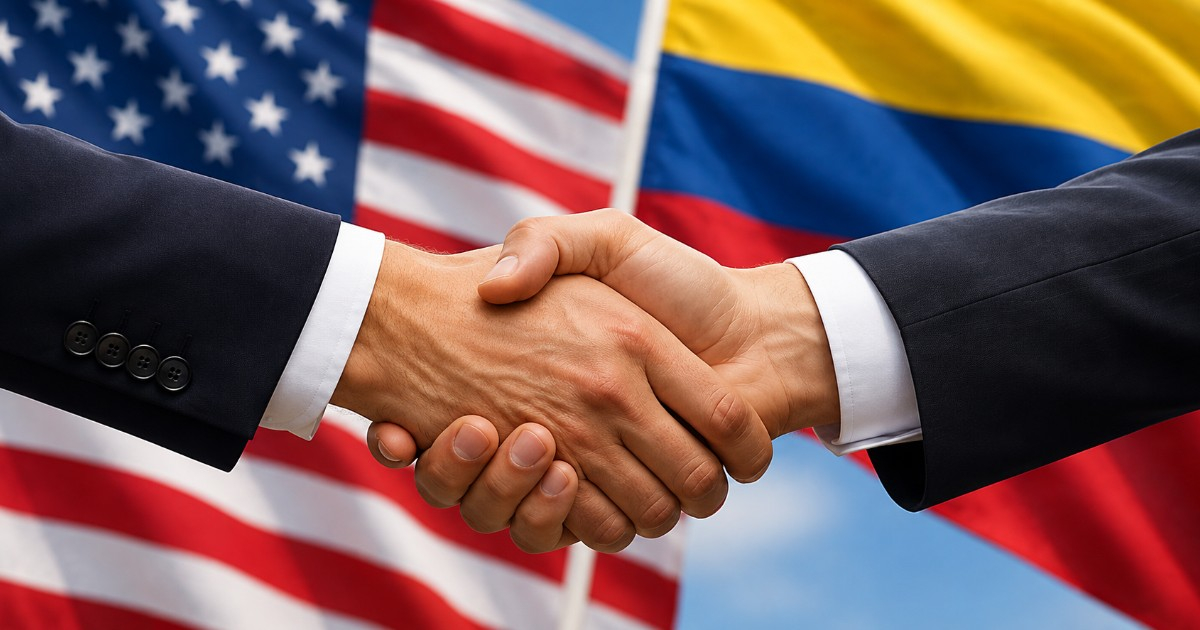
The United States announced its intention to allocate 1 billion dollars to Colombia as part of a new security package aimed at strengthening bilateral cooperation in the fight against drug trafficking and organized crime, coinciding with the beginning of the government of President Abelardo De La Espriella.
The U.S. announcement was made by the State Department, which indicated that Washington, in collaboration with Congress, intends to allocate $1 billion in assistance as part of the security package.
The Presidency of Colombia described the initiative as "the most significant support for the bilateral alliance in decades", in a context of notable rapprochement between Bogotá and Washington following the tensions that characterized much of the relationship during Gustavo Petro's administration.
The funds have not yet been disbursed. The Colombian Presidency itself clarified that the initiative must be processed in coordination with the U.S. Congress, while the Department of State also conditioned the process on working with lawmakers.
In security matters, the package includes strengthening Colombian forces with U.S. technology, expanding coca eradication operations and cocaine interception, dismantling narcoterrorist organizations through asset freezing and prosecuting their financiers, recovering territories controlled by armed groups, and protecting minors from forced recruitment.
The initiative also supports Colombia's incorporation into the Shield of the Americas, the regional security alliance promoted by the United States to combat drug trafficking and transnational organized crime. De La Espriella announced in July that Colombia would join the mechanism and that Medellín would host its headquarters in the country.
In the economic front, both governments anticipate starting a bilateral dialogue for prosperity that includes economic stabilization, investment in critical minerals, strengthening Colombian small and medium-sized enterprises, modernization of digital, port, and energy infrastructures, and cooperation in civil nuclear energy for peaceful purposes.
"This $1 billion security package demonstrates that the U.S. firmly supports its friends and allies. This historic support strengthens our shared fight against narcoterrorism and enhances regional security while promoting our mutual national interests," celebrated Republican Congressman Mario Díaz-Balart. He also congratulated Secretary of State Marco Rubio and the State Department for driving, in his words, "a new era in U.S.-Colombia relations."
De La Espriella took office on Friday, August 7, at the USC Arena in Cali, in a unique ceremony held outside of Bogotá.
The new leader came to power after defeating Iván Cepeda in the runoff on June 21 by less than one percentage point: 49.66% compared to 48.70%.
Even before taking office, De La Espriella had signaled a significant readjustment of Colombian foreign policy.
At the end of July, the president announced the severance of diplomatic relations with Cuba and Nicaragua and the closure of 14 embassies, in addition to his intention to strengthen strategic cooperation with Washington.
The approach also contrasts with what happened just a few months ago. During Petro's administration, Colombia was excluded from the Shield of the Americas initiative after Washington indicated that it did not see the expected level of cooperation in the fight against drug trafficking.
Related videos:
Filed under: