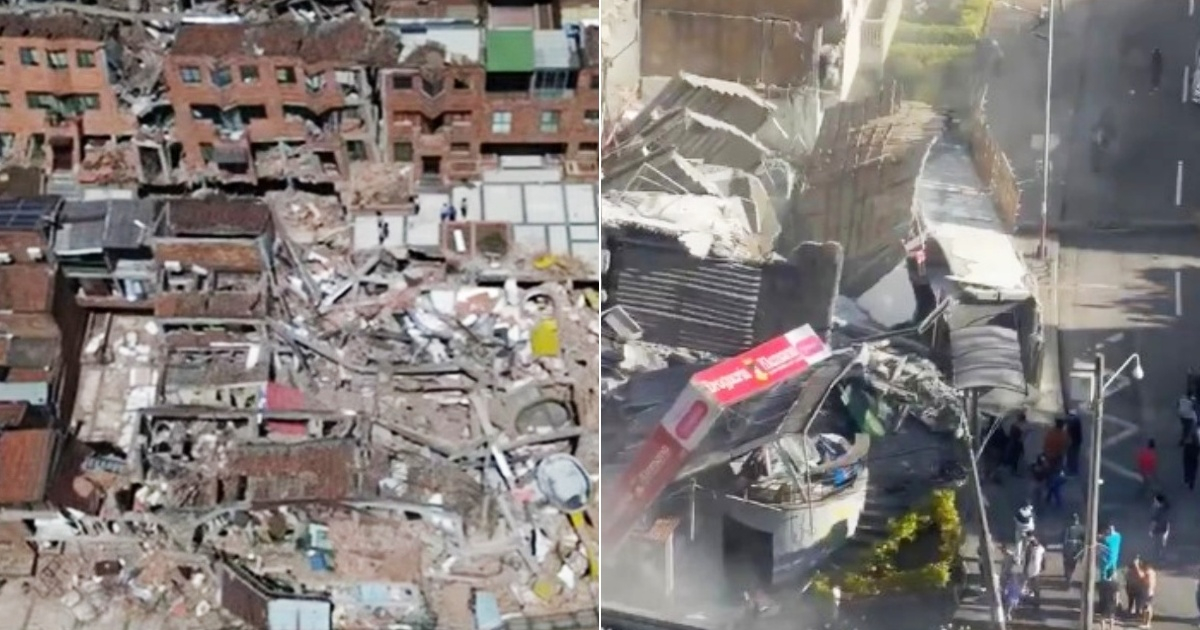
The Colombian Geological Service (SGC) responded to one of the most frequently asked questions following the devastating earthquake of magnitude 7.4 that struck northwestern Colombia this Monday: does this earthquake have any relation to the double earthquake that affected Venezuela on June 24?
The answer is no, and the reasons are strictly geological: both phenomena result from completely different tectonic dynamics, as explained by the organization through its account on the social media platform X.
Two tragedies, two distinct mechanisms
The Colombian earthquake, with its epicenter in San José del Palmar, in the Chocó department, at a depth of 103 kilometers, is the strongest recorded in that country so far this century.
The SGC also clarified that, despite the publication of several bulletins with different magnitude estimates during the initial hours, only one main earthquake occurred. The initial measurements were preliminary, and the definitive magnitude of the event was later established at 7.4.
Despite the fact that the three earthquakes—the Colombian one and the two Venezuelan ones on June 24, with magnitudes of 7.2 and 7.5—exceeded the threshold of 7, the SGC was categorical in ruling out any connection between them.
"There is no relationship between the two events because they obey different dynamics. While the earthquake that occurred in Venezuela was shallower and is associated with the shear interaction of the Caribbean plate with the South American plate, which involves a lateral (transform) movement of one relative to the other; today’s earthquake in Colombia is the result of the subduction (or sinking) of the Nazca plate beneath the South American plate, with a depth of 103 km. This demonstrates that the earthquakes are independent," explained the SGC on X.
What is subduction and why does it matter?
The seismologist Viviana Dionisio from the National Seismological Network of Colombia explained to the agency EFE that the Colombian “was a tectonic earthquake primarily associated with a subduction mechanism”, a phenomenon that occurs when the Nazca Plate, in the Pacific Ocean, is pushed beneath the South American Plate.
"When one tectonic plate is sliding underneath another, it is referred to as a subduction earthquake. Generally, these occur along coastlines," detailed Dionisio, comparing the Colombian event to major earthquakes in Chile, Japan, and Ecuador.
This dynamic also explains the depth of the earthquake: more than 100 kilometers below the surface, which classifies it as "intermediate depth," and contributes to its effects propagating over a very large geographical area.
Earthquakes in Venezuela: Shallow and Lateral
The Venezuelan case was radically different.
The earthquakes on June 24 occurred at a depth of less than 20 kilometers and were caused by a lateral movement between the Caribbean and South American plates, rather than a subduction process.
“The earthquakes in Venezuela are shallower and relate to a different mechanism, which is a strike-slip mechanism. This is a deeper earthquake, which is a subduction earthquake,” emphasized Dionisio.
Doctor Gustavo Ortiz, a specialist in Geological Sciences at the National Council for Scientific and Technical Research of Argentina, summarized it in statements to CNN:
"The only thing these two catastrophic events have in common is that they occur on the South American plate, but the geological and geotectonic context is completely different."
Why does the earth shake so much in Colombia?
The SGC recalled that Colombia is a country with high seismic activity due to the interaction of the Nazca, South American, and Caribbean tectonic plates, which causes movements across much of its territory.
According to the agency, Colombia experiences an average of about 2,500 earthquakes per month, although the vast majority are imperceptible to the population and are only recorded by seismographs.
The SGC also dismissed the idea that more earthquakes are currently occurring than before.
The heightened awareness of these phenomena, he explained, is due to the increase in resources and tools available to detect them and promptly disseminate information.
Replicas can continue for weeks or months
Until 6:30 PM this Monday, the SGC had recorded 47 aftershocks, with a maximum magnitude of 4.8.
The organism explained that these smaller magnitude movements occur after the main earthquake in the same region, as energy continues to be released and the areas close to the rupture zone regain equilibrium.
Replicas can last for days, weeks, and even months, so it is likely that new movements will continue to be recorded.
The agency also reminded that there is currently no scientifically proven method to predict when an earthquake or aftershock will occur, nor what its magnitude will be.
Unrelated to the Puracé volcano
The SGC also ruled out any connection between the Colombian earthquake and the activity of the Puracé volcano, which has been on orange alert since August 1 for unrelated reasons: “This seismic event has no relation whatsoever to the current behavior of the volcano, nor did it cause any ash emissions.”
The seismologist Rodrigo León, a professor in the Department of Geosciences at the University of los Andes, warned that earthquakes cannot be predicted, although he noted that the damage, "although quite extensive, considering the magnitude," could have been worse.
Preliminary death toll
At least 169 people have died and hundreds have been injured in Colombia due to the earthquake that shook the western part of the country, according to local authorities.
The Colombian president, Abelardo de la Espriella, has reported that 188 people are missing in Cali and explained that search and rescue efforts for survivors would continue through the night.
A large portion of the deceased is concentrated in the metropolitan area of the city of Pereira. Serious damage has also occurred in the city of Cali.
Related videos:
Filed under: