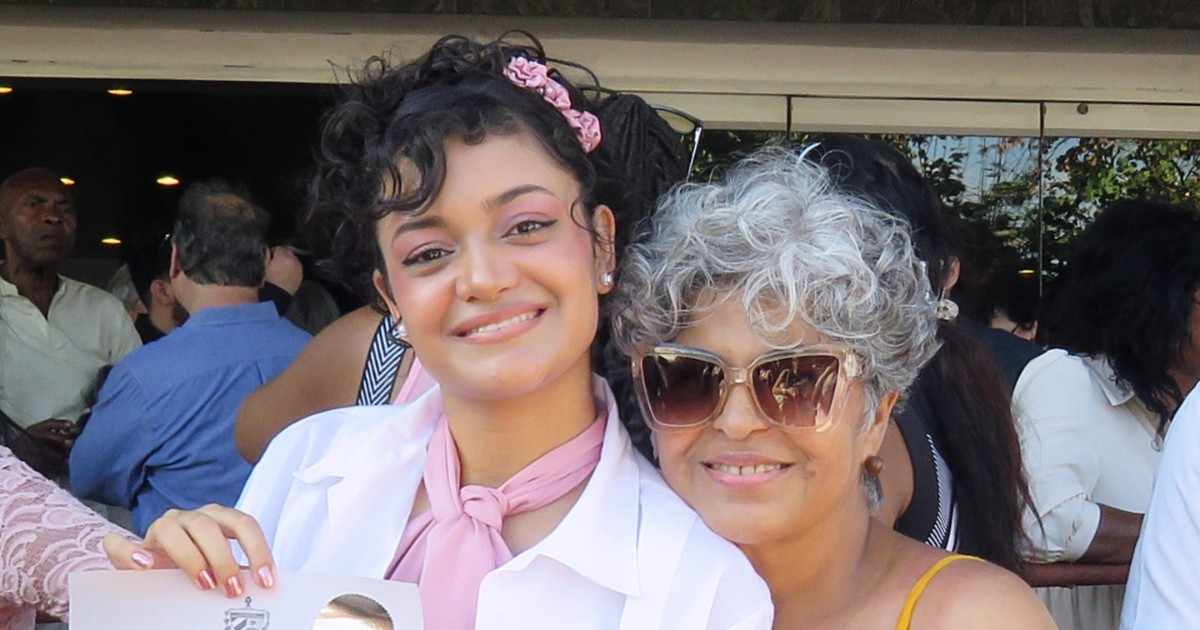
The Cuban court confirmed that the activist Anna Sofía Benítez Silvente, known as Anna Bensi, and her mother, Caridad Silvente, will be tried for recording and posting on social media the visit of a MININT agent to their home. Bensi herself announced this on her Facebook account this Tuesday, where she shared the official notification.
"The court has already confirmed that my mother and I will be brought to trial, accused of violating personal and family privacy. The complaint was allegedly filed by the police officer who considers himself aggrieved, and who appeared at our apartment on March 10 of this year to deliver a summons from State Security in my mother's name. In light of this situation, we decided to record and post the moment on social media as a measure for our safety," wrote the 21-year-old young woman.
The origin of the process dates back to March 10, when the MININT officer Yoel Leodán Rabaza Ramos went to their apartment to deliver a summons from State Security. Mother and daughter decided to document the moment and share it on social media as a protective measure, an action that the authorities turned into the basis for a criminal charge.
The accusations are based on Article 393 of the Cuban Penal Code, which classifies "acts against personal and family privacy" with penalties ranging from two to five years in prison.
The case had an initial closure in April: the defense attorney Roberto Ortega Ortiz managed to have it dismissed by arguing that this crime can only be pursued through a direct complaint from the victim, not by police report. However, the agent Rabaza Ramos filed a direct complaint in July, which reactivated the process and invalidated the defense's argument.
Since March 25, Anna Bensi and her mother have been under house arrest with a prohibition on leaving the country.
The harassment against the activist intensified in early July when she was held for almost 11 hours at the Alamar station of the National Revolutionary Police. As she recounted, the aim was to prevent her from attending the celebration of the United States Independence Day at the residence of the U.S. chargé d'affaires, Mike Hammer. "They released me at nine o'clock at night as if to say, 'We are sure you won't be able to go.' A total injustice," she declared after being freed.
During that interrogation, an instructor from the Revolutionary National Police confronted her directly: "In your videos, you have incited, and if that incitement comes to fruition, you are committing a crime, and we will imprison you." Summarizing what happened, Bensi was straightforward: "In the end, the interrogation can be summed up as shut up or create different content."
The organization Cubalex has asserted that filming public officials while they are carrying out their duties does not constitute a crime, but rather a citizen right recognized by the Cuban Constitution of 2019. The case transcended the borders of the Island and was reported by international media, including the Spanish newspaper El Mundo. Hammer described the situation of Bensi and other activists who were prevented from attending the July 4th event as "unacceptable."
Anna Bensi is a member of the youth collective Fuera de la Caja Cuba, founded in early 2026 in El Cerro, Havana, which brings together young people who use art, theater, and social media to challenge state indoctrination. Last May, Marco Rubio sent messages of support to the activist and the members of the collective.
Caridad Silvente, far from being intimidated, summarized the position of both after the detention in July: "I feel stronger to pursue this. This demonstrates that they are a dictatorship, a regime that tries to overshadow, that tries to silence reality."
Related videos:
Filed under: