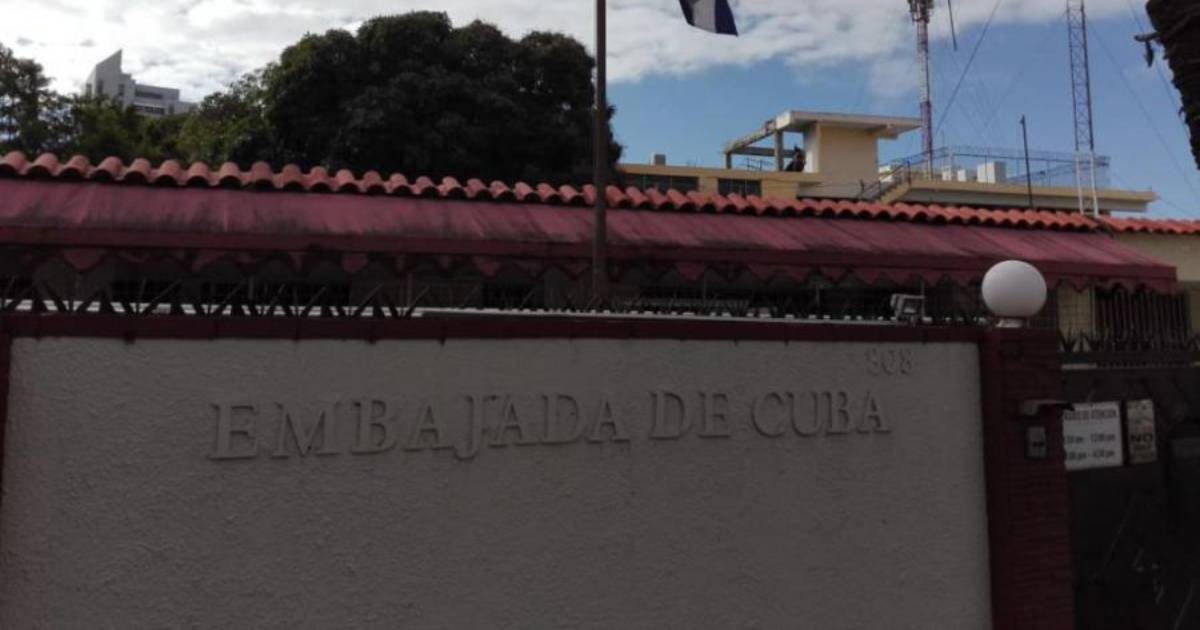
The Ministry of Foreign Affairs of the Dominican Republic confirmed this Thursday that nine members of the Cuban diplomatic mission in Santo Domingo must leave the country along with their families, a measure that deepens the noticeable cooling of relations between the two governments.
The Dominican Foreign Ministry announced in an official statement that the officials have a period of seven days to leave the national territory, although it refrained from disclosing the reasons behind the decision.
According to the Dominican newspaper Listín Diario, the measure affects a total of around 21 individuals, including nine members of the Cuban mission and their family members. The deadline communicated to the officials expires on Sunday, August 16.
Santo Domingo based its decision on the powers recognized by international law to the receiving State, and specifically on Article 9 of the Vienna Convention on Diplomatic Relations, which allows a host country to declare any member of a diplomatic mission persona non grata without being required to explain the reasons.
The Foreign Ministry made it clear that it will not publicly disclose the circumstances that led to the adoption of the measure.
"The Dominican government adheres to current regulations and will continue to handle this matter with due discretion and through established diplomatic channels, in order to preserve the relations between both countries. As it involves diplomatic communications, we inform you that no additional details will be provided on this topic," it stated.
Although the authorities did not explain what prompted the decision, it comes amid growing signs of a rift between Santo Domingo and Havana during the presidency of Luis Abinader.
In October 2025, the Dominican Republic excluded Cuba, Nicaragua, and Venezuela from the X Summit of the Americas planned in Punta Cana. The meeting was canceled weeks later and rescheduled for 2026.
Abinader himself publicly hardened his stance on the Cuban political system in May of this year when he stated in an interview with journalist Eduardo Feinmann for Infobae: “They have their own way of holding elections, but it is not a democratic state”.
Another significant change occurred in July, when The Dominican Republic abstained in the voting of the United Nations General Assembly on the U.S. embargo against Cuba. This stance contrasted with that taken in October 2025, when Santo Domingo had supported, along with 165 other countries, the resolution against the sanctions.
The diplomatic isolation of Havana in the region is growing
The Dominican episode adds to a series of significant diplomatic setbacks faced by the Cuban regime in Latin America during 2026.
In March, Ecuador ordered the departure of all Cuban diplomatic personnel in Quito, allowing only 48 hours to leave the country. Havana responded by closing its embassy in the Ecuadorian capital and described the decision as "unfriendly and unprecedented."
That same month, Costa Rica closed its embassy in Havana and requested the Cuban regime to withdraw its staff from San José, amid criticism over the deterioration of human rights on the island.
More recently, the government of Abelardo de la Espriella in Colombia moved forward with the break in diplomatic relations with Cuba and Nicaragua as part of a broader plan to reorganize its foreign presence, which includes the closure of 14 embassies and 15 consulates. De la Espriella assumed the Colombian presidency on August 7th.
In response to previous episodes of regional distancing, the Cuban regime has described the decisions as "arbitrary" and "unjustified," attributing them to pressures from the United States.
The measure now adopted by the Dominican Republic is particularly significant due to the traditional relationship between the two countries and because Santo Domingo has left the diplomatic channel open. However, it has expressly referred to an international provision that allows it to demand the departure of members of a mission without disclosing the reasons.
At the close of this report, the Ministry of Foreign Affairs of Cuba (MINREX) had not issued any official statement regarding the Dominican decision or the departure of its nine officials and their families.
Related videos:
Filed under: