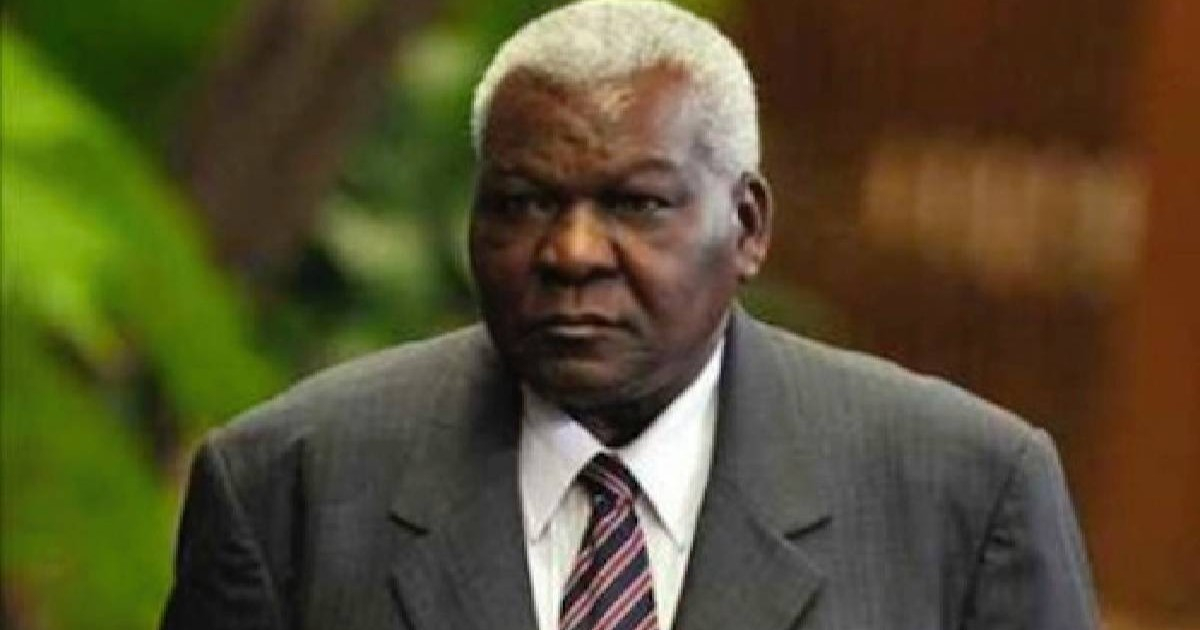
Esteban Lazo Hernández, president of the National Assembly of People’s Power in Cuba, delivered a speech on Wednesday at the forum "Fidel and Parliamentary Diplomacy," in which he stated that "Cuba has never engaged in any act of aggression against the people of the United States."
"From Cuba, there has never been an act of aggression against the people of the United States," Lazo stated before fellow members of the Political Bureau Bruno Rodríguez Parrilla, the Minister of Foreign Affairs, and Teresa Amarelle Boué, the General Secretary of the Federation of Cuban Women, as reported by the official digital newspaper Victoria.
The leader described the militarization of the Caribbean as "gross evidence" of Washington's interventionism, attributing it to the Monroe Doctrine and "the adaptation of it by the government of Donald Trump."
The event was part of the third and final day of the I International Colloquium “Fidel: Legacy and Future,” held at the Convention Palace in Havana from August 10 to 13 to commemorate the centenary of Fidel Castro's birth, an event that brought together more than a thousand foreigners from 63 countries.
The regime's statements come at a time of heightened bilateral tension: Trump reinstated Cuba on the list of state sponsors of terrorism on January 20, 2025, the first day of his return to the White House, reversing a decision made by the Biden administration.
Since then, Washington has implemented more than 240 additional sanctions against the Island and deployed the aircraft carrier USS Nimitz along with over 1,300 marines in the Caribbean under the operation named Southern Spear.
The Secretary of Defense Pete Hegseth invoked the Monroe Doctrine to warn Havana against acquiring weaponry capable of reaching U.S. territory or bases, while in June, Secretary of State Marco Rubio reaffirmed before the Senate that Cuba remains on the list of state sponsors of terrorism due to its alleged support for the ELN and FARC, and for harboring Chinese and Russian intelligence bases.
Faced with that pressure, the regime activated the "Year of Preparation for Defense 2026" and conducted exercises in the doctrine of the "people's war".
In his speech, Lazo also rejected Cuba's designation as a state sponsor of terrorism: "Cuba is not a threat to the United States and its national security, Cuba is not a state sponsor of terrorism," he emphasized.
The leader recalled that Latin America and the Caribbean were declared a zone of peace in January 2014 during the II Summit of CELAC held in Havana, and urged the world's parliamentarians to "multiply calls for peaceful coexistence in parliamentary settings," so that "force does not prevail over the right to life, security, and health."
Lazo also supported the proposals made by Miguel Díaz-Canel during the opening session of the colloquium —to address problems with the truth, build effective networks, and develop critical thinking— and advocated for the continuity of the Cuban political system as "a constitutional decision to continue the construction of a socialist society."
The seminar, which this Thursday coincides exactly with the centenary of Castro's birth, concluded its sessions with debates on information technology, political economy, development models, religion, and cultural heritage.
Related videos:
Filed under: