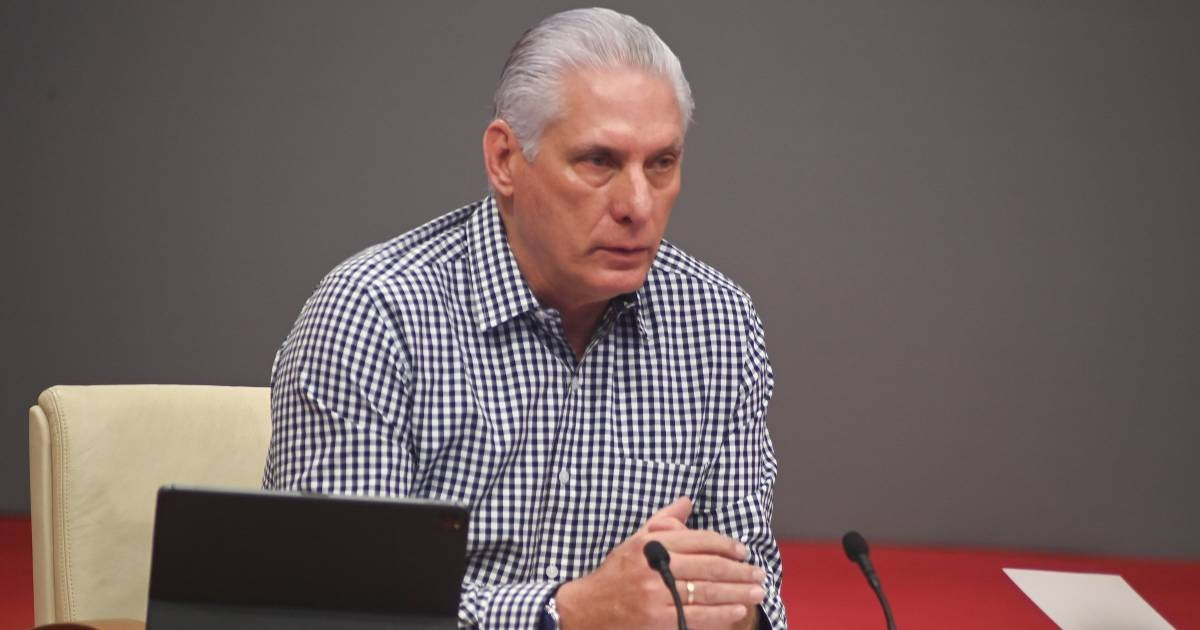
While Cuba has experienced seven nationwide blackouts so far in 2026 and the population endures power cuts of up to 20 hours daily, Miguel Díaz-Canel inaugurated this Monday the I International Colloquium "Fidel: legacy and future" with a message that encapsulates his strategy in the face of the worst crisis in decades: to return to the thought of Fidel Castro as a guide to overcome the collapse.
In his keynote address before more than 1,500 delegates from 63 countries gathered at the Convention Palace in Havana, the Cuban leader acknowledged that the country is experiencing "one of the most difficult moments" of the Revolution in its 67-year history, but dismissed any ideological shift.
The event, which runs until August 13 —the date marking the centenary of Castro's birth—, also featured the presence of the President of the National Assembly, Esteban Lazo, Prime Minister Manuel Marrero, and Roberto Morales Ojeda.
Díaz-Canel stated that the legacy of the historical leader of the Revolution is not a catalog of phrases, but a method of action: "Fidel did not leave recipes; he left a method," he affirmed, and called for its application to confront the current crisis based on the analysis of reality, clear political objectives, popular mobilization, and adaptation to adverse circumstances.
"Saving the Cuban Revolution from one of the most serious threats it has faced in 67 years, amidst all kinds of aggression, is the greatest challenge of our generation," he stated, although he attributed the problems to the U.S. embargo and what he termed "imperial hostility," avoiding responsibility for the economic model managed by the regime itself.
The appeal to the centenary of Castro comes at a time when Cuba has experienced six collapses of its electrical system in 2026, along with a severe shortage of fuel, food, and medicine. This same Monday, the UNE estimated an availability of only 1,000 MW compared to a peak demand of 3,250 MW.
Díaz-Canel himself had acknowledged in April that Cuba “absolutely lacks fuel for nearly everything”, and in June he admitted that the “creative resistance” is no longer enough to tackle the decline.
In July, he also acknowledged that the regime resorted to "capitalist practices" to preserve the system, and he promised to "unleash productive forces," although without abandoning state control of the socialist model.
In front of that backdrop, the government announced a package of 176 economic and social measures, but the central strategy that Díaz-Canel presented to the foreign delegates was ideological legitimization: to study Fidel "not as a repository of quotes," but as a practical compass.
The contrast between the event and the daily reality of Cubans did not go unnoticed: while over a thousand foreigners arrived in Havana to celebrate the centenary, the island's population endures prolonged blackouts and shortages of basic necessities.
The UN warned last May that the lack of oil supplies is worsening the humanitarian situation in Cuba, impacting the health, food, and drinking water sectors.
"The thought of Fidel is the most precise compass to face the storm that the Cuban people are experiencing," concluded Díaz-Canel before the delegates, a phrase that sums up the regime's approach: in the face of a crisis with no solution in sight, invoking the founder as the answer.
Related videos:
Filed under: