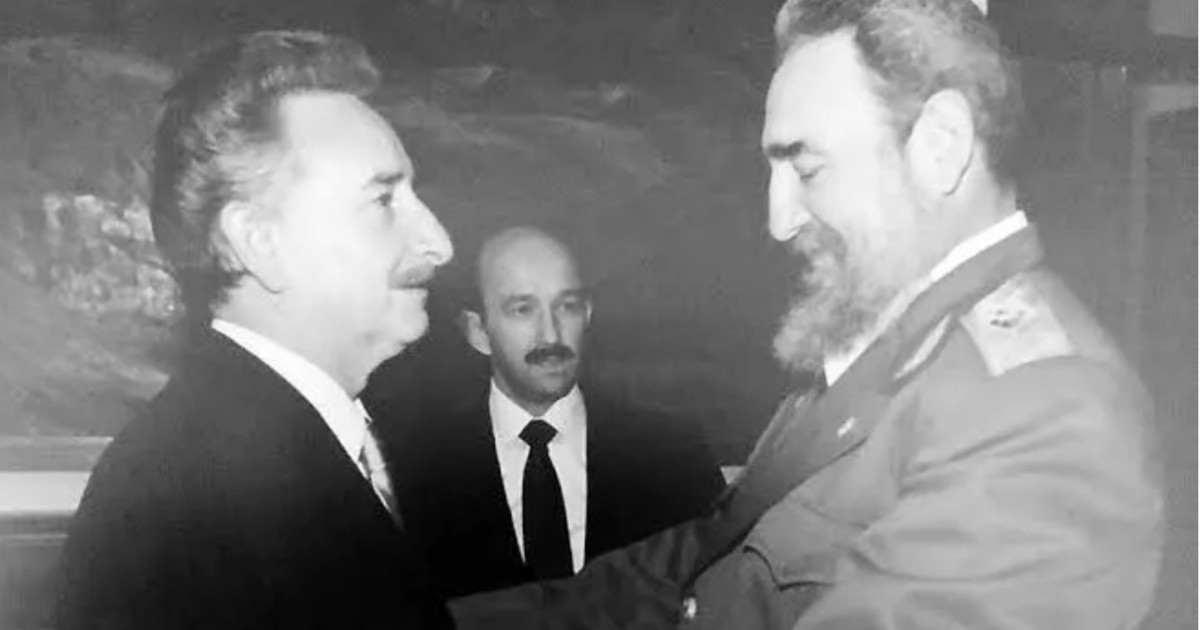
An analysis published by Joel Ortega Suárez in the Mexican magazine Siempre! on the occasion of Fidel Castro's centenary unpacks what the author refers to as "the perverse ties between Cuba and Mexico": a bilateral relationship that, according to the text, did not arise by chance but rather from decades of ideological affinity, shared material interests, and complicities in illegal activities.
"The ties between Cuba and Mexico are not a circumstantial or accidental bond. It is a connection that has been built, generated, and strengthened by a network of ideological relationships, worldviews, culture, and tradition," the analysis states, adding that alongside this deep articulation "there emerged a sovereignist perversion as an instrument for illegal practices in relation to international law."
The text takes the 1980s drug trafficking scandal as a paradigm case, when the Cuban regime facilitated the transit of cocaine from the Cártel de Medellín through Caribbean waters to the United States via the so-called MC group —Moneda Convertible— which also operated the trade of ivory and the sale of counterfeit artworks by Cuban artists such as Portocarrero.
When Washington pressured Fidel Castro to end that operation, the Cuban leader responded with a purge that analysis deems calculated: he sacrificed General Arnaldo Ochoa — hero of the Angola war — and the De la Guardia brothers as scapegoats, thus fulfilling his commitments to the United States while simultaneously eliminating potential internal rivals.
Ochoa had been recorded in Angola stating that it was time to introduce changes in Cuba, something Castro interpreted as a sign of sympathy towards Gorbachev's perestroika. "Fidel clearly chose Arnaldo Ochoa to be the scapegoat, offering his head to the Americans as proof of his genuine commitment to respecting the agreements," the text notes.
The trial, broadcast for weeks, was described as a "sham" in which the defendants were coerced through blackmail to plead guilty. "The so-called Moscow Trials of the 1920s pale in comparison to this staged farce," concludes the analysis. Ochoa and Antonio de la Guardia were executed on July 13, 1989, in what remains one of the most controversial episodes in Cuban history.
Regarding the Mexico-Cuba ties, the text highlights Fernando Gutiérrez Barrios, the historical head of the Federal Security Directorate, as a central figure on the Mexican side, and on the Cuban side, it points to Commander Manuel Piñeiro "Barbarroja" and former Minister of the Interior Ramiro Valdés. "This link was established through the most obscure relations between both states," the analysis states.
"Mexico has had from the beginning a brotherhood, let’s say ideological, cultural, and political, that connects the two revolutions, as has been stated for decades. The Mexican Revolution, or rather, its regime, is the product of the defeat of the popular forces in the great Revolution of 1910-1920, the longest political hegemony on the planet, exceeding in duration the Soviet, Chinese, Cuban, and others established in Algeria, Angola, the Congo, and elsewhere," the article states.
"All of that power network of Castro, extraterritorial, stemming from that Castroite obsession to be the Charlemagne of the contemporary era or Charles V, or rather the figure that Fidel preferred, which is Hannibal. The Cubans, in their delirious ambition to expand, to expand the Revolution as they saw it, carried out operations in Mexican territory such as bank robberies, jewelry heists, and kidnappings, in which the brother of Che Guevara himself was involved, benefiting from the impunity granted by the Mexican security and political intelligence led by Fernando Gutiérrez Barrios," he adds.
The text also addresses the present: it points to Raúl Guillermo Rodríguez Castro, "El Cangrejo" —grandson of Raúl Castro— as an operator in a human trafficking network that used Nicaragua as an entry point to facilitate a massive exodus of Cubans to the United States through Mexico. The New York Times linked "El Cangrejo" to a criminal network in Quintana Roo in a report published this month, although he has not been formally charged in the United States to date.
"Cuba has been a state that uses its power to carry out illegal operations, such as the previously mentioned relationship with the Colombian cartels and now also through the operation of human trafficking cartels," the analysis concludes, describing the Cuban exodus as something "orchestrated by the Cuban state."
Related videos:
Filed under: