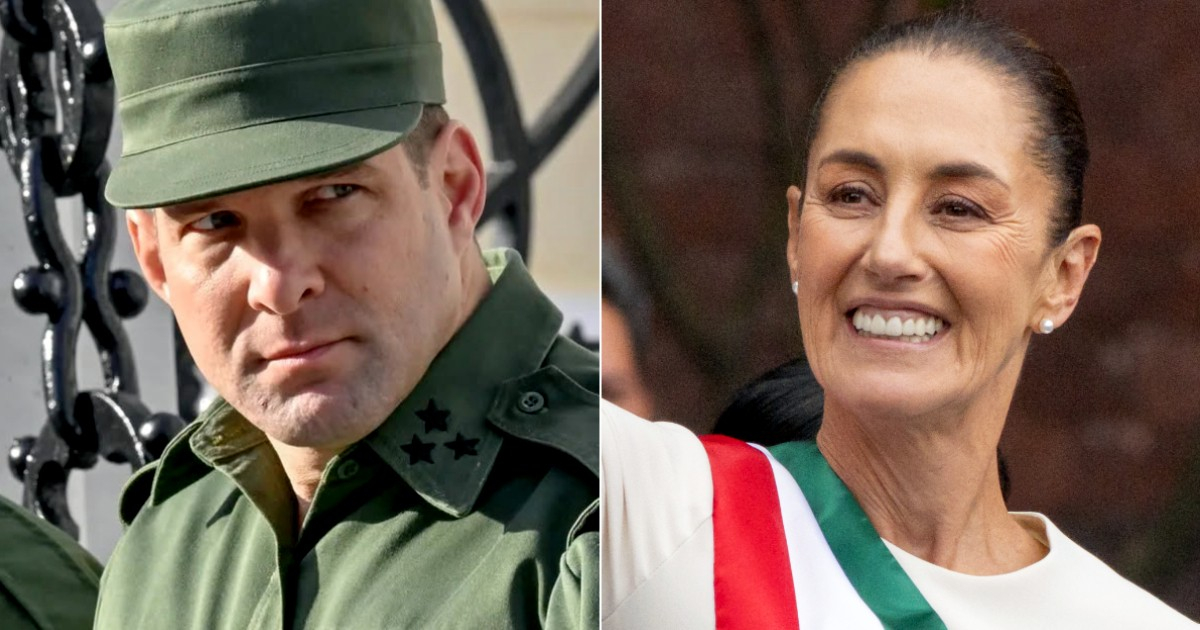
The Mexican Security Cabinet issued an official informational card on Tuesday stating that it has "no information or evidence" regarding the report from the New York Times linking Raúl Guillermo Rodríguez Castro, known as "El Cangrejo" and the grandson of Raúl Castro, to the so-called "Cuban Mafia of Quintana Roo."
The statement from the Security Cabinet, co-signed by the Secretariat of National Defense, the Secretariat of the Navy, the Attorney General's Office, the National Guard, and the Secretariat of Security and Citizen Protection, was published hours after the American newspaper released its investigation into the transnational criminal network.
The official text states that the Mexican government does not have data “regarding the allegations attributed to that news article, nor about the alleged links between criminal organizations and foreign officials, or their relatives.”
The mention of “relatives” of foreign officials is the only implicit reference to “El Cangrejo” —grandson of the former Cuban leader— without naming him at any point.
The statement concludes with a declaration of principles: "The Government of Mexico reaffirms its commitment to international cooperation in the fight against organized crime and human trafficking."
The Mexican government's evasive response contrasts sharply with the seriousness of the revelations from the Times. According to the New York Times investigation into the links of "El Cangrejo", the network operated for over a decade among Cuba, Mexico, Spain, and southern Florida, engaging in the trafficking of Cuban migrants, boat theft, extortion, and torture.
At least 25 people died during the journeys organized by the group, and Operation Sisyphus —a joint investigation by the FBI and the Department of Homeland Security— resulted in at least 21 convictions.
A man sentenced to 25 years in prison, José Miguel González Vidal, testified before U.S. authorities that El Cangrejo received bribes that included a boat, a Rolex watch, a motorcycle, and luxury clothing. Another convicted individual, Reynaldo Crespo Márquez, testified about a meeting where both discussed the shipment of a vessel to Cuba.
The Cuban regime rejected the accusations. The Deputy Minister of Foreign Affairs Carlos Fernández de Cossío described them as "slanders" and asserted that "there is no connection with the Cuban government."
The evasive tone of the Mexican government is striking in light of the brutal Cuban mafia whose plot shakes Quintana Roo and the close political alignment between the Morena government and the regime in Havana.
In 2025, Mexico sent Cuba 17.25 million barrels of oil and over 245 million liters of derived fuels. That same year, Morena and the Communist Party of Cuba signed a political cooperation agreement in Havana during a ceremony led by Miguel Díaz-Canel.
In 2026, under pressure from the Trump administration, Mexico halted oil shipments but dispatched at least five ships with more than 3,100 tons of humanitarian aid.
«El Cangrejo», a colonel in the Cuban Ministry of the Interior and head of the General Directorate of Personal Security since 2016, is not listed on any U.S. sanctions lists, which analysts interpret as a sign that Washington keeps him as an informal negotiation channel.
In May 2026, the CIA director, John Ratcliffe, traveled to Cuba and met with Rodríguez Castro along with the Minister of the Interior, Lázaro Álvarez Casas, and the head of intelligence, Ramón Romero Curbelo.
"Coincidentally" in April 2026, Mexican authorities arrested Remigio Valdez-Lao, 59 years old, identified as a key financier of the group, who is facing extradition to the United States.
Related videos:
Filed under: