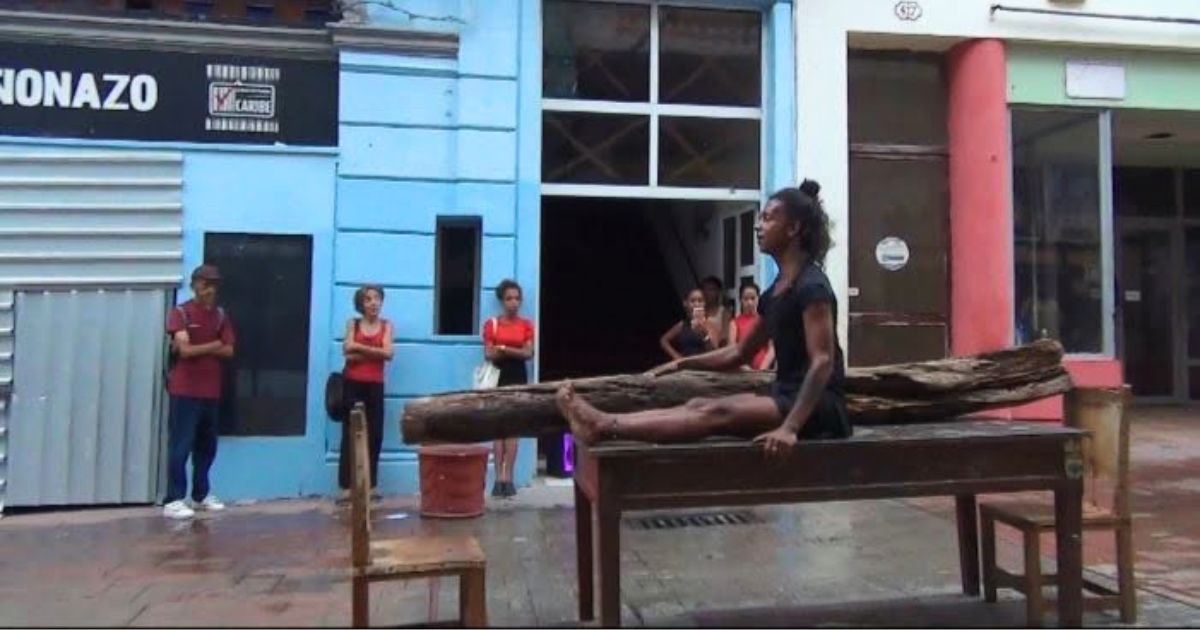
A street performance titled «Camille» burst onto the central Calle Enramadas in Santiago de Cuba, transforming one of the busiest streets in the country into a stage for art, reflection, and provocation for a few minutes, as noted in a post by independent journalist Yosmany Mayeta Labrada this Friday.
Behind the intervention is Yanoski Suarez Rodriguez, an artist and director of the AD Livintum Dance Company, born in Santiago de Cuba in 1980 and known for blending dance, performance, and theatricality in unconventional spaces.
The piece featured a young man dressed in black interacting with a heavy log placed on a table. His body fell to the ground, twisted, stood up again, and faced the object once more, while passersby paused to watch from the sidewalks and doorways along the street.
Suarez Rodriguez himself explained the meaning of the work on his social media: “It is a cry for that freedom to be, to fight for your principles, your ideals, and not to let others command your destiny.”
She also defined it as "a call to meditate on what holds us back and reduces us to being mere puppets within structures that only change in names and times." She also stated, in a comment on Mayeta's publication, that it is dedicated to the great French artist Camille Claudel (1864-1943) and "also to all of us."
The reviewed presentation was, according to the artist himself, the "second and final showcase for the public of the ongoing process of choreography and musical creation" of "Camille," whose music is by composer Roi Man. The invited artist, Glenis Giselle Díaz Luna, also participated; she is a second-year student at the Esteban Salas Conservatory of Music in Santiago de Cuba.
The project received support from several institutions: the Alliance Française of Santiago de Cuba, the Eje Platform, Escena Santiago de Cuba, Anier Limonta, and the Rosacruz AMORC Cultural Center of Guatemala.
Mayeta Labrada highlighted the political dimension of the artistic gesture: "The body subjected to weight, the fall, the struggle to rise, and the wood that seems to accompany or imprison it construct a powerful visual metaphor in themselves." She added, "Free art is also that: not telling the viewer what to think, but forcing them to think."
The Enramadas Street, whose layout dates back to 1603, is considered the longest historic pedestrian corridor in Cuba, stretching approximately 1.5 kilometers, and serves as one of the main commercial and cultural arteries of the city.
The context in which "Camille" is situated is significant. The Decree-Law 349, in effect since December 2018, prohibits artistic activities in public spaces without prior authorization from the Ministry of Culture and empowers authorities to suspend performances, impose fines, and confiscate materials. Organizations like Amnesty International have described it as a tool for criminalizing independent art in Cuba.
At the end of 2025, the Cultural Rights Observatory reported that 17 Cuban artists remained incarcerated and another 10 were serving sentences under restrictive regimes, totaling 27 creators punished by the State.
The definitive premiere of "Camille" is scheduled for the coming months, when the work completes its creation process.
Related videos:
Filed under: