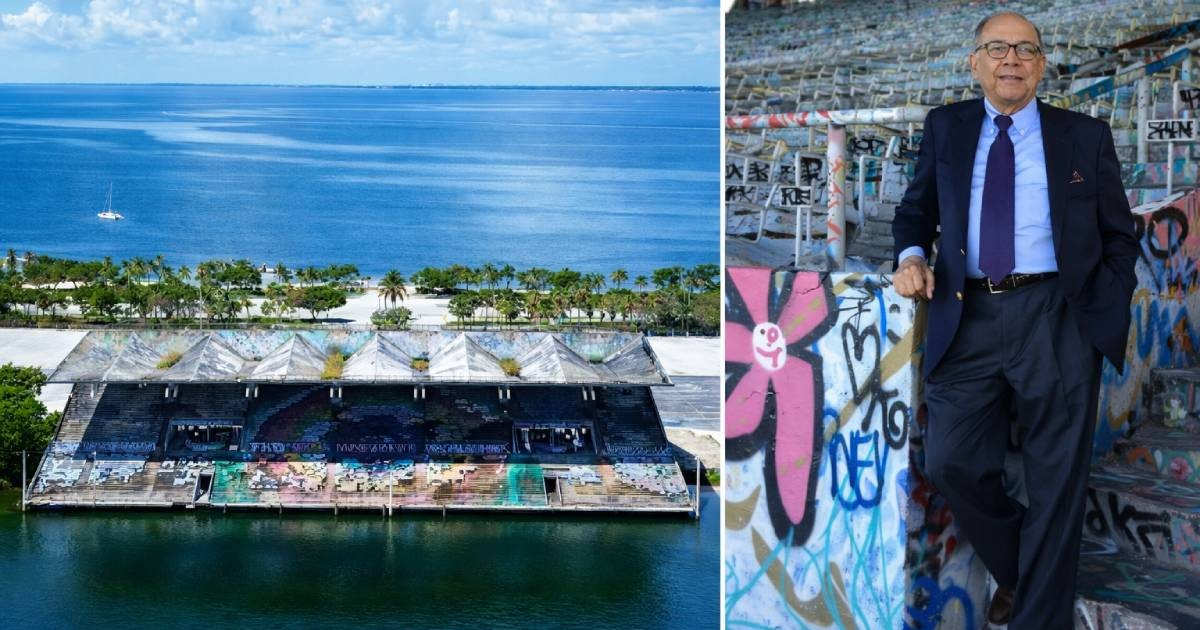
Miami voters must decide this Tuesday the future of the Miami Marine Stadium, the iconic venue located in Virginia Key that has been abandoned for over three decades and was designed by Hilario Candela, a Cuban refugee who arrived in the city fleeing the Revolution.
The referendum, held for a vote this Tuesday, determines whether the city can partner with a private company to restore the structure, regarded as a masterpiece of 20th-century brutalist architecture.
Hilario Candela was born in Havana in 1934 and fled Cuba in 1960. He was 27 years old and had just gone into exile when he conceived, from the firm Pancoast, Ferendino, Skeels and Burnham, a structure that defied all architectural logic. He created a stadium that faced the water rather than the land.
The result of their work was an innovative structure, featuring a cantilevered concrete roof of 99 meters without a single column to obstruct the view, the longest in the world at the time. The venue opened in December 1963 with a capacity of 6,500 people and quickly became the cultural and sporting heart of South Florida.
On its floating platform, Elvis Presley—whose movie Clambake was filmed there in 1967—, Gloria Estefan, Ray Charles, and Jimmy Buffett performed. In 1972, the stadium was the site of a rally for Richard Nixon, where Sammy Davis Jr. publicly accompanied him.
Hurricane Andrew in 1992 led to its closure, although subsequent engineering studies revealed that the structure did not sustain any real damage. Since then, the stadium has been fenced off and covered in graffiti, despite being listed on the National Register of Historic Places since 2018.
Candela dedicated his final years to advocating for the restoration of the stadium and passed away in January 2022, at the age of 87, without seeing his work restored.
In February of this year, the Miami City Commission unanimously approved the transfer of management of the venue to Global Spectrum L.P., a subsidiary of Oak View Group, with a renewable five-year contract lasting up to 40 years.
The agreement states that the city would receive 93% of the profits from events, 85% of the sponsorship revenue, and up to 10 million dollars to cover restoration costs, which are estimated to total between 65 and 85 million.
In July, Emi Guerra, co-founder of Breakwater Hospitality Group and associated with the selected consortium, compared the potential of the site to the Red Rocks Amphitheatre in Denver and emphasized that the city would retain full ownership of the stadium and the land.
Not everyone shares the enthusiasm. Ernesto Cuesta, president of the Brickell Homeowners Association, expressed concern about the noise, traffic, and environmental impact on residents across the bay, and would prefer that the area be transformed into a park with more green spaces.
The architect in charge of the restoration, Richard Heisenbottle, noted that the galvanized steel bars used in the original construction have protected the structure from severe deterioration and that the necessary documents for the work have already been approved by the city.
The commissioner Damian Pardo summarized the historical significance of the place: “It encapsulated an incredibly unique era of Miami with an extraordinary history that connects with all the city's residents.”
Related videos:
Filed under: