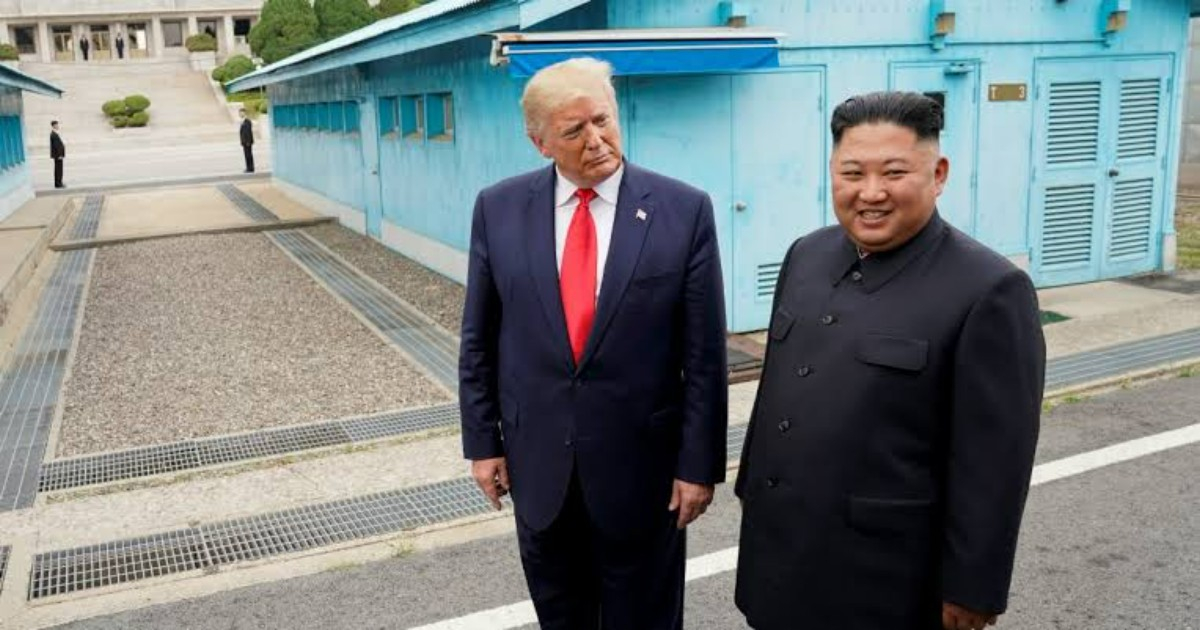
Donald Trump announced this Sunday that he instructed the Secretary of War, Pete Hegseth, to “substantially” reduce joint military exercises between the United States and South Korea, citing his “very good relationship with Kim Jong-un” as the central argument for the decision.
The Republican leader shared the announcement through his Truth Social network, one day before the scheduled start of the Ulchi Freedom Shield exercises, set to take place from August 17 to 27 with the participation of about 18,000 South Korean soldiers and a focus on modern threats such as drones, GPS signal interference, and cyberattacks.
In his post, Trump argued that such maneuvers "send a completely inappropriate and hostile signal to a country that, since Donald J. Trump has been president, has not been threatening and has shown respect."
The president also noted that the United States bears "a large portion" of the cost of the "expensive" exercises, an argument he had already put forward during his first term to justify similar decisions.
The measure took Seoul by surprise, as it had not been consulted, and historically, it views these maneuvers as essential for maintaining joint operational readiness with Washington.
The announcement comes at a time of tension on the Korean Peninsula: North Korea launched two ballistic missiles in recent days—the first on August 6 from the Wonsan area toward the Sea of Japan, and the second on August 12, which traveled over 700 kilometers before falling into the sea—and had warned that it would respond with "a new level of deterrence" to the maneuvers.
Trump also took the opportunity to reveal a diplomatic friction with Seoul: he stated that he asked the South Korean government if they wanted to join Washington's efforts for the denuclearization of Iran, and their response was "No, thank you."
The decision follows the pattern of Trump's first term: in June 2018, after the summit in Singapore with Kim, the then president suspended key exercises such as Freedom Guardian, labeling them as "provocative" and "very costly," raising concerns among allies and within the Pentagon itself. The denuclearization negotiations failed, and the maneuvers resumed some time later.
In his second term, Trump had resumed a conciliatory tone with Pyongyang since February 2025, when he announced his intention to engage with North Korea and stated that he got along "very well" with Kim Jong-un.
The reduction of the Ulchi Freedom Shield exercises is interpreted as a new strategy by Trump to use military maneuvers as a diplomatic bargaining chip with Pyongyang, which could be the prelude to a new round of negotiations with the North Korean regime.
Related videos:
Filed under: