Donald Trump stated this Monday from the Oval Office that Kim Jong-un responded to the messages of dialogue he has sent and that the exchanges between them are "very positive".
When asked why the North Korean leader had not responded publicly, Trump simply said that "he has," without providing details about the content or channel of those communications.
The statements continue a series of diplomatic gestures that began over the weekend, when Trump ordered to reduce joint military exercises with South Korea by instructing Secretary of Defense, Pete Hegseth, to cut them "substantially."
On his platform Truth Social, Trump argued that such maneuvers "send a completely inappropriate and hostile signal to a country that, since Donald J. Trump has been president, has not been threatening and has shown respect."
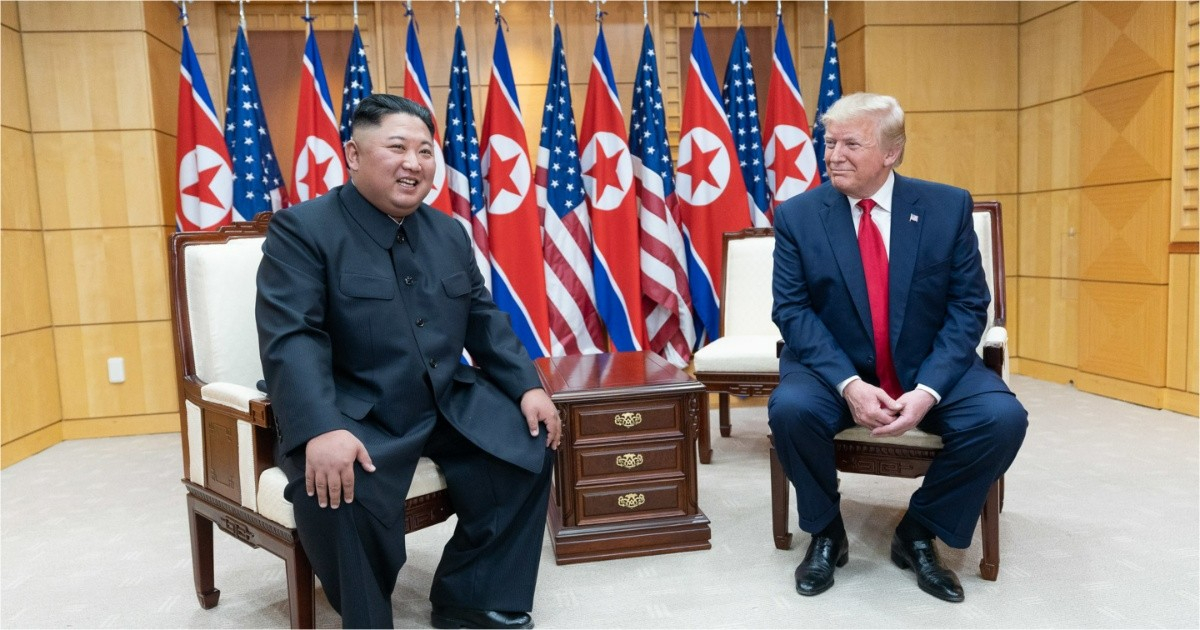
The day before, the president had posted an archive photo of his meeting with Kim in Panmunjom—dated June 30, 2019—accompanied by the message that, despite the "unfriendly gesture" of the image, both leaders "get along wonderfully."
The exercises affected are the Ulchi Freedom Shield, scheduled between this Monday and August 27, with participation from approximately 18,000 South Korean soldiers and scenarios focused on modern threats such as drones, GPS jamming, and cyberattacks.
Despite Trump's order, the South Korean Ministry of Defense stated that the exercises would continue as planned, although the number of field maneuvers was reduced from 17 in 2025 to 14 this year.
The decision took Seoul by surprise, as it was not consulted beforehand. Trump also took the opportunity to reveal a diplomatic friction with the South Korean government: he claimed to have asked whether they wanted to join the efforts for Iran's denuclearization, and that the response was "No, thanks."
The immediate context is one of heightened tension on the peninsula. North Korea launched two ballistic missiles in August: the first on August 6 from the Wonsan area towards the Sea of Japan, and the second on August 12, which traveled over 700 kilometers before falling into the sea. Pyongyang also warned that it would respond with "a new level of deterrence" in light of the joint exercises.
Trump's strategy mirrors a pattern from his first term. Following the Singapore summit in June 2018—the first between a sitting U.S. president and a North Korean leader—he canceled key military exercises, labeling them "provocative" and "very costly." The denuclearization negotiations subsequently failed at the Hanoi summit in February 2019, and the maneuvers resumed shortly after.
In his second term, Trump had adopted a conciliatory tone since February 2025, when he announced his intention to reach out to North Korea and stated that he got along "very well" with Kim Jong-un in a press conference alongside Japanese Prime Minister Shigeru Ishiba.
The South Korean presidency, for its part, expressed hope that the good relationship between Trump and Kim would lead to "meaningful dialogue" aimed at peace and stability on the Korean Peninsula.
Related videos:
Filed under: