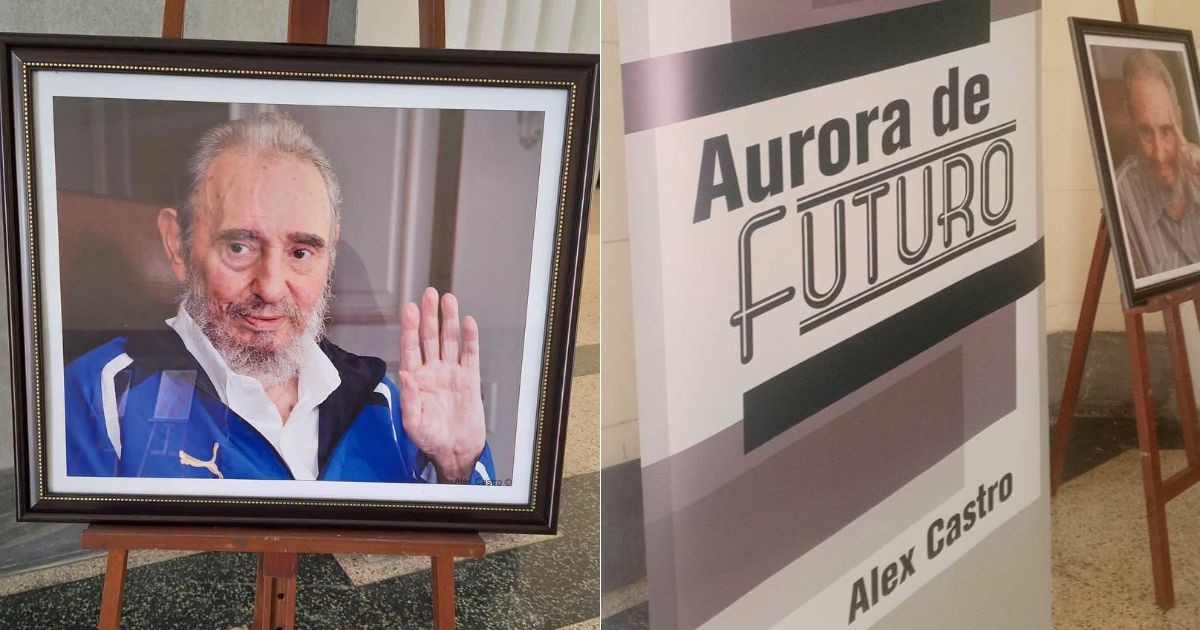
The University of Havana inaugurated this week the photographic exhibition "Aurora de Future," by Álex Castro Soto del Valle, son of the dictator Fidel Castro, as part of the official agenda of tributes for the centenary of the birth of the late leader, celebrated on August 13, 1926.
The exhibition, consisting of 20 photographs taken by Álex Castro during his father's final years, was presented in the institution's Aula Magna. The inaugural event was led by Dr. C. José Antonio Baujín, who took the opportunity to deliver a speech of epic proportions —or epically ridiculous, depending on one's perspective— in honor of the man who ruled Cuba with an iron fist for nearly five decades.
Baujín began with textbook philosophy: "Every authentic leader is accompanied by an iconography that not only represents them but also constructs them. [...] Fidel is both one and many." However, the speaker escalated his rhetoric. He described the dictator as "the accused accuser of '53," "the bearded insurgent of the Sierra, victorious in his final entry into the capital, with a white dove on his shoulder like a laurel crown," and, to leave no doubt, proclaimed him "one of the most important figures in Contemporary History."
He also didn't overlook the concept of natural law. He acknowledged that "the life cycle of a leader typically follows natural law: emergence, rise, and decline," but he was quick to clarify that Fidel was not subject to those earthly limitations: "Disobedient to the annulment of norms, old age and illness also failed to bring about his downfall." A man above time, biology, and apparently, also reality.
The speaker described the images as an intimate portrait: "Free from marble pedestals, distant from a divine halo, the images humanize the subject, perhaps from a more intimate perspective and, if that's possible when talking about Fidel, even closer and more honest." The unintentional irony of humanizing someone while denying them the opportunity to decline is undoubtedly one of the great rhetorical achievements of the event.
The photographs depict Fidel Castro alongside students, scientists, and intellectuals, "happy with Chávez, complicit with Raúl," according to Baujín himself, who also noted that "Fidel never just sees; Fidel looks, devouring the world with the depth of his gaze." Supernatural powers, it seems.
The climax came at the end, with a phrase that blends revolutionary epic and equestrian metaphor: "Like in the grateful song, in front of the caravan that we all make up, ready for the charge, Fidel, the horse is waiting for you." The allusion refers to "Riding with Fidel," the song composed by Raúl Torres after the death of the Cuban dictator in 2016, whose lyrics precisely evoke the image of a caravan led by a horse without a rider destined for Fidel Castro.
It is not the first time that Álex Castro has showcased his work during the tributes to Fidel. In August 2025, he inaugurated the exhibition "All the Glory of the World" at the José Martí Memorial, featuring 50 photographs. The photographer is also known for referring to the protesters from July 11 as "delinquents" on Facebook in January 2022, when the prosecution acknowledged 790 people facing charges.
The exhibition is part of a series of tributes organized by the regime throughout 2026, declared the "Year of the Century of Commander in Chief Fidel Castro Ruz," which included the First International Colloquium "Fidel: Legacy and Future" with over 1,500 delegates from 63 countries. All this while electrical outages frequently exceed 2,000 MW, with blackouts lasting more than 20 hours daily in Havana and a record of over 80 hours in Matanzas.
This Sunday, the government announced a maximum expected impact of 2,193 MW. The horse waits. The Cuban people do too, but without electricity.
Related videos:
Filed under: