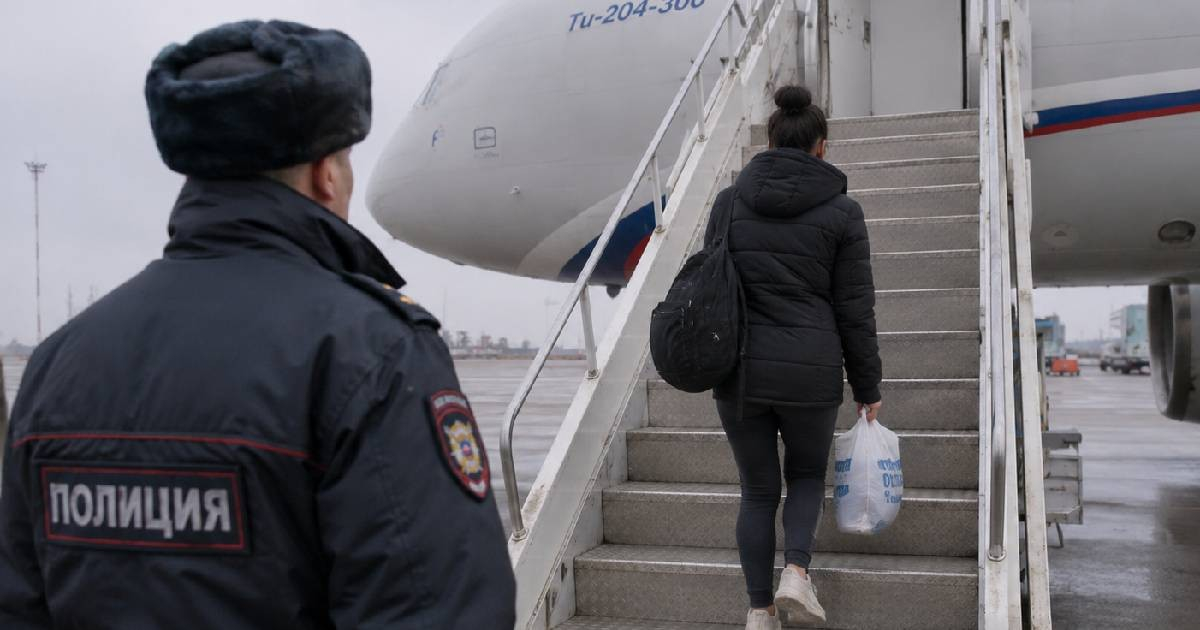
Yalina González Morales, a 29-year-old Cuban native of Mayabeque, boarded a plane under police custody in Russia, believing she was returning to Cuba.
The Russian authorities had promised it after holding her for months in a detention center; but upon landing, she was not in Havana but in Tashkent, the capital of Uzbekistan, over 11,000 kilometers from the Island, according to a report by Cubanet published on August 14.
According to the article, Yalina was unable to check the ticket or learn about the route: she was escorted to the airport and handed directly to the crew. It was only after passing through Uzbek border control and retrieving her passport that she understood what had happened.
"They told us we were going straight to Cuba. It was all a lie, it was all a deception," he reported.
The young woman and her husband, Ronniel, had left Cuba on April 6, 2025, heading to Russia, taking advantage of the visa-free agreement between the two countries that allows stays of up to 90 days without a visa.
Like thousands of Cubans driven by the economic crisis, they chose that route because it is relatively accessible, even though the agreement does not authorize them to work nor guarantee their stay once the deadline has passed.
The couple found employment in Kolomna, a city located about 100 kilometers southeast of Moscow, with a company identified as Progress Service. For about 10 months, they cleaned streets, collected garbage, and removed ice in winter.
"They make you do too much physical work. They pay below the minimum wage and exploit you excessively," Yalina recounted. Eleven people shared a two-bedroom home, for which the couple paid around 300 dollars a month.
On April 27, the police detained them. They spent three nights in a police facility sleeping on the floor and without regular access to water or food, before being transferred to a deportation center where they stayed for nearly three months. The total period in custody extended to about four months.
When Yalina was finally released, no one explained to her why Uzbekistan had been the chosen destination or what the entry conditions were. Her husband Ronniel remained detained in Russia, and as of the publication date of the report, she had no accurate information about his situation.
In Uzbekistan, the authorities warned her that she could only stay for a month. After that period, she fears being detained and sent to another country, possibly Tajikistan. "We have to live in hiding because this country has its laws, and we are not citizens here. If we don't have registration, the police can detain us and impose extremely high fines," she explained.
Returning to Cuba is not an option within reach. There are no direct flights between Tashkent and Havana; the only available route involves flying with Turkish Airlines with a layover in Istanbul, a journey that can exceed 18 hours. A fare inquiry conducted on August 11 found that a one-way ticket ranged from $1,310 to $1,703, an amount that neither she nor her family on the Island can afford.
Yalina's case is not isolated. Other Cubans expelled from Russia were also sent to Uzbekistan and remain dispersed, some without resources or shelter. They have created a Telegram group to stay in touch.
According to international media, at least 19 Cuban citizens were deported from various regions in Russia during 2025 for immigration violations, although the actual number could be significantly higher.
The phenomenon is part of a gradual tightening of Russian immigration policy. In July 2026, Russia introduced new rules that allow only 15 days for foreigners who lose their jobs or do not meet the minimum income requirement to leave the territory.
During 2025, 24,683 Cuban citizens crossed the Russian border, according to statistics from the FSB Border Service released by the TASS agency.
Related videos:
Filed under: