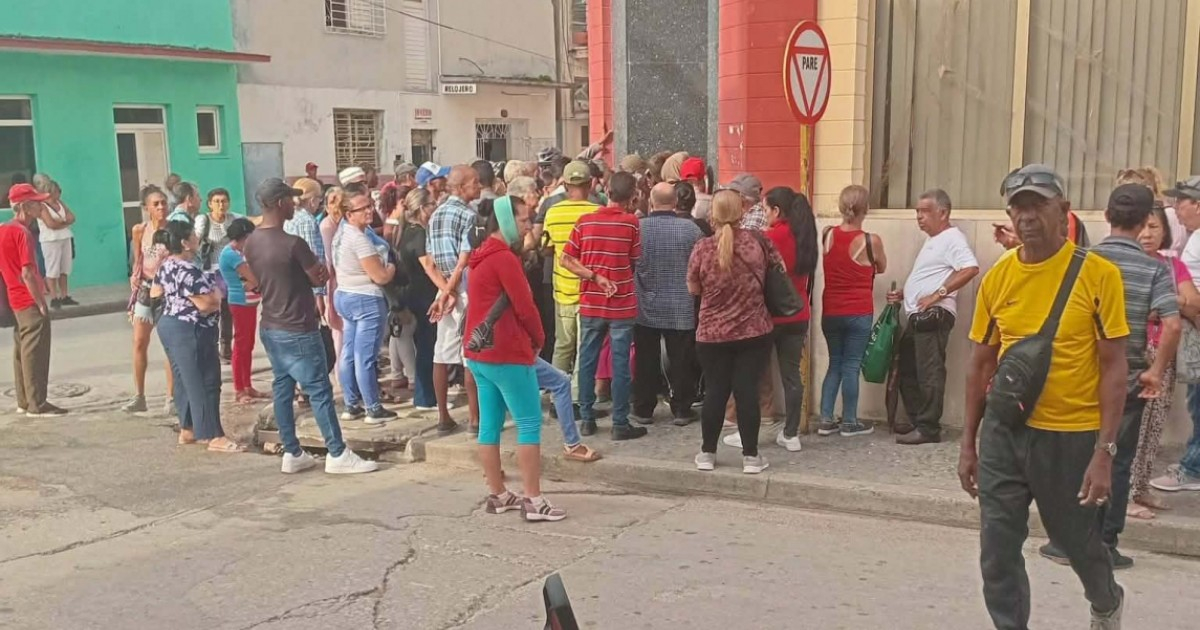
The Cuban writer Manuel García Verdecia reported this Tuesday on Facebook about the situation faced every month by retirees in Holguín when trying to collect their pensions: long lines of dozens of people outside bank branches and, for those who rely on postal offices, the inability to collect their funds because the money simply did not arrive.
"The retirees who collect their payments at the post office were unable to do so because... the money has not been deposited. The banks... well, as always, a sea of despair," wrote García Verdecia.
The publication, titled "PAYDAY," is accompanied by photographs that depict crowds of dozens of people in front of branches of BANDEC (Bank of Credit and Commerce) and the Popular Savings Bank in the city.
The images show elderly individuals mingling with people of other ages under the sun, with concern and fatigue written on their faces.
The writer concluded his statement with a question that encapsulates the accumulated outrage: "Is there any official who is concerned about this cycle that repeats itself every month, sowing anxiety and bewilderment?"
The scene is not exceptional. It is the monthly snapshot of over 1.7 million Cuban retirees trying to access a minimum pension of 4,000 Cuban pesos—less than 10 dollars at the informal exchange rate prevailing in 2026—while the cost of the basic basket ranges between 12,000 and 30,000 pesos per person.
On the same Tuesday, the Banco Popular de Ahorro in Sierra de Cubitas, Camagüey, had been closed for several days, leaving elderly individuals without access to their pensions.
In Santiago de Cuba, some branches can only serve about 50 retirees per day, forcing many to line up from six in the evening the day before.
The collapse of the Cuban banking system has been worsening for months. In May, more than 50% of the country's ATMs were out of service or empty. Banks operate with reduced hours—in Camagüey, from 9:00 AM to 1:00 PM, Monday to Friday—and power outages frequently disrupt customer service.
In April, retirees in Havana described it as a "miracle" to be able to cash their pension amidst pushes and chaos in the bank branches.
The regime has acknowledged the problem in a fragmented manner.
In June, the authorities of Granma admitted that they did not have the more than 400 million pesos necessary to pay their over 111,000 retirees that month. In an emergency response, in July the Central Bank expanded the "Extra Cash" scheme, through which private businesses and small and medium-sized enterprises pay pensions with their own cash and receive state compensation within a period of up to 72 hours, a mechanism that economists have questioned due to its risks and limitations.
In February, the Minister of Finance and Prices, Vladimir Regueiro Ale, promised that pension payments were "guaranteed in the budget", although he admitted that the system faced "significant challenges." The reality documented month by month on the streets of Cuba contradicts that promise.
The crisis has also created opportunities for corruption: in Ciego de Ávila, a postal worker was sentenced to four years in prison for telling retirees that "there was no cash" while misappropriating their funds.
In San Luis, Pinar del Río, the theft of over three million pesos allocated for pensions left more than 1,110 retirees without payment at the beginning of June.
Related videos:
Filed under: