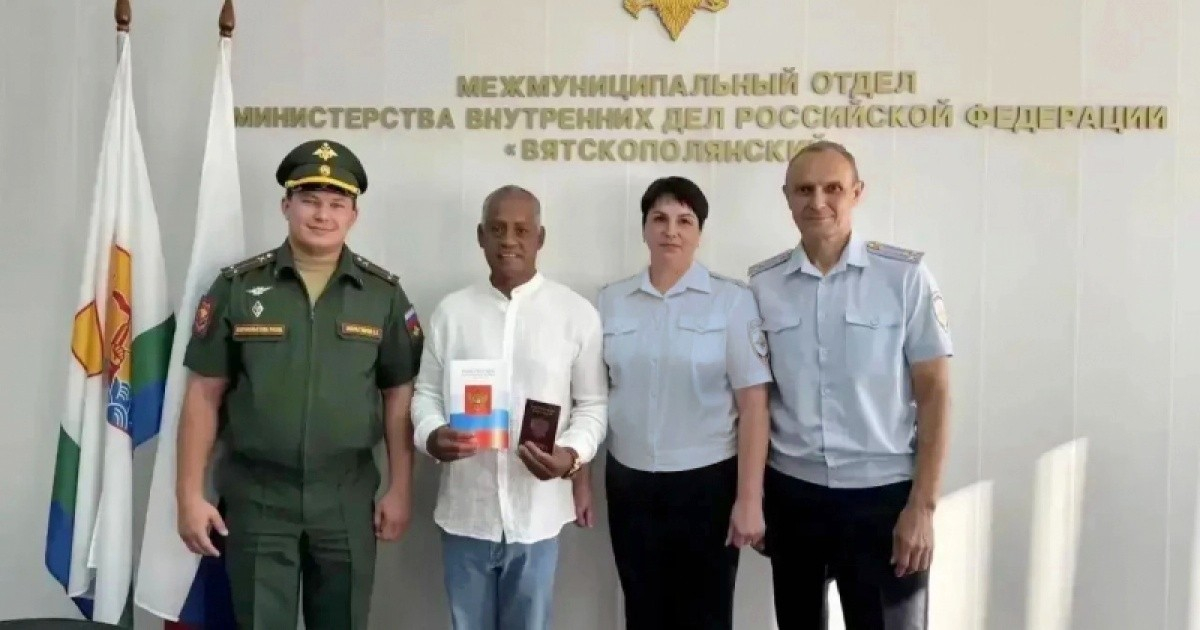
Ernesto Villarino Trujillo, a Cuban citizen who fought in the Ukrainian region of Lugansk, received his Russian passport at an official ceremony held in the city of Vyatskie Polyany, located in the Kirov region.
The news was reported by Russian media on August 18 and highlights how Moscow is using accelerated naturalization as an incentive to attract foreign fighters to its war against Ukraine.
The ceremony and the details of the case
Villarino Trujillo was part of a unit described by Russian authorities as "voluntary," deployed in Lugansk between December 2024 and June 2025.
The passport was handed over to him by Colonel of Police Serguéi Ulánov, head of the Ministry of Internal Affairs department in Vyatskie Polyany, at an event also attended by the head of Migration, Svetlana Aleksándrova, and the military commissioner for the districts of Vyatskie Polyany and Malmyzh, Salávat Ibragímov.
The news was first reported on August 6 by the local police office of Vyatskie Polyany and was amplified nearly two weeks later by the regional Directorate of the Ministry of Interior.
Russian publications did not specify the age, rank, duties, unit, or circumstances of the Cuban's recruitment.
During the event, Villarino Trujillo promised to uphold Russian laws, defend the freedom and independence of the country, and respect its culture, history, and traditions.
The police indicated that the new citizen thanked the officials for their efforts, although no direct statements from him were disclosed.
The legal path that opens the door to citizenship
Naturalization was based on Article 17 of the Federal Law on Citizenship of the Russian Federation, which allows foreigners recognized as combat veterans to apply for citizenship without meeting the three general requirements: five years of permanent residency, proficiency in the Russian language, and knowledge of the country’s history and legislation.
This mechanism was reinforced by Presidential Decree No. 10 on January 4, 2024, which extended simplified citizenship to foreigners who signed contracts to serve in the Russian Armed Forces during the so-called "special military operation," the euphemism by which Moscow refers to its invasion of Ukraine.
Lugansk, where Villarino Trujillo served, is part of the internationally recognized territory of Ukraine.
Russia proclaimed its annexation in September 2022, but the UN General Assembly condemned that attempt as illegal with 143 votes in favor.
A pattern of mass recruitment of Cubans
The case is part of a well-documented phenomenon.
In March 2026, Andriy Chernyak, representative of the Main Directorate of Intelligence of the Ukrainian Ministry of Defense, stated to Radio Svoboda that his agency had confirmed the names of over 1,000 Cubans with military contracts with Russia and estimated that the total could be between 10,000 and 15,000.
The contrast with the case of Villarino Trujillo is striking: while he receives a passport in an official ceremony, other Cubans arrive in Russia deceived by false job offers and are then coerced into enlisting as soldiers even if they wish to be deported to Cuba.
Jannis del Toro Almenares, originally from eastern Cuba, has been detained for six months in a migration center in Volgograd under constant pressure to sign a military contract.
"The only thing they bring me are contracts to make me go to war. The guards offer me money and citizenship, but I don't sign anything," he declared from his cell, according to Cubanet.
The position of the Cuban regime
The Cuban government has systematically denied any state involvement in recruitment.
In September 2023, the Ministry of Foreign Affairs acknowledged the existence of a network operating from Russia aimed at recruiting Cubans to fight in Ukraine and asserted that "Cuba is not part of the military conflict in Ukraine."
In October 2025, the regime reiterated that the nationals involved did not have "the incentive, commitment, or consent of the Cuban state" and reported that between 2023 and 2025, the courts on the island prosecuted 40 defendants in nine cases for mercenarism, sentencing 26 of them to prison terms ranging from five to 14 years.
However, the Ukrainian project "I Want to Live" has documented at least 93 deaths of Cubans on the front by January 2026, with an average survival time of only 150 days after deployment.
Related videos:
Filed under: