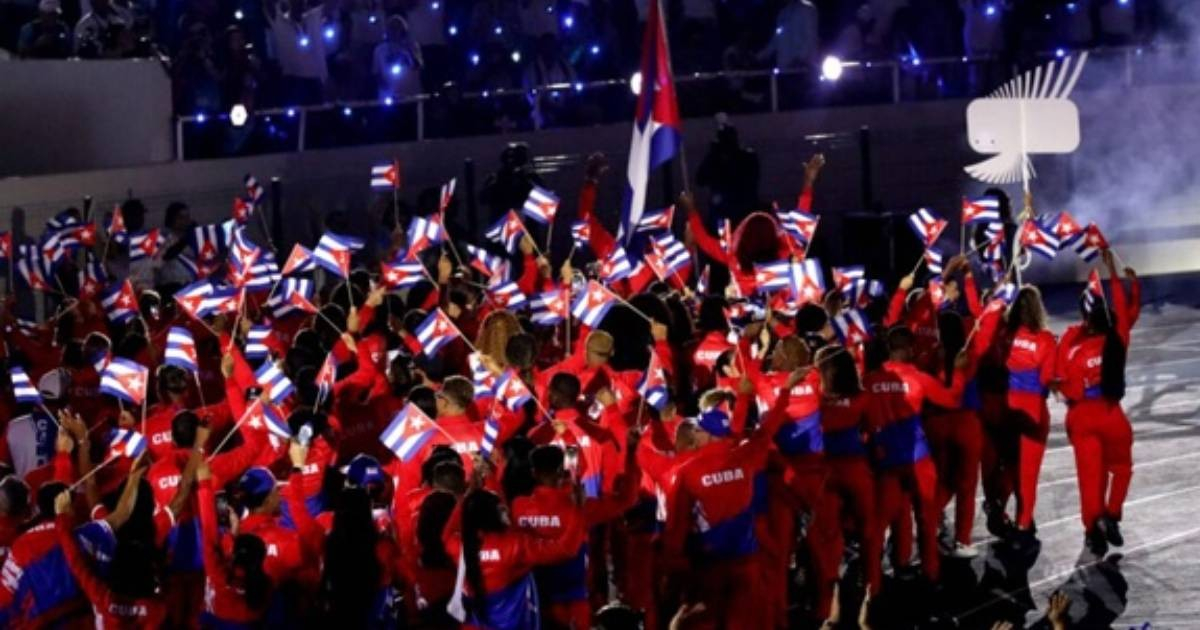
Two of the five Cuban athletes who left the official delegation during the Central American and Caribbean Games in Santo Domingo 2026 have started the process to regularize their status in the Dominican Republic, while the other three remain in the country awaiting the start of their own process.
According to a report by Diario Libre published this Wednesday, the two athletes have already started their registration with the National Refugee Office (CONARE), a first step in seeking protection and legal status that will allow them to remain in Dominican territory.
The situation of the other athletes may be more complex due to the actions of the Cuban authorities during the competition: the retention of the passports of the delegation members after Dominican immigration authorized their entry into the country.
This situation particularly leaves those who choose to separate from the official representation vulnerable, as in addition to starting a new life away from Cuba, they must resolve their immigration status without having their main identity and travel document in hand.
José Alberto Fernández, president of the Cuban Association in the Dominican Republic, confirmed that he has been in contact with two of the athletes and explained that the organization is providing them with legal advice and logistical support. For security reasons, he refrained from revealing their identities.
Fernández, who has lived in that country for 20 years and has helped dozens of Cubans with immigration regularization processes, stated that he is not surprised by the allegations regarding the surveillance that the island's delegation may have been subjected to.
"Had it not been for that control, the number of athletes and technical staff who would have defected could have been much greater," he stated.
Five athletes decided not to return to Cuba
The five athletes who left the Cuban delegation during the Games have already been identified.
The first was Moisés David Torres Puig, goalkeeper of the field hockey team, who separated from the delegation on July 24, coinciding with the opening day of the tournament.
Four days later, the shirt was worn by Leah Daniella Almeida. Subsequently, the Cuban team was left by Yasmina Evelio Álvarez Peraza, a member of the softball team.
The latest known departures were those of the fencers Hershey Daniela de la Cruz and Adán Isbel Núñez Pina, who decided to stay in Santo Domingo after completing their competitive participation on August 12.
Now they are entering a stage very different from the one they experienced during the games. The athletes have expressed their intention to resume their sports careers, but their immediate priority is to obtain a migratory status that allows them to remain legally in the Dominican Republic and find work.
The uncertainty is particularly challenging for those who are left without documentation.
The case of Torres Puig highlighted that vulnerability. After it became known that he had left the delegation, his brother publicly sought help and warned that the young man was "left alone and without a passport."
Reports of surveillance and a diplomatic crisis
The defections have also occurred amid an unusual diplomatic crisis between the Dominican Republic and Cuba.
On August 13, the Dominican government ordered the departure of nine officials from the Cuban mission and their families —approximately 21 people in total—and granted them a period of seven days to leave the country, citing Article 9 of the Vienna Convention.
Havana rejected the decision and stated that the affected officials were 10 and not nine.
Journalistic reports have linked the Dominican measure to Cuban intelligence activities aimed at monitoring and locating the athletes who left the delegation.
This was further compounded by a revelation from Diario Libre stating that Dominican security had detected infiltrated Cuban agents in the game facilities, some of whom were even using uniforms belonging to other delegations. The organizing committee, for its part, claimed that it had not received any official information regarding these events.
A new escape of Cuban athletes in 2026
The departures that occurred in Santo Domingo are part of a phenomenon that has continued to severely impact Cuban sports throughout 2026.
In July, nine out of the 12 members of the Cuban canoeing team left a training camp in Montreal, Canada, an episode regarded as the largest desertion recorded in that discipline. Four of those athletes were registered to compete later in the Santo Domingo Games.
The defection of athletes during international competitions and training camps has become one of the most visible events of the Cuban exodus in recent years.
For the five athletes who decided to stay this time in the Dominican Republic, the competition is already over. Now they face another challenge: obtaining documents, finding jobs, and rebuilding their lives outside the Cuban sports system, while not giving up the possibility of returning to compete someday.
Related videos:
Filed under: