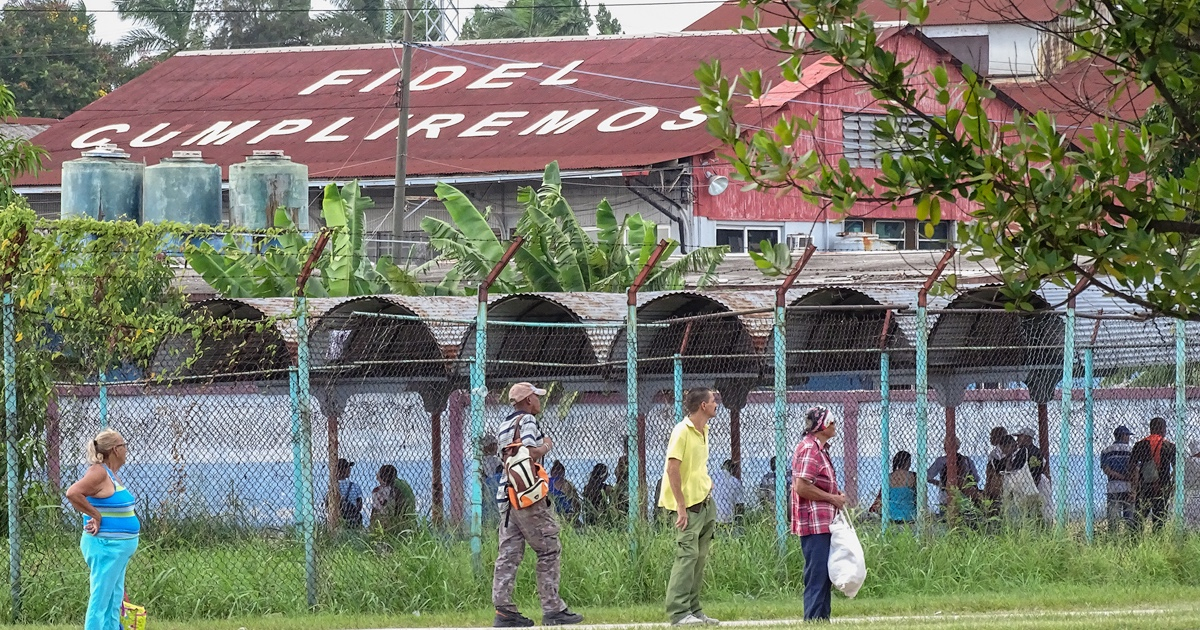
There are moments in the history of a 'revolution' when its leaders must decide what they want to build after seizing power. It is one thing to overthrow a regime; it is a much more significant matter to establish the institutions that will govern several generations. In Cuba, that decision began to take shape during the second half of the 1960s and reached its formal expression in 1976, when the first socialist constitution of the 'Revolution' was approved.
Until then, the revolutionary power had operated through provisional structures, decrees, and organizations created or transformed according to the political needs of the moment, alongside an extraordinary concentration of authority around Fidel Castro.
The so-called institutionalization aimed to bring order to that situation. The structures of the State were reorganized, a new political-administrative division was established, the bodies of People's Power were created, and a Constitution was adopted.
On the surface, it seemed to be about providing that 'Revolution' with a stable legal framework. But here arises one of the great paradoxes of Cuban political history: institutionalization was not intended to limit revolutionary power, but to transform it into a permanent system. And that distinction is fundamental.
From revolutionary power to institutional power
A revolution can be historically justified by the exceptional nature of the circumstances that bring it about. It may argue that it is facing internal and external enemies, that it needs to act quickly, and that ordinary rules do not apply to an extraordinary situation. But once the revolution has triumphed, an inevitable question arises: Who controls those who govern in the name of the revolution? That was the essential problem that Cuba did not resolve.
The institutional process that began in the 1970s did not establish a system in which different powers could control power. Instead, it built a structure in which the Communist Party was placed above the State. The 1976 Constitution declared that the Communist Party was the "superior guiding force of society and the State." This was not merely an ideological statement; it was the constitutional definition of the role the Party would occupy within the Republic.
The National Assembly of the People's Power was presented as the supreme organ of state power and as the body with legislative and constitutional authority. However, this structure coexisted with a guiding principle: the political leadership belonged to the Party. Here lies a contradiction that deserves to be examined calmly: If the Party directs the State, who directs the Party?
And if the Party constitutes the highest guiding force of society, what institution can effectively exercise control over its decisions? The answer leads to the core of the Cuban problem.
Fidel Castro and the Myopia of Power
Fidel Castro is often portrayed as a great statesman. No one can deny his extraordinary ability to mobilize, persuade, resist, and maintain power for decades. However, the political skill to acquire and hold onto power does not necessarily equate to the ability to build a Republic.
A statesman should not be judged solely by how long he remains in power, but also by which institutions are left functioning when he is no longer in office. And it is precisely here where I believe Fidel Castro's significant political myopia becomes apparent.
Castro built an effective system to preserve his project, but it was profoundly weak in guaranteeing political plurality, alternation, and independent mechanisms of power control. Institutionalization could have been the historical opportunity to set limits on personal leadership and create institutions capable of surviving any ruler. That did not happen.
The new structure ultimately legalized and consolidated the political concentration that already existed. The very process of institutionalization placed Castro in an extraordinarily powerful position: he continued as First Secretary of the Communist Party and Commander-in-Chief, and also assumed the Presidency of the Council of State and the Council of Ministers. Therefore, institutionalization did not eliminate the caudillismo; it incorporated it into a formal state structure.
In my opinion, that was one of Fidel Castro's greatest strategic mistakes. A leader truly concerned about the historical permanence of their legacy should have understood that the best defense of a revolution is not to prevent it from being questioned, but to create institutions capable of withstanding even such scrutiny. Stability rooted in institutions can outlast individuals.
The chosen model
The 1976 Constitution did not emerge in a political vacuum. Cuba was deeply integrated into the socialist bloc and had adopted numerous structures inspired by the Soviet model. The new Constitution established a socialist state, recognized the Communist Party as the leading superior force, and organized the political system around the People's Power bodies and mass organizations.
The problem was not that Cuba chose a particular economic or social orientation. A nation can choose socialism, capitalism, or any other political formula. The real issue was constitutionally closing off the possibility for society to choose something else in the future.
The 1976 Constitution went as far as declaring the socialist system irrevocable and established that Cuba would never return to capitalism. Here arises a historical question that still retains all its significance: Can one generation constitutionally decide the political fate of all the generations that will come after? The democratic answer should be negative.
A Constitution must organize power, protect rights, and establish the rules for citizens to peacefully change the course of their nation.
When a Constitution makes a specific ideology and a particular political system irrevocable, it ceases to be merely an instrument for organizing coexistence and becomes a mechanism for preserving power as well.
The disappearance of alternation
The institutionalization had another decisive consequence: it eliminated the real possibility of political alternation. The Communist Party was not simply a party competing with others. It was constitutionally defined as the superior leading force of the State and society.
Therefore, the citizen could participate within the system, choose representatives, and express opinions through the established channels, but they could not legitimately organize a political alternative aimed at replacing the Communist Party in the exercise of power. It is not enough to ask whether elections exist. One must ask: Is there a real possibility that those in power will lose it? That is one of the fundamental tests of any political system.
An election without the effective possibility of alternation can become a procedure for legitimizing the existing power, but not necessarily a mechanism for replacing it.
Mass organizations
Institutionalization also incorporated social and mass organizations into the political structure. The Committees for the Defense of the Revolution, the Federation of Cuban Women, the Central Workers' Union of Cuba, the Union of Young Communists, the University Student Federation, and other organizations were integrated into the functioning of the socialist system.
These organizations had the ability to mobilize millions of citizens and fulfill real social functions. However, they also played a political role: integrating the population into the revolutionary structure and maintaining a permanent relationship between the citizen and the system. In this way, an extraordinarily extensive political network was built: the Party led; the State administered; the organizations mobilized, and society was incorporated into a structure where the boundaries between the State, the Party, and society became increasingly narrow. This model had a tremendous capacity for control and, precisely for that reason, a significant difficulty in self-correction.
The great strategic mistake
Here we reach the central point of this chapter. I do not believe that Fidel Castro's greatest political mistake was the construction of socialism. His deeper error was confusing the permanence of his project with the permanence of a single system of power. A statesman thinks in decades. A great statesman thinks in generations. And a truly exceptional statesman even considers what will happen when he is no longer around.
Castro could have built a socialist institutional framework with room for criticism, plurality, institutional autonomy, and alternation. He could have separated the Party from the Government, established a truly independent judiciary, and allowed for a press capable of holding power accountable.
He could have transformed the Constitution into a guarantee against the State, rather than merely a guarantee for the State. He did not do so. He preferred to build an institutional framework whose primary function was to ensure the continuity of the 'revolutionary' process. And that choice had consequences that Cuba would bear for decades.
The consequences
The first consequence was the concentration of power. The second was the absence of political alternation. The third was the weakness of independent control mechanisms. The fourth was the identification between the State, the Party, and the Revolution. And the fifth, perhaps the most serious, was the creation of a system with enormous difficulties in acknowledging its own mistakes.
When a society has independent institutions, mistakes can be discussed, corrected, and replaced through legal procedures. When political power controls the institutions responsible for making corrections, an error can become state policy.
This helps explain why certain economic, political, and social problems could persist for years without the existence of an institutional mechanism capable of producing a deep correction.
The institutionalization achieved stability. But stability is not synonymous with political health. A system can be stable and, at the same time, be profoundly sick.
The irony of history
There is an irony that should not go unnoticed. Fidel Castro had deep distrust of the institutions of the previous Republic. He considered them part of a corrupt, dependent, and exhausted system. However, in replacing them, he did not build a Republic more open to criticism and civic oversight. Instead, he constructed a structure in which the revolutionary power was shielded by the institutions he himself created.
The Revolution that had promised to restore sovereignty to the people ended up placing the Party above the State. The Constitution that proclaimed popular sovereignty simultaneously established the superior leadership of the Party. And the leader who came to power promising to transform Cuba ended up building a system whose continuity depended on the absence of an organized political alternative. That is the paradox that history must examine without passion and without silence.
A lesson for the Cuba of the future
History is not just about remembering what has happened. It is also about learning from it. When Cuba rebuilds a democratic Republic, one of the great challenges will be to understand that no person, no party, and no ideology should be placed above the nation—even those who have fought for it.
A truly free republic requires institutions capable of holding leaders accountable, political opposition, a free press, an independent judiciary, competitive elections, and above all, the ability to peacefully change those in power.
Because the true statesman is not the one who ensures that his system survives his enemies. It is the one who ensures that his nation survives him.
Fidel Castro managed to ensure that the system he built survived for decades. However, the historical question that remains open is a different one: Did he succeed in building the institutions that Cuba needed to survive after Fidel Castro? The answer now belongs to history. And that history, still unfinished, illustrates something that Cubans should never forget: power can create institutions to perpetuate itself; but only a free Republic can establish institutions to limit power.
That was the major challenge that Cuban institutionalization did not resolve.
Related videos:
Filed under:
Opinion article: Las declaraciones y opiniones expresadas en este artículo son de exclusiva responsabilidad de su autor y no representan necesariamente el punto de vista de CiberCuba.