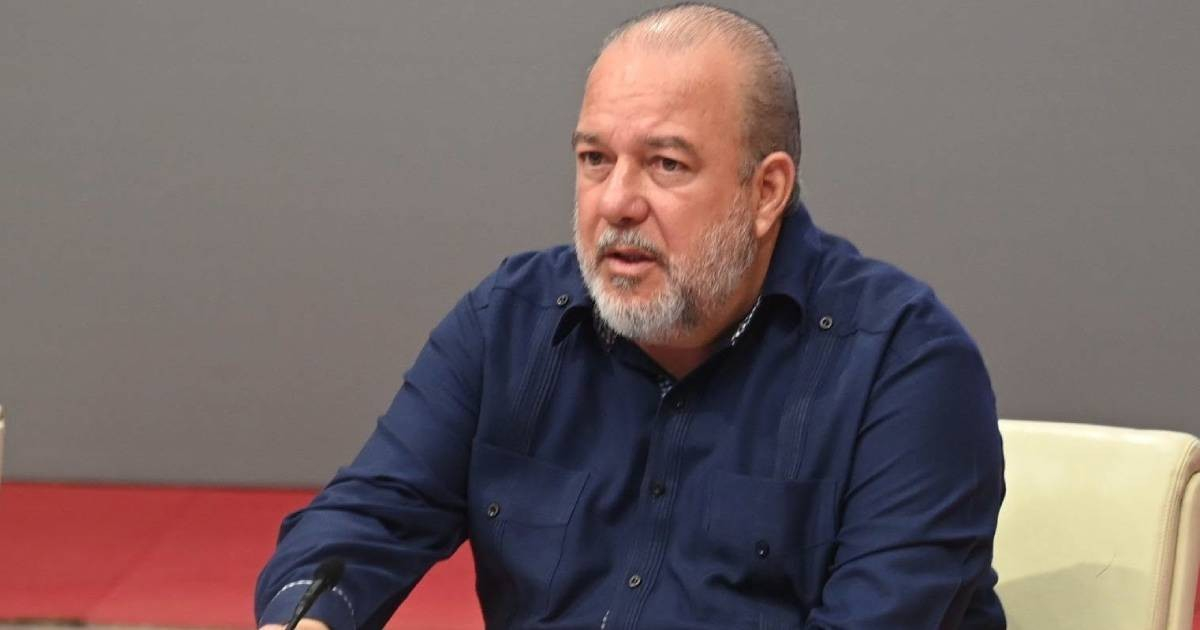
The Cuban Prime Minister Manuel Marrero Cruz stated this Tuesday that Cuba is integrating into the global economy "with sovereignty and not with submission," in a message posted on his X account that revisits remarks made during the I International Colloquium "Fidel: legacy and future."
“Cuba asserts itself in the global economy with sovereignty and not submission, true to the legacy of the Commander on the centenary of his birth, who taught us that sovereignty is non-negotiable,” wrote Marrero on his profile on X, under the official campaign hashtags #100AñosConFidel.
The message amplifies what the Prime Minister presented days earlier at the panel "Fidel and the Global Economy" during the colloquium held at the Palace of Conventions in Havana from August 10 to 13, as part of the events celebrating the centenary of Fidel Castro's birth.
In that forum, Marrero defended the 176 economic and social transformations approved in June 2026 —organized into 23 axes— as "one hundred percent Cuban" measures, and dismissed the notion that the regime is mimicking the models of China or Vietnam.
"Cuban socialism cannot be a rigid theory," asserted the Prime Minister, presenting the package of reforms as a sovereign adaptation to the challenges of the global economy rather than a abandonment of the system.
The package approved in June includes greater space for small and medium-sized private enterprises, the opening of banking and exchange houses to non-state actors under the supervision of the Central Bank, facilities for foreign investment, and reforms in foreign trade.
The regime presents these measures as an "updating of the socialist model," although critics point out that they introduce market elements that contradict decades of official rhetoric.
The discourse of "non-negotiable sovereignty" is a recurring resource of the Cuban government to justify both its resistance to external pressures—including those from the U.S. embargo and the conditionalities imposed by international financial organizations—and the internal legitimacy of changes that expand the private sector.
The centenary of Castro is being used as an ideological framework to provide revolutionary continuity to a set of reforms that, for critical sectors, represent a shift towards market formulas that the regime itself fought against for decades.
The colloquium brought together over 1,500 delegates from 63 countries, including more than 1,000 foreigners, and the closing events featured Miguel Díaz-Canel, Raúl Castro, Esteban Lazo, and Roberto Morales Ojeda.
The statements come amidst one of Cuba's deepest economic crises, characterized by prolonged blackouts, shortages of fuel and food, sustained inflation, and an unprecedented exodus of people.
The Cuban government declared 2026 as the "Year of the Centennial" and has extended the commemorative agenda until December 4, the date of the tenth anniversary of Castro's burial at the Santa Ifigenia cemetery in Santiago de Cuba.
Related videos:
Filed under: