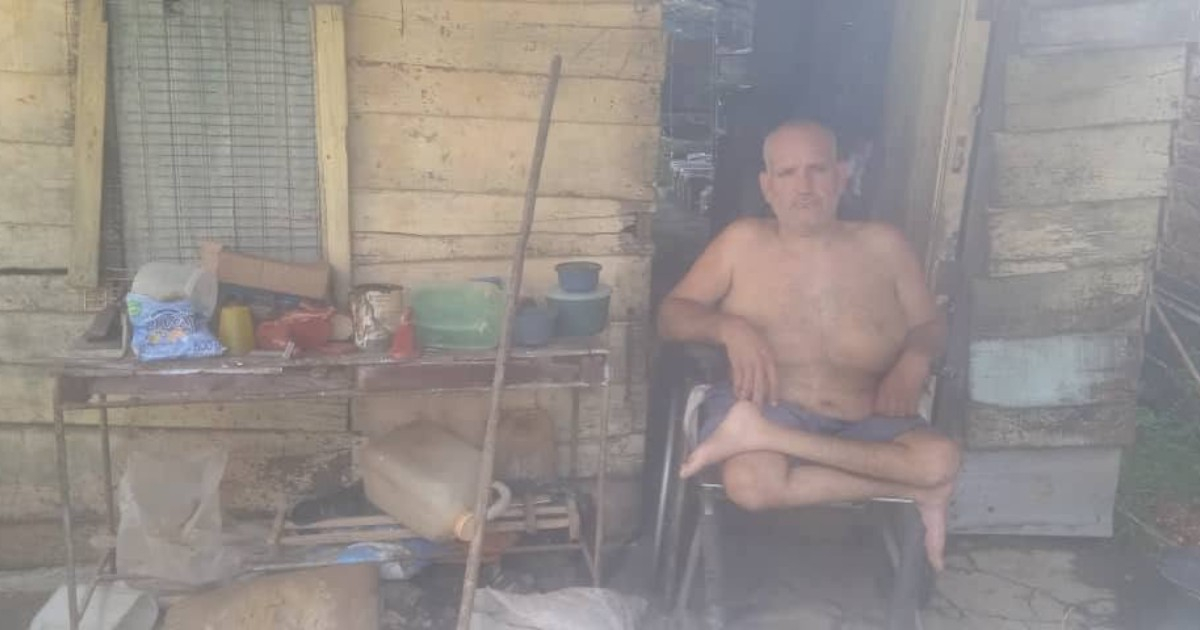
Reinier Vega Suárez, 44 years old, lives in a wheelchair in the Agramonte neighborhood of Camagüey and has been waiting for a decade for the local government to fulfill its promise to build him a decent home, according to a report by journalist José L. Tan Estrada published through the #TanteandoCuba platform.
Vega lives in a wooden and tile room at 64 D Street, between 2nd Street and 3rd Street, with a sinking roof, rotting front beams, and cracked walls.
The bathroom, built in a rustic style, lacks a floor and a ceiling, and is located about 15 meters from the room, the post describes.
When it rains, water comes in through the roof, the floor, and from the street, practically flooding the entire space where he lives.
The government of Camagüey granted that land in 2016 with the promise of providing a subsidy to build a house.
Before even receiving the documents, Vega had to pay 2,600 pesos for the land—a sum that at the time was equivalent to more than 16 months of his social assistance income, which was around 160 pesos.
Since then, what Tan Estrada describes as "a long bureaucratic process that, ten years later, still has not concluded with a solution" began.
Vega waited nearly a year for the land to be measured and another similar period to receive the corresponding documents.
In 2018, the then provincial government chief visited the home accompanied by officials, vehicles, and cameras, and made new promises that were also not fulfilled.
Two years later, his case reached the local television program Toque de Clarín on Televisión Camagüey, and he received another visit from high-ranking officials in the area, again without results.
Two years later, Vega obtained the subsidy approval, the housing plan, and the construction order, but the work never began.
For 2022, they promised him that his housing would be included in that year's plan.
He received some tiles and, with the help of friends, built a temporary structure while waiting for a permanent solution.
"The solution never arrived," summarizes the report.
That same year, leaders of the Party and the municipal Government visited him again with new guarantees.
In 2024, your delegate informed you that the materials had already been delivered.
Vega denies it and demanded to see where he had signed as proof of the delivery, without receiving a response.
Currently, he survives on a social assistance check of just 1,540 pesos per month —less than 13 dollars at the informal exchange rate— and fears that the structure will eventually collapse around him.
His case reflects a housing crisis that is worsening in Camagüey: in 2024, the province fulfilled only 44% of its housing plan, with just 10 properties completed through the subsidy route — the modality specifically intended for cases like Vega's.
On a national scale, housing production in Cuba fell by 54% in 2024 compared to the previous year, with only 7,427 units completed nationwide, while the housing deficit exceeds 800,000 units according to data from 2025.
This is not the first documented case of people with disabilities being denied or indefinitely delayed the subsidy they are entitled to by the housing system: in 2018, the Housing Directorate denied this benefit to another disabled Cuban in Camagüey citing irregularities in the property, and in 2019, the case of a man with severe disabilities was reported, who had been asking for help since 2012 without any response.
"The story of Reinier Vega is also one of a decade filled with paperwork, documents, official visits, and unfulfilled promises," concludes Tan Estrada. "Ten years later, he is still waiting for the house that was promised to him, while the housing he received from the Government of Camagüey threatens to collapse."
Related videos:
Filed under: