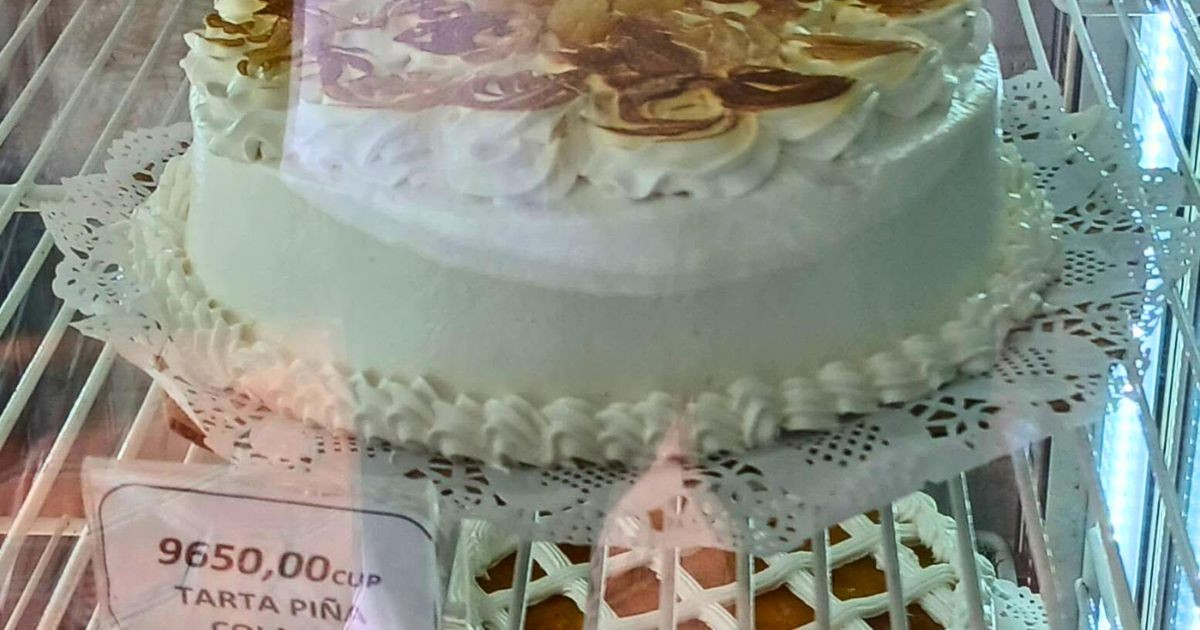
A historian and tenured professor at the University of Havana denounced this Friday on Facebook the prohibitive cost of sweets in Havana, where a whole piña colada cake is sold for 9,650 Cuban pesos in a private pastry shop, an amount that exceeds the average monthly salary of state workers in the country.
Reinaldo Manuel Sánchez Porro, a full professor of History and researcher affiliated with the Center for African and Middle Eastern Studies, published a reflection titled "WITHOUT SUGAR, THERE IS NO COUNTRY" in which he recounts his visit to the sweet shop Biky, located at Infanta and San Lázaro, in Central Havana.
"I remember when I used to indulge in that delight at the 'Biky' pastry shop, located at Infanta and San Lázaro, and also when I was outraged to see that the lemon pie had gone up to 750 pesos. Well, today I stopped by, and the cashier explained to me that now you have to order it, and it costs 12,000 pesos. Goodbye, beloved lemon pie, my taste buds are in mourning," wrote the academic.
In the display case of the establishment, Sánchez Porro noted other equally high prices: "a small coconut tart costs 480, and a wedge or slice of guava or coconut pie is 950. And the whole pineapple cake is priced at 9,650 pesos."
The professor also visited the establishment Buenissimo —formerly known as Bim Bom—, located at 23 e Infanta, which presents itself as a "gourmet soda fountain" with a lounge and terrace. There, the prices aren't very different: "a slice of brazo gitano costs 790 pesos, a wedge or slice of strawberry tart 920, a small Tres Leches cup 950, and a simple Brownie 980 bills featuring the stern face of Martí."
The real significance of these figures becomes clear when compared to the income of the population. The average monthly salary in Cuba was 6,930 pesos in 2025, according to official data, which was equivalent to about 13 dollars at the informal exchange rate. Between January and April of this year, that average increased slightly to 7,074 pesos per month. This means that the pineapple tart from the Biky bakery costs more than a full month’s salary.
The contrast is further heightened when considering that covering the basic needs of a family requires around 96,000 pesos monthly, according to independent economic calculations, most of which would be allocated solely to food, based on estimates from June 2026. This means more than ten times the average salary.
The background of this situation is the crisis in the sugar industry, which Sánchez Porro himself references in the title of his publication. "WITHOUT SUGAR, THERE IS NO COUNTRY. That is what was said before. Ending this dependency by diversifying national production was one of the initial objectives of the process. But unfortunately, today there is no sugar; it is lost from the warehouse even though the mipymes sell it at prices of... mipymes," he stated.
The reality supports that description: the 2024-2025 harvest fell below 150,000 metric tons, the lowest level in over a century, and economists point out that Cuba produces less sugar today than in 1899. In the informal market, a pound of sugar has reached prices over 500 pesos, while in the rationed basket of April 2026 in Santiago de Cuba distributed just one pound per person.
This shortage is compounded by an annual inflation rate that reached 20.70% in July 2026, with food and non-alcoholic beverages accounting for 63.18% of the total increase in the consumer price index that month.
In light of this situation, Sánchez Porro describes the social divide that has taken root on the Island with a phrase that encapsulates the reality: "inequality delineates an economic apartheid that allows me to satisfy my sweet tooth with a bar of guava candy, priced at 400 pesos in the markets, which, when sliced well, is enough for fifteen or twenty desserts. And if I manage to pair it with Maria cookies (at whatever price they might be), I can escape into the fantasy of the traditional Creole gourmet."
Related videos:
Filed under: