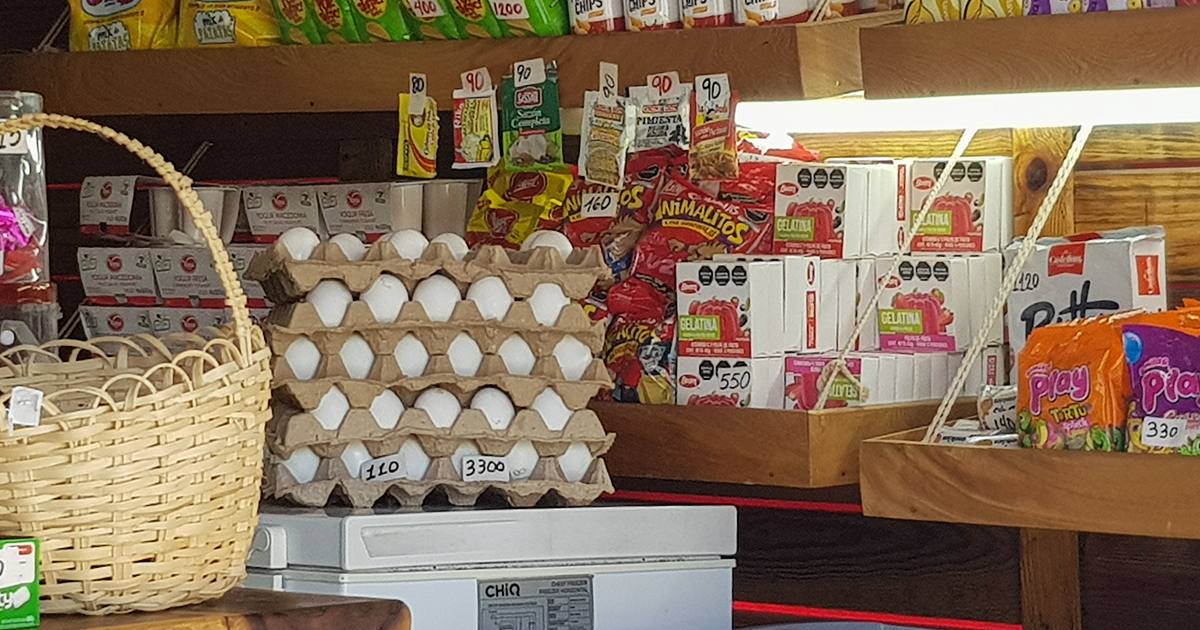
The year-on-year inflation in the Cuban market reached 20.70% in July 2026, according to the monthly Consumer Price Index bulletin published by the National Office of Statistics and Information (ONEI).
The figure exceeds the June record by more than two percentage points and significantly surpasses the 14.37% recorded during the same period last year.
The monthly variation was 2.56% compared to June, and the cumulative total since January reached 15.12%, confirming a trend of sustained acceleration. The year-on-year inflation has climbed steadily every month of 2026, from 12.52% in January to 20.70% in July.
The main driver of the monthly increase was food and non-alcoholic beverages, which grew by 3.51% in July and accounted for 63.18% of the total increase in the CPI.
Among the products that recorded the greatest monthly variations were vegetable oil, hard-crust long bread, and beer.
By categories, the highest year-on-year increases corresponded to Restaurants and Hotels (32.57%), followed by Food and Non-Alcoholic Beverages (26.36%), Transport (24.96%), Education (23.32%), and Housing Services (20.83%). On the opposite end, Health recorded only a 0.51% year-on-year increase, and Communications a 0.68%.
The official figures, however, are considered by independent economists to be an understatement of the actual inflation.
The consensus among these specialists suggests that the statistics from ONEI do not adequately capture the dynamics of the informal market or the private sector.
Economist Steve Hanke placed Cuba, in a graph published this Tuesday, among the countries with the highest inflation in the world, with a 67% year-on-year, just behind Venezuela, Iran, North Korea, and Sudan.
The price spiral has been dragging on since the failed monetary reform of 2021, which unified the dual currency but caused costs to soar. According to ONEI itself, prices on the island quadrupled between that year and 2025.
The crisis intensified from January 2026 with U.S. restrictions on fuel supply. Cuba only produces crude oil to meet 40% of its energy needs. The fuel shortage has increased blackouts and halted a significant part of the state economy.
The projections for Cuba's GDP in 2026 are bleak. The Economic Commission for Latin America and the Caribbean (CEPAL) forecasts a decline of 6.5%.
This situation is further complicated by a new issue: the July CPI data does not yet reflect the impact of the price caps reintroduced in August by various provincial governments.
The effect of that regulation is already noticeable on the streets with products disappearing from the shelves, a significant increase in food prices in the informal market, and closed businesses.
The economist Pedro Monreal warned that the 176 economic measures approved by the regime in June 2026 were largely undermined by those provincial interventions, which replicate the same control mechanisms that have historically exacerbated shortages in Cuba.
Related videos:
Filed under: