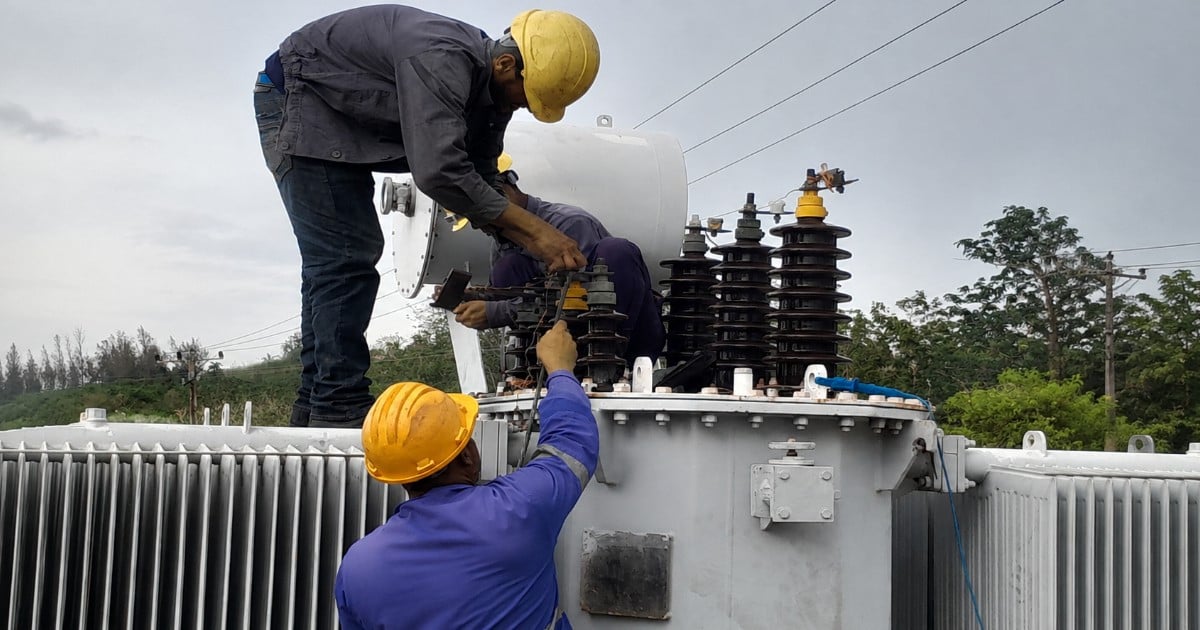
The province of Holguín has recorded 28 thefts of dielectric oil from transformers so far this year, a practice that electrical authorities describe as increasingly common and which already affects all municipalities in the area.
Eduardo Felipe Gutiérrez Estrada, chief security and protection specialist at the Electric Company of Holguín, described the phenomenon as "a sort of epidemic spread throughout the country, with apparent impunity, due to the slowness of judicial processes," in a report published this Saturday in the print edition of the official newspaper ¡Ahora!, which was highlighted on the page on Facebook of the mentioned company.
The municipalities with the highest number of cases are Moa, with seven; Mayarí, with six; and Urbano Noris and Cueto, each with four. According to the official, the perpetrators usually operate in remote areas away from settlements, although no territory in the province is exempt from such incidents.
The impact on the communities can be significant. In Moa, 3,000 liters of oil were stolen from a substation, an incident that left around 2,000 people without electrical service. In Levisa, a municipality of Mayarí, the theft of oil from a transformer also affected residents of Nicaro and Cabonico.
In June, a similar incident left 69 homes in the Las Torres neighborhood of Urbano Noris without electricity. Earlier, the transformers at the Farallones substation were affected in May, and those at Moa Nueva were impacted in March.
The dielectric oil plays essential roles in the operation of transformers, as it helps to insulate the electrical components and cool the equipment.
The extraction of the fluid can cause overheating, damage to the coils, and irreversible failure of the transformer, according to the report.
The scope of the problem extends beyond Holguín. At the end of July, the Minister of Energy and Mines, Vicente de la O Levy, acknowledged before the National Assembly that the theft of dielectric oil occurs "daily" and that the volume taken is "almost similar" to what Cuba produces during the same period.
In Holguín, the Provincial Prosecutor's Office confirmed that crimes against the infrastructure of the National Electric System have increased, primarily due to the theft of dielectric oil.
Reynaldo Castellanos Pérez, head prosecutor of the Criminal Processes Department, assured that these cases are processed with the utmost severity prescribed by the Penal Code.
The extraction of oil from transformers is classified as sabotage under Article 125 of the Penal Code. According to information provided by the Prosecutor's Office, penalties can range from seven to 15 years in prison, and can extend up to 30 years or life imprisonment if there are aggravating circumstances.
Castellanos also explained that 100% of the individuals tested for participation in these events receive provisional detention as a precautionary measure.
When there are elements of violence against custodians, cases can be prosecuted as robbery with violence, with penalties ranging from 15 to 30 years or life imprisonment.
Despite the severity announced, the official report itself acknowledged a contradiction that is hard to ignore. The slowness of judicial processes, the text notes, creates "the illusion of impunity," a situation that can encourage new crimes and fuel the populace's frustration and the discrediting of the institutions responsible for combating them.
The authorities have implemented measures such as repairing perimeter fences, installing locks, sealing valves, and increasing patrols and inspections at substations. They also call for greater involvement from community organizations to reject these incidents.
The problem becomes more serious in an electrical system that is already facing a severe shortage of equipment. When a transformer is rendered unusable due to the removal of oil, its replacement does not solely rely on replenishing the fluid, and the lack of spare parts inventory can prolong the impact on communities.
This Saturday, the Granma Electric Company admitted that employees within the electrical sector are involved in the thefts, which exacerbates the scale of the issue.
Related videos:
Filed under: