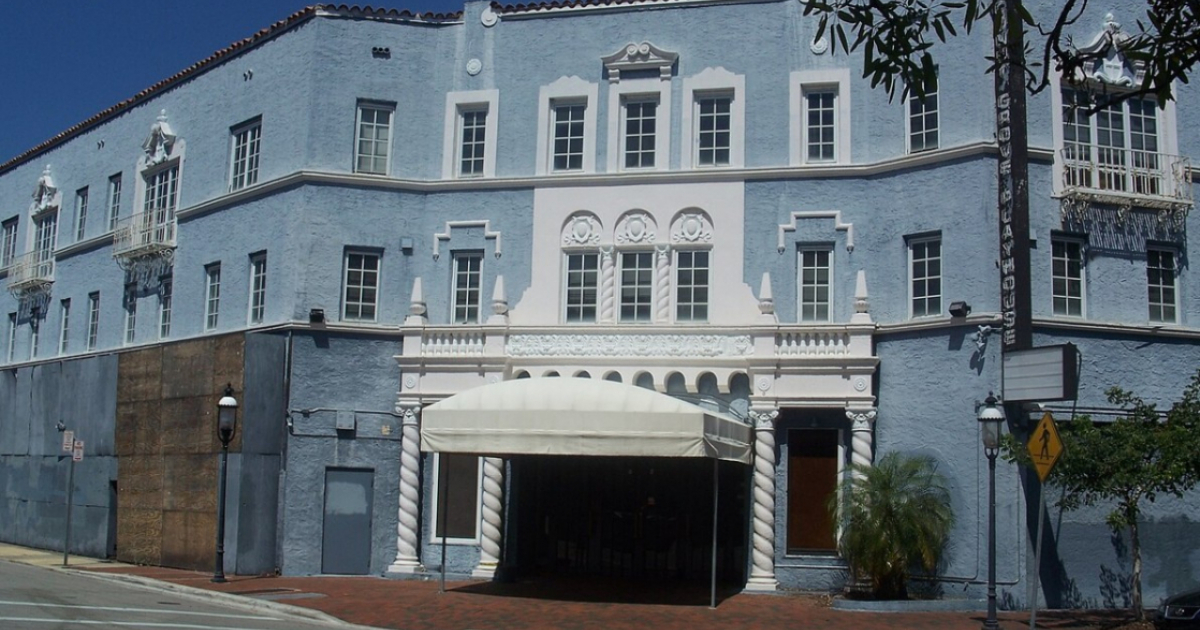
The Coconut Grove Playhouse, one of Florida's most iconic theaters, is set to be reborn after 20 years of being closed, with a $58.4 million project that will completely redesign the cultural heart of the Coconut Grove neighborhood in Miami.
The road to this point has been long: the venue closed in 2006 due to financial issues and since then has been mired in legal disputes, debates over historical preservation, and design changes that kept the project stalled for years.
The definitive unlock came on July 9, when the Miami City Commission unanimously approved the appeal submitted by Miami-Dade regarding the zoning requests, allowing the county to move forward with the permits for the second phase of construction.
What will be preserved and what will change
The Mediterranean Revival-style façade, built in 1927, will be restored and will maintain its presence facing Main Highway and Charles Avenue, the most recognizable feature of the building.
Behind it, however, the change will be radical: the old auditorium, which once had nearly 1,100 seats, will be replaced by a modern hall with approximately 310 seats, designed to become the permanent home of GableStage, the regional theater company of South Florida.
The project is managed by the firm Arquitectonica, with landscaping by ArquitectonicaGEO, and separates the historical facade from the new hall through open spaces and circulation areas.
In 2018, an appeals court had already supported this strategy by determining that the front structure maintained relevant architectural integrity, while the old auditorium did not hold the same historical value.
More than a theater
The new complex will not be limited to the performance hall. The plan includes a public square, green spaces, pedestrian pathways, commercial areas, restaurants, offices, and educational uses, with the intention of making the venue an active meeting point during and outside of performances.
The project also includes a public parking facility with approximately 289 spaces, developed in coordination with the Miami Parking Authority.
Liliana Hernández, spokesperson for the Department of Cultural Affairs of Miami-Dade, described to Diario Las Américas the extent of the transformation: "It will offer a modern, state-of-the-art theater, as well as restored historical facilities, revitalizing a cultural landmark in the heart of Coconut Grove. This will enhance access to the arts, support local artists and organizations, and contribute to the economic development of the area."
"Furthermore, a space dedicated to theatrical education will enrich the artistic offerings for students and families in Coconut Grove and the rest of Miami-Dade," he specified.
Critical voices from the community
Not everyone welcomes the project with unreserved enthusiasm. According to a report by Telemundo 51, residents of West Grove and Little Bahamas, a historically Black community adjacent to the Playhouse, have expressed concerns about traffic, noise, and the impact of commercial activity on the residential fabric of the neighborhood.
During the approval process, conditions were introduced to reduce those effects: a buffer zone next to the houses, a traffic study, and a mitigation plan with community participation.
From the artistic community, there are also warning signals being raised. Alexa Kuve, actress, producer, and founder of the theater group Arca Images, pointed out that institutional support for culture does not always translate into concrete actions: "There is verbal acknowledgment of the importance of culture and the challenges facing the sector. But the problem is that this acknowledgment does not always result in specific decisions, clear timelines, or sufficient resources."
The calendar for reopening
The construction of the new hall has not yet begun, although the historic building has already undergone rehabilitation and stabilization work.
The official timeline, confirmed by the Department of Cultural Affairs, indicates a partial reopening in 2027, coinciding with the centenary of the Playhouse, and a full service launch in 2028. However, Hernández clarified that this goal "depends on the construction schedule of phase 2, which is contingent on obtaining permits and bidding."
Related videos:
Filed under: