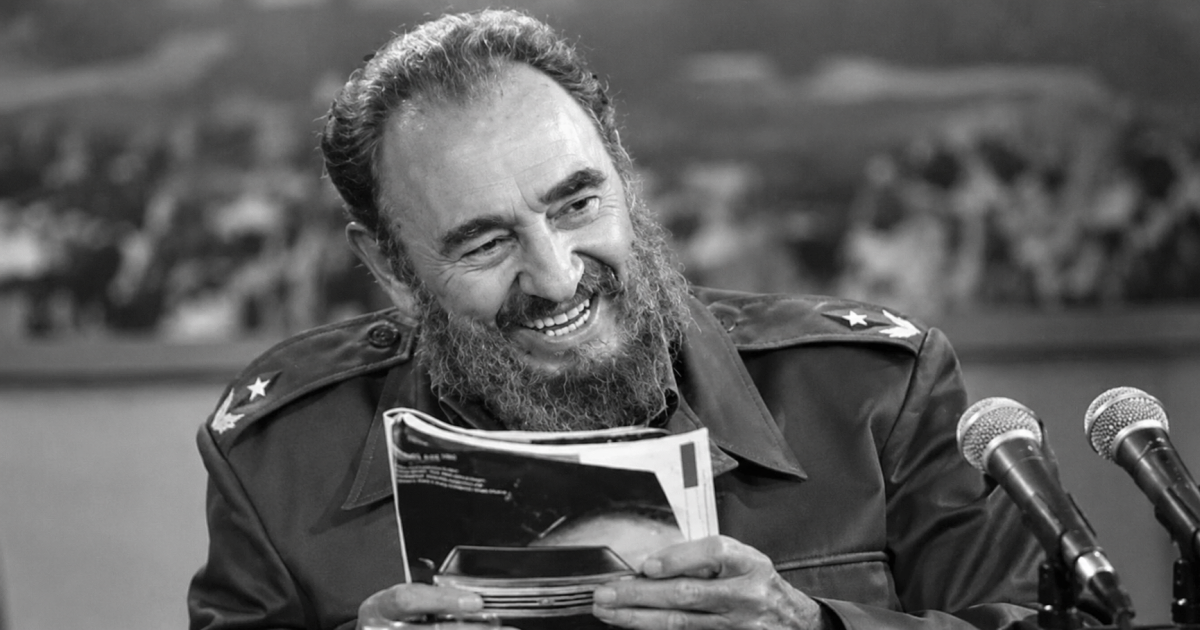
One hundred years since his birth in Birán. One hundred years since the personal story of a man began, a man who would ultimately become one of the most powerful, controversial, and destructive political figures in contemporary Cuban history.
This chapter does not aim to celebrate its centenary. It seeks to accomplish something much more important: to remember its victims. Because behind the photograph of the bearded guerrilla, behind the endless speeches, behind the revolutionary propaganda, and behind the carefully crafted image of the world leader, there existed a reality that millions of Cubans experienced firsthand: imprisonment, persecution, exile, censorship, fear, executions, family separation, and the disappearance of political freedoms.
Fidel Castro died in 2016. But his political legacy did not die with him. His system survived. And Cuba continues to bear the consequences.
Without a soul
I say that Fidel Castro was a soulless man because for decades he demonstrated an extraordinary ability to place the reasoning of the State, the revolution, and his own longevity in power above individual suffering. I am not speaking about religion. I am speaking about humanity.
A ruler can make mistakes. They can fail. They can make wrong decisions. But when they turn repression into a permanent tool of governance, when they imprison those who think differently, and when they transform political obedience into a prerequisite for social life, we are facing something far more serious than a mere political error. We are confronted with a system of domination.
Human Rights Watch documented for years the existence of a repressive machinery that targeted opponents, independent journalists, activists, and citizens who publicly challenged those in power. Thousands of Cubans ended up in prisons. Others were sent into exile. Some lost their jobs, their education, or their opportunities for advancement simply because they refused to submit. And there were those who lost their lives.
History cannot be reduced to the achievements that the regime wished to showcase. A revolution cannot be judged solely by its schools, hospitals, or political campaigns. It must also be assessed by the freedom it allowed, the justice it ensured, and the dignity it respected.
And there emerges an inevitable question: What value does a society have where the State can decide what you can think, what you can publish, what you can say, and how far you can go?
Faceless
Fidel Castro had many faces. He was a lawyer, rebel, revolutionary, nationalist, socialist, Marxist-Leninist, ally of the Soviet Union, leader of the Third World, and a declared enemy of the United States. But he was also an extraordinary architect of his own image.
The man who spoke for hours ultimately became the very image of the Revolution. His face appeared in schools, factories, offices, books, newspapers, posters, and public events. The figure of the leader came to occupy a vast space within national life.
But there was another side. The side of concentrated power. The side of the single party. The side of a press subservient to the State. The side of a persecuted opposition. The side of a justice system lacking true political independence. The side of citizens forced to live under the scrutiny of a system that infiltrated neighborhoods, workplaces, schools, and social organizations.
Human Rights Watch precisely described that framework of surveillance and control, including the role played by mass organizations in monitoring the population. That is the face that propaganda has tried to conceal for far too long.
Without a word
And we arrive at the third element: without word. Because Fidel Castro made the word a political weapon. He promised democracy. He promised elections. He promised to return to the people the freedoms they had lost. He promised that the Revolution was not communist. But the ensuing path led to the construction of a socialist state with a single party and the gradual elimination of political pluralism.
The word spoken in 1959 was not the same reality that emerged afterward. And that contradiction represents one of the great political tragedies of Cuban history. Castro quickly grasped the power of language. His speeches could last for hours because they were not merely speeches: they were instruments for constructing an interpretation of reality.
The revolution was speaking. The state was speaking. The party was speaking. But society had fewer and fewer opportunities to respond.
The Human Price
We cannot talk about Fidel Castro without discussing those who ended up behind bars. About political prisoners. About those executed. About the men and women who endured interrogations, isolation, forced labor, and degrading prison conditions. About the divided families. About the exiles. About those who crossed the sea in search of freedom. About those who died trying to escape.
Repression was not an isolated accident. It was a structure. Amnesty International has pointed out that the social advancements attributed to Castro's regime were accompanied by a systematic repression of fundamental freedoms. This distinction is crucial for any historian. It's not about denying what may have worked. It's about preventing certain achievements from being used to erase the crimes and human rights violations. History must consider the whole picture.
The man and his work
Fidel Castro ruled Cuba for nearly half a century and left a profound mark on several generations. However, recognizing his historical significance is one thing, while elevating him to the status of a hero is quite another. Dictators can also be significant figures in history. That does not make them great men.
Castro was undoubtedly a figure of immense international influence. However, his influence cannot be separated from the system he built within Cuba: concentration of power, a single party, absence of political alternation, and repression of dissent. Perhaps that is the greatest lesson of this centenary. We should not study Fidel Castro to admire him. We should study him to understand how a society can progressively relinquish its freedoms to a man who promises to speak on behalf of the people.
Let the dead speak
That is why this chapter is not dedicated to Fidel Castro. It is dedicated to his victims. To those who died. To those who were imprisoned. To those who had to leave Cuba. To those who lost parents, children, siblings, and friends. To those who still carry in their bodies and memories the consequences of that history.
Let no one claim that the passage of time turns suffering into propaganda. Let no one say that remembering the crimes divides Cubans. What divides Cuba is injustice. Memory, on the other hand, can help us reconcile with our own history.
In this month of August, when the regime celebrates the centenary of its top leader, Cubans have the right to remember what the official ceremonies do not show. Because a nation is not built solely by erecting monuments to its rulers. It is also built by remembering those who suffered under them.
Fidel Castro would turn one hundred years old on this August 13. But for those who suffered under his regime, this date is not a cause for celebration. It is an opportunity to confront history directly. Without propaganda. Without fear. Without silence. And to finally say what many could not say for decades: Fidel Castro was not Cuba. Cuba was, and continues to be, much greater than Fidel Castro.
And when the definitive history of this tragedy is finally written, we must remember the man who sought to become the embodiment of a revolution, but who ultimately left behind a nation marked by division, exile, repression, and a profound crisis.
That is why I call him: the man without a soul, without a face, and without a word. Without a soul, because power ultimately triumphed over compassion. Without a face, because behind every public image, there were multiple political faces. And without a word, because between the promises of 1959 and the reality he left behind, there is a distance that propaganda will never be able to erase.
Today we do not raise a glass to celebrate its hundred years. We raise the memory of its dead. And for them, only for them, we continue to tell the story.
Related videos:
Filed under:
Opinion article: Las declaraciones y opiniones expresadas en este artículo son de exclusiva responsabilidad de su autor y no representan necesariamente el punto de vista de CiberCuba.