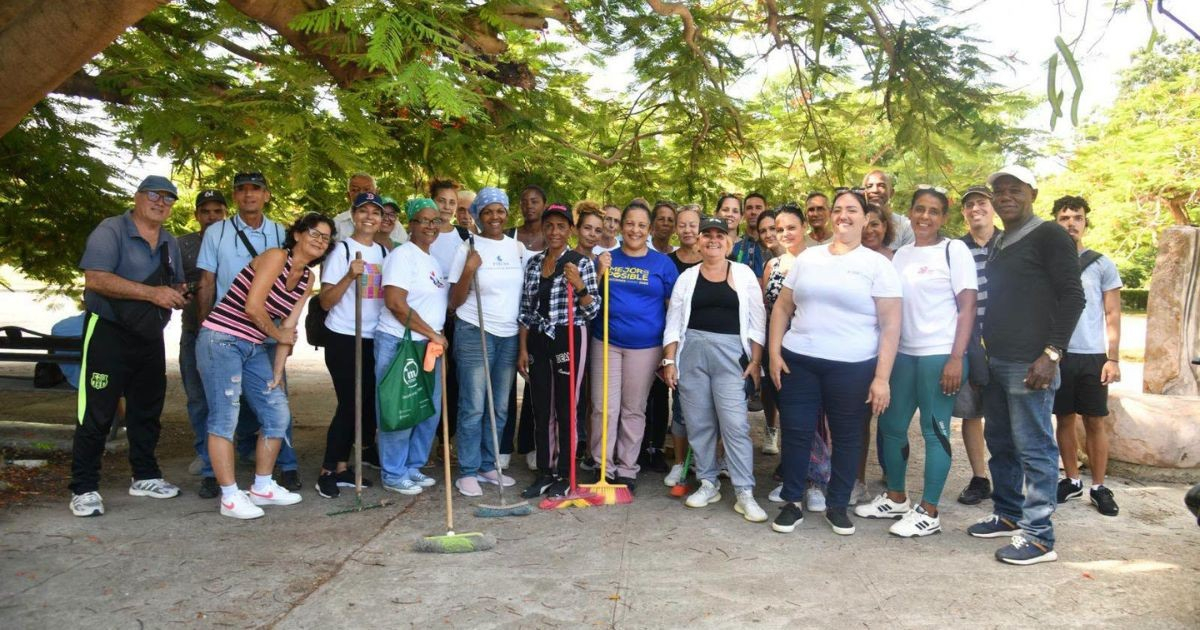
This Sunday, while thousands of Cubans have been without landline service for months and are still shaken by a false seismic alarm created by ETECSA's own technicians, the Ministry of Communications (MINCOM) found time to publish on Facebook a celebratory note about a day of clearing and cleaning in the Communications Park, located in the Plaza de la Revolución municipality of Havana.
The event was held in celebration of the 66th Anniversary of the Cuban Women's Federation (FMC), founded on August 23, 1960, by Vilma Espín Guillois. About thirty people — judging by the photo — with brooms and rakes in hand, posed under the shade of a leafy tree to demonstrate, according to the official statement, that "the Communications sector remains loyal to the work of the Revolution."
The ministry described the scene with the usual vocabulary: "The new generations participated with enthusiasm, demonstrating that the spirit of dedication and sacrifice that inspired Vilma, Celia, Melba, Haydee, Mariana, and Teté is still very much alive in Cuban youth, the guarantee of historical continuity." "With discipline and a sense of belonging," the statement added, "the participants reaffirmed that voluntary work is an expression of patriotism and social responsibility." Enthusiasm, discipline, patriotism. Everything in order, except for the communications.
Five days before that day of brooms and hashtags, on Tuesday the 18th, ETECSA's specialists accidentally activated the emergency messaging system while conducting tests on the network, triggering a false seismic alarm that caused panic across Cuba. Elderly and ill individuals descended on foot down the staircases of buildings up to 12 stories high in cities like Ciego de Ávila. A user identifying herself as a cardiac patient and hypertensive wrote that it was "a mistake that almost cost me my life."
ETECSA took three days to acknowledge its responsibility, and only did so after Google publicly denied any involvement. The company finally admitted that "the messages were issued due to a technical-human error, generated by our specialists who were conducting tests on the telecommunications network." An internet user summed it up accurately: "If Google doesn’t deny it, you continue lying and claiming it was Google."
Shortly before the voluntary day, on Friday the 21st, the National Center for Seismological Research reported a real earthquake of magnitude 3.6 in Santiago de Cuba. Several users commented that the ETECSA alert, this time, did not work. "Well, it shook in Santiago and the alert didn’t work. Another thing that’s useless," wrote one of them. The system capable of causing panic with imaginary earthquakes proved unable to warn about a real one.
The recent history of ETECSA does not inspire much optimism. On August 17, a fiber optic cut affected the Nauta payment system, including top-ups and balance transfers. In May 2026, Cuba recorded a median download speed of only 7.21 Mbps according to Ookla's Speedtest Global Index, a result that placed it in last place in Latin America.
This occurs a year after ETECSA implemented a controversial rate change that deepened the partial dollarization of internet access and limited national top-ups to 360 CUP every 30 days for the main balance of prepaid mobile lines. In the first 46 days following the implementation of these measures, the company earned over 24.8 million dollars, as reported by Prime Minister Manuel Marrero to the National Assembly.
Meanwhile, serious problems in the infrastructure persisted: in June 2025, the official Granma reported that there were more than 25,000 interrupted landline services, of which 24% had been out of service for over six months.
Cubans from La Víbora, El Cerro, Luyanó, Matanzas, Mayabeque, and other locations report having been without a landline for several months to over two years, while continuing to receive bills for payment. "I've had a broken landline for three years; still, I keep paying it, bill after bill," wrote a resident of Havana. Another responded with three words to a post from ETECSA: "What phone, what is that?"
The comedian Ulises Toirac stated plainly in an open letter to ETECSA published in early August: "Add power plants to the towers, increase the actual capacities. Invest my life, because you can't get paid with just a gun, my dear!"...
Meanwhile, the MINCOM celebrates with brooms, patriotic hashtags, and tributes to Fidel and Raúl. Communications, those can wait.
Related videos:
Filed under: