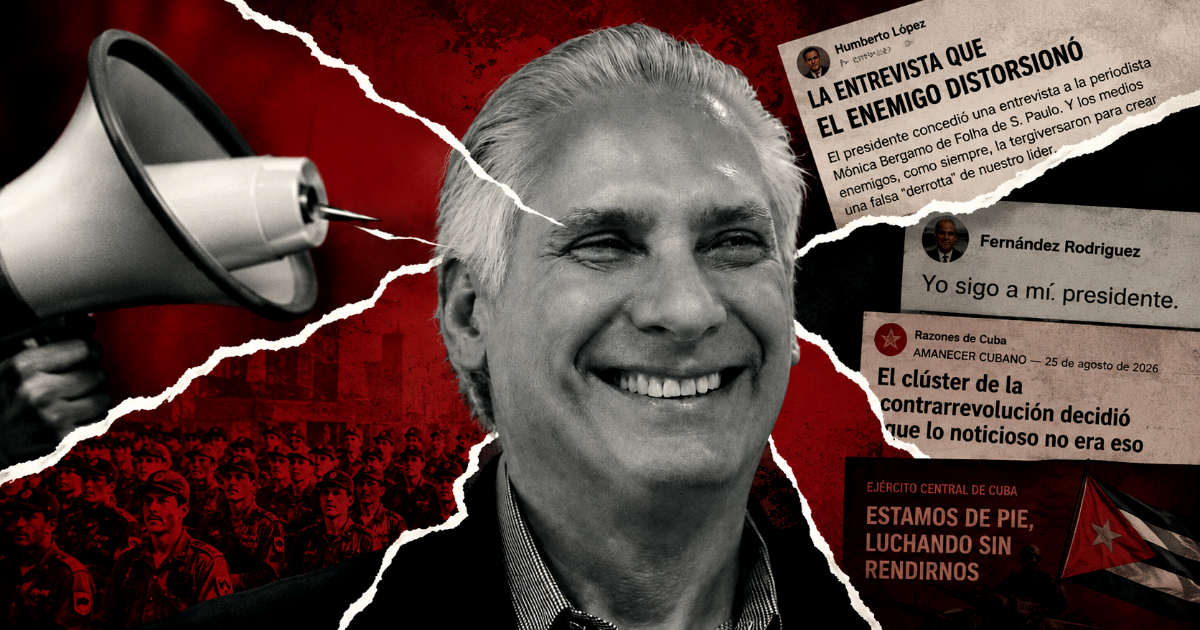
The controversial interview with Miguel Díaz-Canel and Brazilian journalist Mônica Bergamo seems to have triggered one of those reflexes that the official Cuban apparatus knows by heart: when the leader faces uncomfortable questions, spokespersons soon emerge to explain that the issue was not his responses, but rather those who listened to, analyzed, or published them.
Starting this Tuesday, profiles linked to the government have come out in defense of Díaz-Canel and against the coverage that independent media and journalists provided regarding the conversation published by Folha de S.Paulo.
One of the most explicit messages was published by Humberto López, a well-known presenter of state television and a regular defender of the regime's positions, under a title that practically summarizes the entire thesis: "THE INTERVIEW THAT THE ENEMY DISTORTED."
According to López, “the enemy media” distorted the leader's words to fabricate a false “defeat” and used “sensationalist headlines,” “decontextualization,” and “editorial judgments as news.”
The spokesperson specifically mentioned CubitaNOW and the journalist Magdiel Jorge Castro, whom he criticized for describing Díaz-Canel as "disoriented" and "dishonest".
The president's interview was not a "defeat." It was a strong defense of Cuban sovereignty against a journalist trying to impose her narrative, stated López.
From state television to diplomacy
The message resonated with Luis Mariano Fernández Rodríguez, Cuba's ambassador to Syria, who shared it on his Facebook profile.
The diplomat did not limit himself to sharing the defense put forth by López. Shortly thereafter, he published his own message accompanied by a photograph of Díaz-Canel from his youth, presenting him as a man of "principles" and with "the dignity of a patriot."
I continue to support my [sic] president, wrote Fernández Rodríguez.
The ambassador also took the opportunity to defend Díaz-Canel by attacking the U.S. president Donald Trump, whom he called a "stupid dictator" and accused of having "the world on the brink of extinction" and believing himself to be "the master of the universe."
The language is particularly striking as it comes from a serving Cuban diplomatic representative, although it aligns with the confrontational tone against Washington that characterized much of Díaz-Canel's own responses to Bergamo.
"The counter-revolution cluster"
The official page Razones de Cuba also dedicated its "Amanecer Cubano" segment this Tuesday to reinterpreting the impact of the interview.
His thesis was similar: the issue was not what Díaz-Canel said, but rather what those who covered the conversation chose to focus on.
The counter-revolution cluster decided that what was newsworthy was not that, stated the publication, which criticized the attention given to "the President's face," his silences, the close-ups, and the moment when Lis Cuesta arranges his hair with saliva before the interview.
When the argument cannot be countered, the gesture is attacked. When the political response is uncomfortable, the face delivering it is editorialized, the text continued, concluding that such treatment "is not journalism."
Reasoning allows for a curious inversion: the leader's responses can only be analyzed in the terms deemed relevant by the ruling party; focusing on their contradictions, evasions, gestures, or moments of tension becomes part of an enemy narrative.
But the questions and answers are there
CiberCuba's coverage of the interview was not limited to gestures or close-ups. It extensively captured the ruler's own statements on some of the central issues of Cuban reality.
Díaz-Canel defended, for example, the single-party system and rejected the notion that political pluralism is a requirement for democracy. He went on to ask Bergamo if he truly believed that having many parties equates to more democracy and insisted that the Communist Party exists to "lead the Revolution," even though it is not formally an electoral party.
He also denied that Cuba is on the verge of collapse, despite acknowledging an extremely serious situation: prolonged blackouts, lack of fuel, shortage of medications, and immense economic difficulties. When confronted with the mention of the so-called "internal blockade," he again placed the fundamental cause of the crisis outside the Island.
In economic matters, Díaz-Canel denied that the measures expanding the scope for private businesses represent capitalist reforms. This explanation also generated critical responses, including that of comedian Ulises Toirac, who questioned whether the effectiveness of an economic policy should be measured by its ideological label rather than its results.
These are statements and political positions from the ruler himself. That journalists and media contrast them with the Cuban reality or question his arguments does not necessitate altering the interview: it is enough to just listen to it.
Even the Army came out to support him
On Tuesday, the Central Army of Cuba joined the media defenses, publicly stating that the Armed Forces "take these statements as their own".
The military command shared an image from the Ministry of the Revolutionary Armed Forces featuring a photograph of Díaz-Canel along with the slogan "We are standing strong, fighting without surrendering."
"The position taken by comrade Miguel Díaz-Canel Bermúdez is not an isolated gesture: it reaffirms that Cuba does not negotiate its dignity or its self-determination," stated the Central Army.
The military message did not directly target the media that covered the interview, but it concluded a day in which various voices from the state and official apparatus deemed it necessary to publicly defend the actions of the leader.
The old reflection
There is not enough evidence to assert that these publications are part of a coordinated action, nor is it necessary to do so in order to observe the phenomenon.
What can be verified is simpler: after an interview conducted by a foreign journalist generated uncomfortable headlines for Díaz-Canel, messages appeared from a well-known spokesperson of the state television, a propaganda platform, an ambassador, and a structure of the Armed Forces defending the ruler or his statements.
And a large part of the defense returns to a familiar formula: the United States as the fundamental responsible for the crisis, independent media turned into "enemies," and criticisms of the government framed as manipulation.
Perhaps that's where one of the paradoxes of this entire reaction lies. If the interview truly was the demonstration of firmness and clarity that its supporters now describe, it shouldn't require too many subsequent interpreters.
The conversation with Mônica Bergamo has been published. The questions are there. Díaz-Canel's answers are there as well.
Related videos:
Filed under: