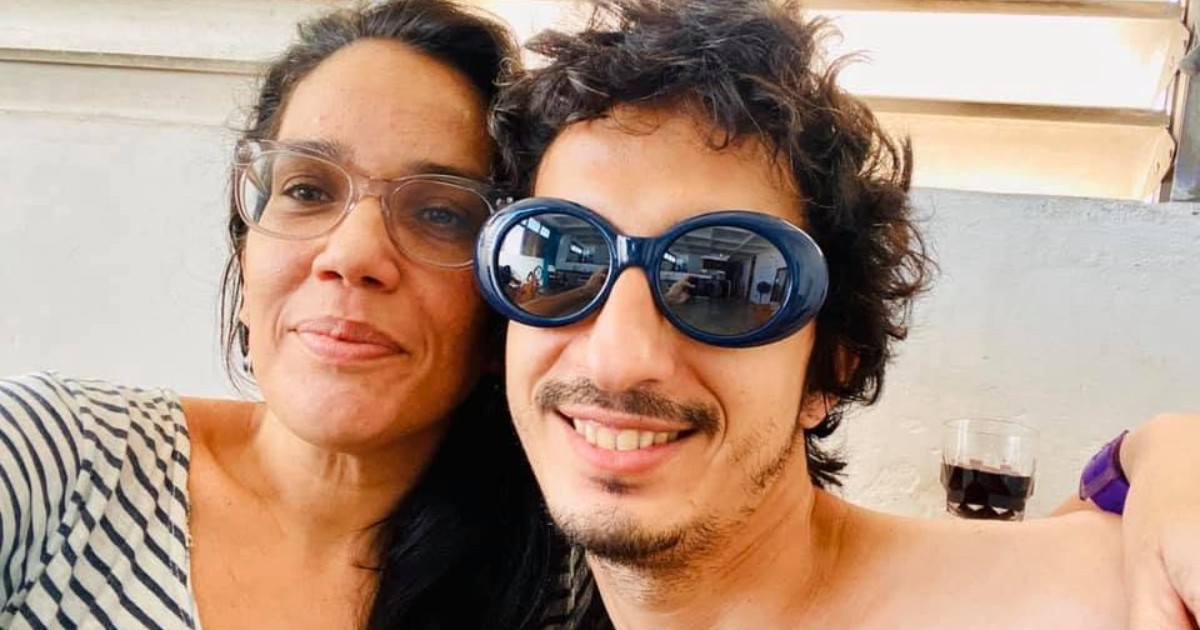
Luz Escobar, a Cuban journalist from the independent media 14ymedio and activist, announced this Wednesday on Facebook that Spain has granted her the right of asylum, a protection that also extends to her husband, the visual artist Julio Llópiz-Casal, and their daughters, as it pertains to a family-based application.
"Yesterday I received news I had been waiting for nearly four years: Spain has recognized me as a refugee and granted me the right of asylum," wrote Escobar, who accompanied her post with an image of the official document that states: "To recognize the status of refugee and grant the right of asylum to Luzbely Escobar Pérez, a national of Cuba."
The journalist arrived in Spain on October 17, 2022 and submitted her application for international protection on March 21, 2023. Since then, more than three years of waiting and uncertainty have passed.
According to what was expressed in their Facebook post, the Spanish resolution explicitly acknowledges that Cuba is a country with an authoritarian regime, lacking the elements of a representative democracy, where the Communist Party remains the only party.
The document also indicates that political freedoms are restricted, that there are arbitrary detentions and police persecution, that there is no judicial independence, and that the regime controls the media and pursues independent journalists and activists.
"The resolution acknowledges that I was persecuted for my political opinions and for the views expressed during my work as a journalist. It discusses a pattern of harassment and unjustified arrests," Escobar recounted.
The resolution concludes that his case meets the requirements established by the 1951 Geneva Convention.
Escobar worked for years in Cuba under a systematic pattern of repression: interrogations, constant surveillance, house arrests, and a prohibition on leaving the country.
Since May 2019, she had been "regulated" under Article 25 of the Immigration Law, which prohibited her from traveling abroad as she was considered a person of "public interest."
In February 2022, Cuban immigration authorities even denied him the extension of his passport. The final trigger for his exile was the regime's inclusion of his daughters in the repressive pressure.
Escobar recalled in his post that during the waiting process, there were those who warned them that they would not receive protection. "I especially remember a worker from an NGO who went so far as to tell us that we wouldn’t be granted protection because if we returned to Cuba, we wouldn’t be killed," he wrote, and he responded with a question that sums up his position: "Since when is the only reason to protect a person the risk of them being killed?"
The journalist, who has continued to practice her profession from exile, dedicated the recognition to those who remain on the island. “I think of the journalists who continue to work under pressure, of the political prisoners, of the activists, of the artists, of the families who live in fear, and of all those who have had to leave because they found no other way out,” she wrote.
"I will continue doing journalism. I will keep telling the story of Cuba," concluded Escobar.
Her husband, Julio Llópiz-Casal (Havana, 1984), a visual artist and graphic designer, is part of the 27N movement — the group of artists and intellectuals who gathered in front of the Ministry of Culture in Havana on November 27, 2020, to demand freedom of expression.
The State Security also threatened and monitored him: upon returning to Cuba from Spain in February 2022, he was interrogated at the airport and warned that he would be under surveillance.
Related videos:
Filed under: