
Related videos:
The exiled Cuban journalist Luz Escobar harshly criticized the interview that the magazine Newsweek published yesterday with Miguel Díaz-Canel, describing it as an exercise that had "nothing of journalism" and served only to amplify the regime's narrative.
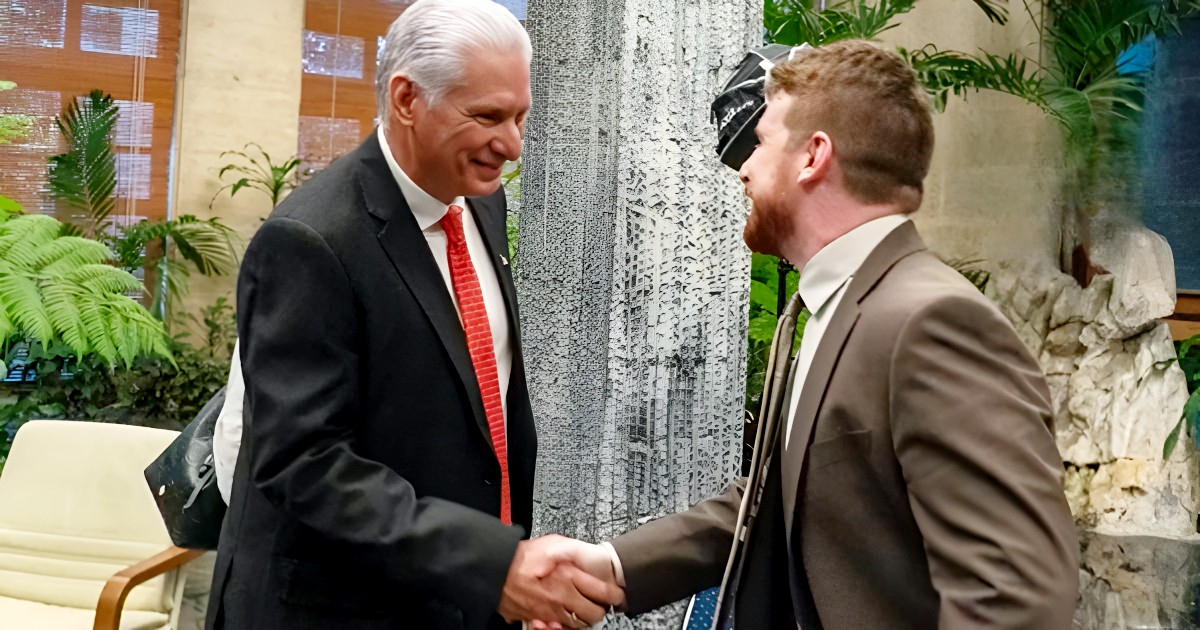
The interview, conducted by senior Foreign Policy writer Tom O'Connor at the Palace, became the cover story of Newsweek in its Tuesday edition with the headline "We Will Respond" and the subtitle "Cuban President Miguel Díaz-Canel Responds to U.S. Pressure with Defiance." It was Díaz-Canel's first interview with a U.S. media outlet since 2023.
Escobar, a collaborator of the independent media outlet 14ymedio, published a thread of ten messages last night on her X account in which she analyzed each of the five questions from the interview and concluded that they all followed the same pattern: "comfortable questions, external focus (U.S., war, geopolitics), zero uncomfortable questions about the internal reality."
Regarding the first question, related to the dialogue with the U.S., Escobar pointed out that they provided Díaz-Canel with "exactly the ground he needs: dialogue, sovereignty, cooperation, 'mutual respect'" and that the key question was notably absent: "Why is there no dialogue with his own people?".
The second question, regarding a possible military attack, was characterized as "the perfect framework for the regime's classic rhetoric: external threat, resistance, victimization," without any mention of the internal crisis that Cubans are experiencing.
The third one, regarding the personal safety of the ruler, seemed to Escobar "almost senseless" and "completely disconnected from the reality of the country," when it would have been pertinent to inquire about political prisoners, repression, or censorship, all of which is documented by civil society and international organizations.
The fourth question, about the Communist Party of Cuba, was described as one that legitimizes the system instead of questioning it, omitting the fundamental issue: why political pluralism does not exist in Cuba.
The fifth one, on how much Cuba can endure, was pointed out as another opportunity for the "epic narrative of resistance," without asking, Escobar noted, "resist whom? The power or the people who have no freedom, light, food, or future?"
The journalist was emphatic in pointing out that the complete absence of questions regarding protests, political prisoners, blackouts, or mass exodus was not an accident: "It is evident that this is not a mere oversight. It is an editorial decision."
Escobar compared the work of Newsweek with the interview conducted by the Spanish politician Pablo Iglesias with Díaz-Canel in March, pointing out the same pattern as the interview that Pablo Iglesias conducted with Díaz-Canel: "when a power is not questioned, it is not interviewed, it is amplified."
The criticism comes at a time when Cuba is experiencing a severe humanitarian crisis: according to Prisoners Defenders, there are 1,214 political prisoners in the country, a record high, while power outages reach up to 20 hours daily after the blockade of oil shipments ordered by the Trump administration since January.
The Secretary of State Marco Rubio responded with disdain to Díaz-Canel's statements during the interview: "I don't think much about what he has to say."
Escobar closed his thread with a reflection on journalistic responsibility: "In a country where citizens cannot speak freely without paying a high price, the journalist who comes with the privilege of being 'accredited' or 'authorized' has even more responsibility, and here the basics were lacking: to challenge those in power".
Filed under: