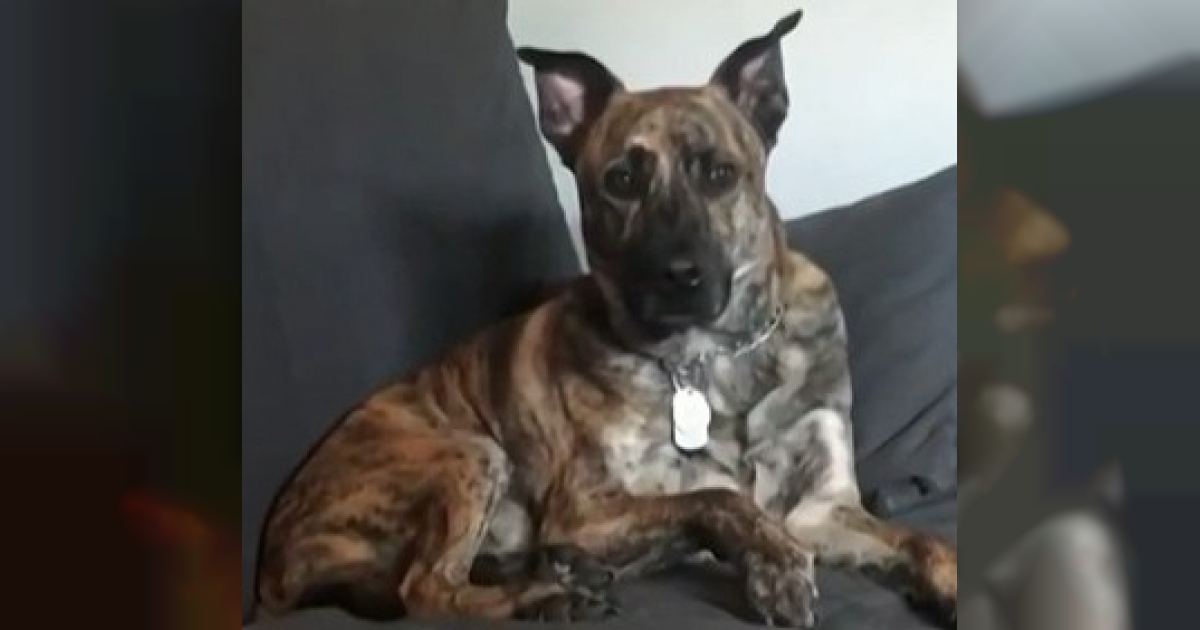
A crocodile emerged from a canal, burst into the backyard of a home, and killed a nine-year-old dog in South Miami last Thursday, as confirmed by the South Miami Police in a statement that included a public safety warning for the entire community.
The attack occurred around 9:30 am in the 6200 block of Southwest 64th Court, a residential area with direct access to a canal.
The victim was Kygo, a mixed-breed Dutch shepherd weighing around 70 pounds, whom the family had rescued and had been with them for six or seven years.
The owner of the animal, Enrique Pomares, recounted that he let his pet out into the backyard as he did every morning, when the reptile emerged from the water and dragged Kygo into the canal.
"When he went out for a walk this morning, he was nearby, by the shore, and the crocodile came up and grabbed him. It attacked and killed him," Pomares declared to Telemundo 51.
The owner tried for several minutes to rescue the animal, even throwing a kayak into the water to distract the reptile, but the creature returned to him with the dog already lifeless in its jaws.
"He showed it to me like a trophy. It was horrific. I had never seen anything like that," Pomares described.
The man estimated that the crocodile measured between 13 and 15 feet in length, although this is a personal estimate and not an official measurement.
A local resident, Dexter Lovett, claimed to have warned the residents for some time about the presence of the reptile in that canal.
"I have been warning people for a while not to approach the canal. The crocodile is large and it eats. I have seen it several times," said Lovett, who believes that the animal he recorded on video while fishing is the same one that attacked Kygo.
It was he who, several hours later, found the remains of the dog floating in the canal at Southwest 64th Avenue and Miller Drive.
The South Miami Police stated that they have no record of any similar incidents in that area, and the Florida Fish and Wildlife Conservation Commission (FWC) has opened an investigation into the case, as confirmed by the agency's spokesperson, Melissa Brevik.
In its statement, the Police Department urged the community to be extra vigilant: "Please keep children and pets away from canals, waterways, ponds, and other areas where a crocodile may be present. Do not approach the animal, do not feed, disturb, or attempt to capture it."
The American crocodile is a species protected by state and federal laws, which means that residents cannot attempt to harm, capture, or relocate it.
Killing one of these reptiles constitutes a third-degree felony in Florida, punishable by up to five years in prison.
South Florida and the Keys represent the northernmost edge of this species' natural habitat, whose population was decimated in the 1970s and is currently estimated to exceed 2,000 individuals in the state, thanks to conservation efforts.
Anyone who detects the presence of a crocodile in their area can contact the FWC through the toll-free line 866-FWC-GATOR (866-392-4286).
Unlike alligators, American crocodiles generally avoid people, although attacks on pets have been recorded, especially in the Keys.
Incidents involving these two types of reptiles in residential areas of South Florida are not entirely uncommon: in recent months, several sightings of alligators in Miami's canals have been reported, causing alarm among residents.
At the beginning of the month, a
Related videos:
Filed under: