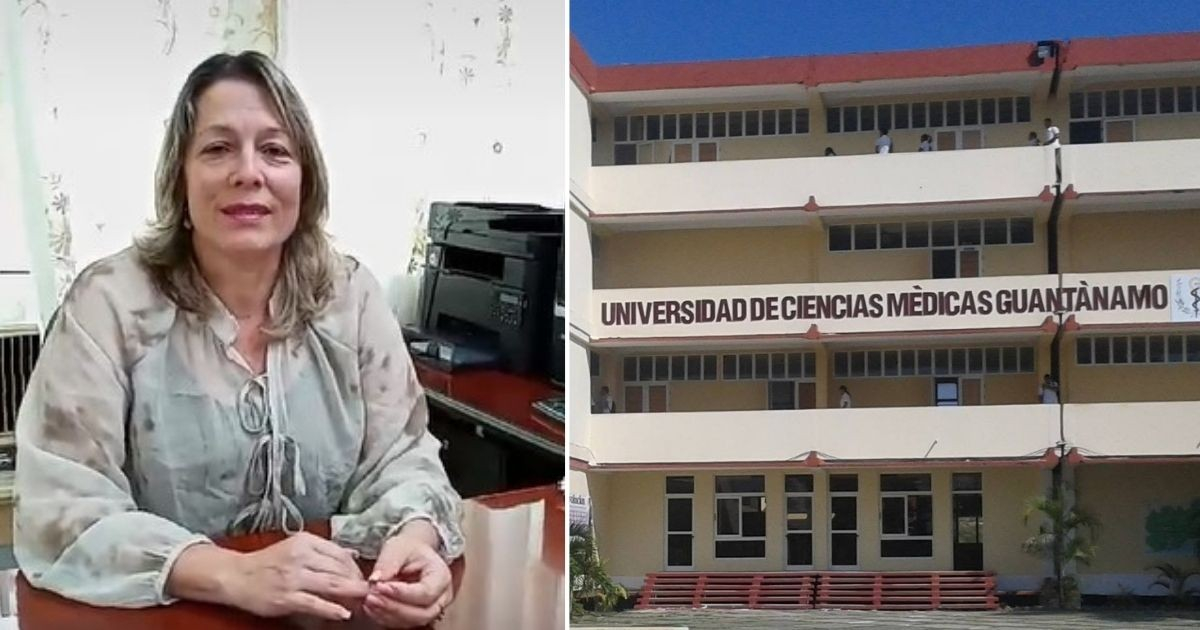
A report concerning the alleged relocation of sixth-year Medical Sciences students in Guantánamo has sparked controversy on social media and prompted a public response from the university's rector, Yamilé Rodríguez Sotomayor, who denied that there is an order to "evict" the students, although she confirmed that the student residence is being reorganized.
The controversy began with a post shared in a Facebook group from Guantánamo, in which a student—later identified by the rector herself—reported that sixth-year students were being removed from the scholarship they had been part of for the previous five years of their studies.
According to the complaint, those students had organized and arranged the rooms they occupied on their own and are now being moved to another residence that, according to the publication, “does not have adequate conditions or security” for them.
The author stated that the goal would be to allocate the current spaces to first-year students, while those starting their sixth and final year would have to vacate the rooms they had lived in for a significant part of their studies.
"The sixth-year students have spent the five years of their program on the same scholarship, in the same rooms that they have arranged and adapted," stated the publication, which described the decision as an "injustice" and called for assistance to bring attention to the situation.
The response arrived this Friday from Yamilé Rodríguez Sotomayor, rector of the University of Medical Sciences of Guantánamo, who denied that the management of the institution had ordered the eviction of students.
"The Dean and the Rector have not given any instructions to evict any students," Rodríguez stated.
The official explained that the guidelines have been aimed at carrying out a reorganization of the student residence based on academic years and majors, with the participation of the University Student Federation (FEU) and the Union of Young Communists (UJC).
However, he also made it clear that this reorganization may imply that certain students do not continue in the rooms they currently occupy.
"It's not always possible to ensure that every student is where they want to be because the circumstances often do not allow it," she affirmed.
It was then that the rector delivered one of the statements that most directly addresses the students' concerns: “The rooms are not the property of the scholarship students.”
Rodríguez added that when a student cannot continue in a certain room, the decision must be properly explained.
The rector also acknowledged that there may be poor communication within the institution itself behind the conflict.
"Behind these situations may lie an incorrect response from a supervisor or insufficient information, the indiscipline of the scholarship holders, or a malicious intent to create conflicts," he wrote.
However, her response was particularly critical of the way the complaint appeared online. She began her statement by asserting that lately social media has become "the meeting place of falsehood and cowardice" and questioned why the student resorted to an anonymous post instead of coming directly to her office.
She also accused individuals who, according to her, take advantage of such controversies to gain benefits on digital platforms, and compared them to "vultures" that seek content to feed their algorithms and monetize on Facebook.
"Don't play their game," insisted the rector, who stated that the institution is open to hearing suggestions "under the premises of respect" and announced that she would visit the student residence that same night.
At the moment, both versions clearly highlight one point: students are reporting that sixth-year students are being forced to leave the scholarship where they have lived for years to be sent to another facility that is allegedly in worse conditions; the administration denies that there is an order for "eviction", but admits to an reorganization that may involve changes in rooms or residences.
The controversy occurs at a university where protests had already been registered regarding the living conditions of students.
In May 2025, students from the University of Medical Sciences of Guantánamo protested during a power outage and reported issues in the dormitory, including a lack of electricity, drinking water, and what they described as inadequate food.
On that occasion, reports of alleged threats and intimidation following the protests were also circulated, as students demanded better living and studying conditions.
Complaints about the conditions in Medical Sciences residences have been echoed in other provinces.
In July of this year, foreign students staying at the Faculty of Medicine in Santiago de Cuba staged a pot-banging protest after enduring about 24 consecutive hours without electricity in their dormitories.
Related videos:
Filed under: