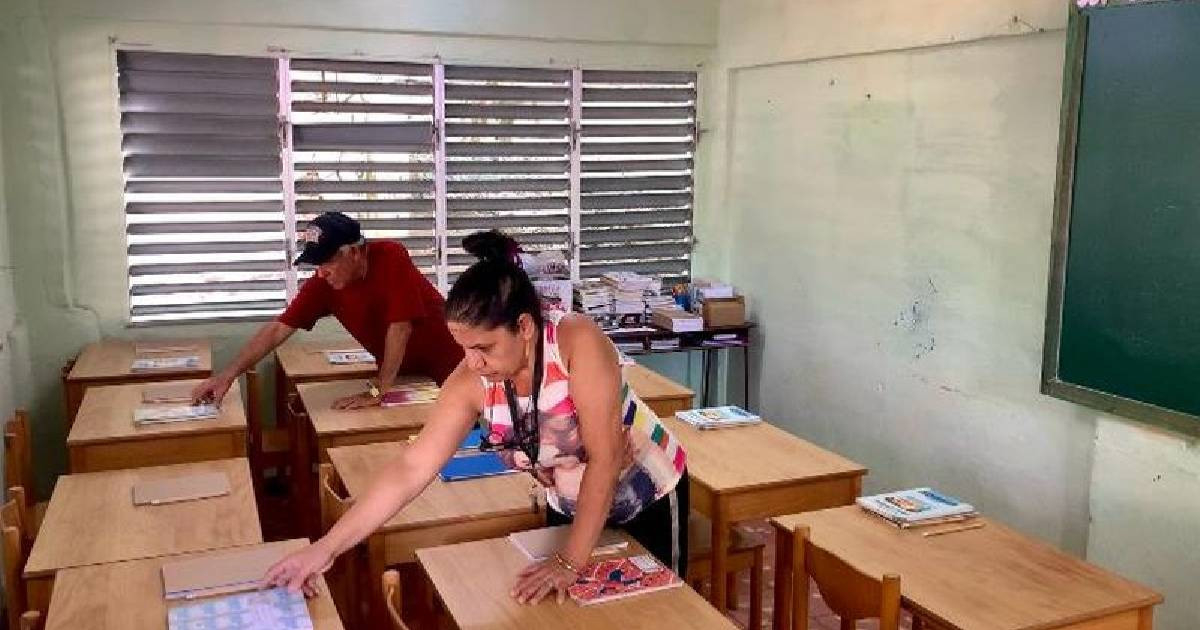
Holguín will start the school year 2026-2027 next Monday with a deficit of more than 2,000 teachers throughout the province, acknowledged the general director of Education in the area, Luis Felipe Batista Rodríguez, in statements this Saturday to the official newspaper ¡Ahora!
The shortfall primarily affects the increase in teaching load and the student-teacher ratio, although it also includes vacant positions that authorities will attempt to fill using emergency measures such as hiring production and service specialists, and incorporating university students who will pursue their studies in a semi-presential mode.
The province, which has the largest network of schools in the country with 1,319 educational institutions and over 131,000 students, will implement 156 educational zones distributed across all its municipalities to coordinate the available resources in the local councils.
"In each area, we have a coordinator, who can be a school principal, responsible for bringing together all educational influences so that students can develop tasks, activity systems, and educational projects focused on their centers for the days they do not attend school," Batista explained.
The 51 residential centers will accommodate all 3,062 of their students, while the prioritization of 42 transport routes is being evaluated to transport over 4,000 external students residing in hard-to-reach areas.
The situation is complicated by the damage caused by Hurricane Melisa, which affected 524 schools in the province. Of these, 157 remain awaiting recovery at the start of the school year, and eight will operate in the homes of families and teachers.
The Minister of Education, Naima Ariatne Trujillo Barreto, recently visited Holguín to assess the material, financial, and human conditions of the area.
He urged for the decentralization and flexibility of decision-making so that each municipality and school can manage its own model of care, and emphasized the need to broaden the concept of learning with more inclusive practices.
The teaching crisis in Holguín is not new. In the previous academic year, the province recorded a coverage rate of 83.5%, with over 2,700 positions unfilled.
The 2025-2026 cycle had to be closed prematurely, between mid and late June, due to the energy crisis and fuel shortages.
The deficit in Holguín is part of a national educational crisis. For example, in Camagüey, the teacher deficit is almost 3,000 for over 95,000 students.
In the central province, 910 basic secondary students will be transferred to primary schools in their localities due to a lack of teachers.
In addition to the shortage of teachers, there is a lack of uniforms; in the case of Holguín, production is over 60% complete only for the prioritized grades: preschool, fifth, and seventh.
Regarding this, the Deputy Director General of Education, Yudira Tamayo Menéndez, warned that "not everyone will be able to acquire the garments on time," although she clarified that this will not prevent the return to classrooms on Monday.
The start of the school year has also sparked a debate among Cuban mothers divided between those who advocate for their children's right to education and those who refuse to send them to classrooms without qualified teachers, without food, and after nights of prolonged blackouts.
Minister Trujillo summarized it bluntly: "We are asking for collaboration that we have never had to ask for before, not even in these last few years, which have also been difficult."
Related videos:
Filed under: