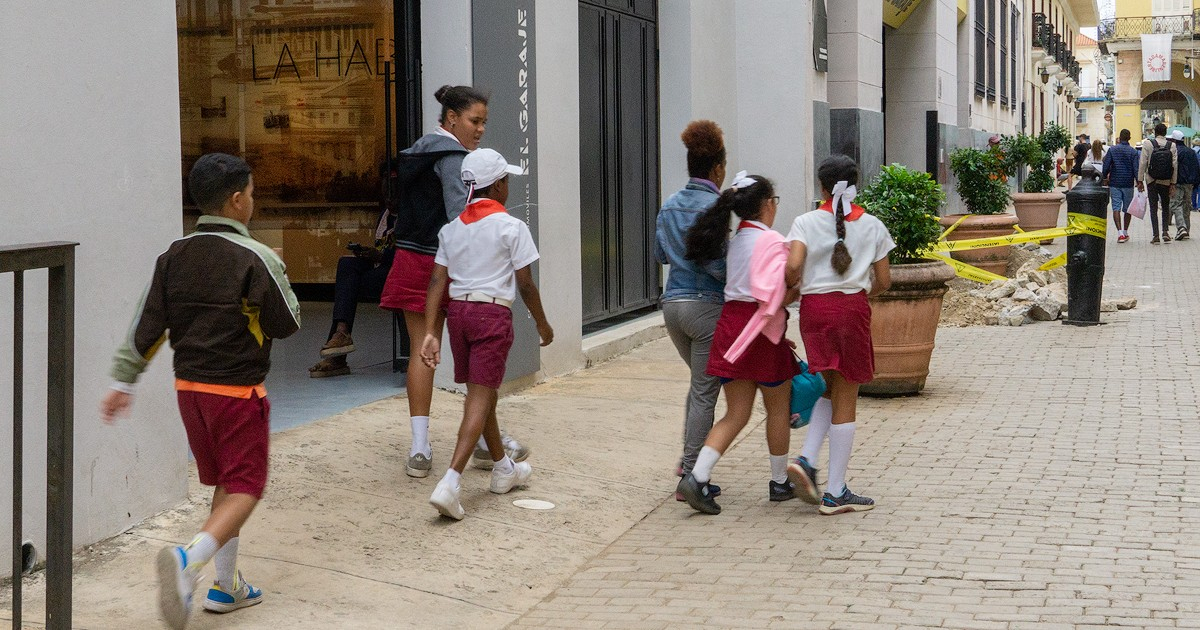
The start of the school year has sparked an unprecedented debate among Cuban mothers, with irreconcilable positions on whether to send their children to classes amid blackouts lasting over 20 hours, hunger, and schools that the regime itself admits are not fit to welcome them.
The controversy erupted in the Facebook group "Cuban Fighting Mothers 2," where a mother identified as Brenda Martínez published a post that quickly generated dozens of mixed responses. Her main argument: depriving children of education is not the solution, because knowledge is a resource that no one can take away from them.
"I have seen thousands of posts saying my child won't go to school because there are no living conditions. Mommies, that is not going to change, and our children have the right to study whether or not there is electricity, food, or teachers," wrote Martínez, who admitted that she herself faces shortages: without a backpack, without shoes, without a belt, wearing second-hand uniforms.
The response from other mothers was immediate and mostly critical.
"Of course we want them to study, but the problem is: how do you expect children who don't sleep all night, who don't have breakfast to eat in the morning, and some at night only have a piece of bread while others have nothing... do you really think those children can understand anything?" replied a user.
Another was more direct about the physical conditions of learning: "It is true that it is unfair to deprive someone of studying, but it is also unfair not to have rest, because in order to learn and memorize, the brain must rest. When someone is tired, or rather, without sleep, not even an ant can reason, let alone with a lack of food."
Some comments raised the debate to the political level.
"The problem goes beyond whether children study or not... see it as a means for us to protest. An entire country where children are not sent to school, where there is a student strike because the majority disagree with this system, would be ideal," suggested a participant, claiming that sending children is equivalent to supporting the regime.
Other voices rejected that logic. "I am a mother and grandmother; the right that children have to study cannot be taken away from them. They may not be able to go every day, but a mother has to make sacrifices for them," wrote another user.
Another remark was striking about the future awaiting those children: "Study for what? To work and earn eight thousand for a bottle of oil."
An internet user bitterly summarized the position of many: "I’m not sending my son to school until he sleeps with electricity."
Numerous Cuban mothers have announced that their children will not go to school if there are no minimum conditions, and the debate on social media shows no signs of calming down before the first day of classes.
The Minister of Education, Naima Ariatne Trujillo Barreto, admitted on Thursday that the school year will start with "tremendous difficulties" due to a lack of teachers, uniforms, and power outages - a notable shift from her previous statement that "September will once again be a celebration"-.
The previous school year had to end early, between June 15 and 30, due to the energy crisis and fuel shortages.
The Cuban educational system faces a shortage of at least 24,000 teachers, equivalent to 12.5% of the expected positions. The production of uniforms meets only 12% of the demand in primary education.
This is compounded by a food crisis documented by the World Food Programme (WFP), which revealed that 48.5% of Cuban children aged six to eleven do not receive any meals or snacks at school.
Related videos:
Filed under: